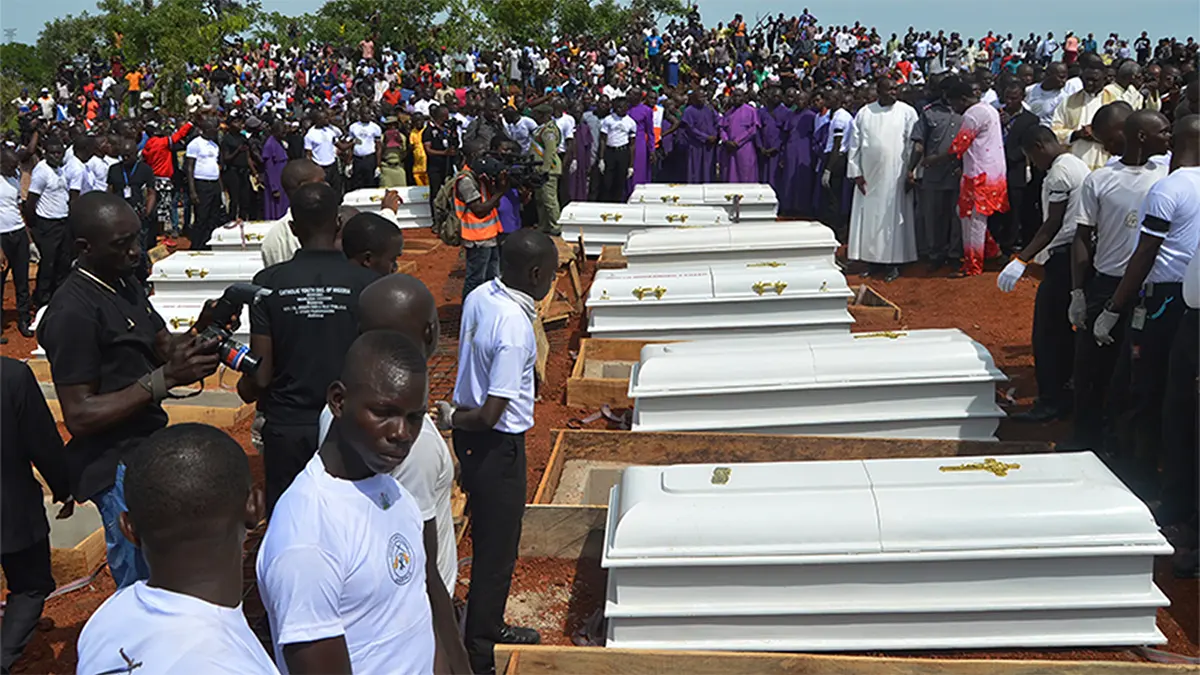
A new wave of deadly attacks across Nigeria’s Middle Belt has renewed concerns over the country’s worsening security situation, with Christian communities, clergy, and human rights organizations warning of escalating violence and growing displacement.
Throughout September 2025, reports of village raids, targeted killings, and kidnappings highlighted the ongoing instability affecting several regions of the country. While the Nigerian government continues to characterize many of the incidents as criminal activity or land-related conflicts, advocacy groups argue that the violence increasingly reflects a pattern of religious persecution.
Christian Clergy Continue to Face Serious Threats
One of the most troubling aspects of the crisis is the continued targeting of Christian religious leaders.
On September 19, Father Mathew Eya, a Catholic priest serving in Enugu State, was killed after being attacked by gunmen. Church officials described the incident as an execution-style killing and called for a thorough investigation.
The attack came just days after another Catholic priest, Father Wilfred Ezeamba of Kogi State, was abducted on September 12. Although he was later released, two parishioners who were reportedly with him during the kidnapping were killed.
These incidents reflect a broader trend that has raised alarm among religious organizations. According to monitoring groups, more than 250 Christian priests have been kidnapped across Nigeria since 2015.
Experts say these abductions often serve multiple purposes, including generating ransom payments while simultaneously creating fear among local congregations and religious institutions.
Rural Communities Bear the Brunt of the Violence
Beyond attacks on clergy, rural Christian communities continue to face repeated assaults that have forced many families from their homes.
One of the most significant incidents occurred on September 14 in the village of Ndimar, located in Plateau State. Local sources reported that armed attackers raided the community, killing at least six residents and setting fire to homes and businesses.
Residents and local leaders blamed armed Fulani militias for the attack, although such incidents often occur in regions where disputes over land, grazing routes, and community boundaries have contributed to longstanding tensions.
For affected communities, the result is often the same: destroyed property, loss of life, and growing displacement from ancestral lands.
Advocacy Groups Raise Alarm Over Rising Death Toll
Human rights organizations have increasingly expressed concern over the scale of violence occurring across parts of Nigeria.
In August, the International Society for Civil Liberties and Rule of Law (Intersociety) reported that approximately 7,000 Christians had been killed during the first 220 days of 2025. The organization argues that the pattern of attacks, killings, and displacement points to a coordinated effort targeting Christian populations in several regions.
Based on those figures, the group estimates that roughly 32 Christians were killed each day during the reporting period.
Intersociety and other advocacy organizations have described the situation as an “unacknowledged genocide,” a characterization that remains strongly disputed by Nigerian authorities.
The debate over how to define the violence has become one of the most contentious aspects of the crisis, with different groups offering sharply contrasting interpretations of the conflict’s causes and motivations.
Government Response Faces Growing Scrutiny
The administration of President Bola Tinubu has faced mounting criticism from church leaders, civil society organizations, and international observers regarding its handling of the security crisis.
Government officials have consistently rejected claims that the violence constitutes systematic religious persecution. Instead, authorities often describe the incidents as a combination of criminal banditry, communal disputes, and conflicts over land and resources.
Critics argue that this explanation fails to fully address the recurring attacks on Christian communities and religious leaders.
Some church representatives have also voiced concerns about what they describe as a lack of accountability for perpetrators, claiming that investigations frequently fail to result in meaningful prosecutions.
International Pressure Begins to Build
The ongoing violence has increasingly attracted attention beyond Nigeria’s borders.
In early September, U.S. Senator Ted Cruz introduced the Nigeria Religious Freedom Accountability Act of 2025, legislation aimed at increasing international scrutiny of the crisis.
If enacted, the proposal would authorize sanctions against Nigerian officials found to be complicit in religiously motivated violence or who fail to take adequate action against perpetrators.
The legislation would also require the U.S. State Department to consider designating Nigeria as a Country of Particular Concern (CPC), a classification reserved for nations accused of severe violations of religious freedom.
Supporters of the measure argue that stronger international pressure could encourage greater accountability and more effective protection for vulnerable communities.
A Crisis With No Easy Solution
As violence continues across parts of Nigeria, many affected communities remain caught between insecurity, displacement, and uncertainty about the future.
While government officials emphasize the complexity of the conflict, religious leaders and human rights advocates continue to call for stronger action to protect civilians, investigate attacks, and address the underlying causes of the unrest.
With casualties mounting and international attention growing, the situation is likely to remain a major humanitarian and political challenge for Nigeria in the months ahead.