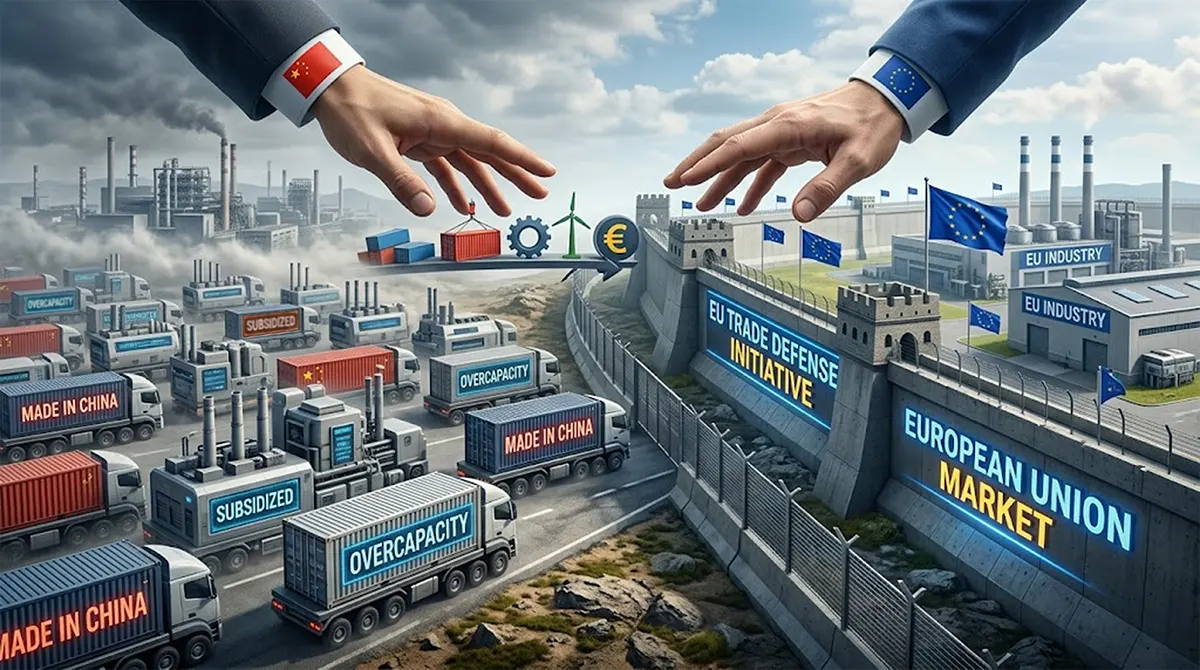
For years, Europe quietly absorbed the economic reality of deep trade dependency on China. That era is over. Following a major European Council summit, European Commission President Ursula von der Leyen delivered one of the sharpest warnings Brussels has ever aimed at Beijing: Europe is ready to hit harder on trade, and it has the tools to do it.
The question is whether it can win a fight it may not be fully prepared for.
A €360 Billion Wake-Up Call
The numbers that framed this shift are staggering. The EU’s goods trade deficit with China has hit €360 billion roughly €1 billion every single day. More striking still: for the first time in history, all 27 EU member states simultaneously ran a trade deficit with China. Not one country was spared.
EU industry leaders are sounding the alarm. According to their estimates, up to 29 million European manufacturing jobs are now at high risk, undercut by a wave of heavily subsidized Chinese imports that domestic producers simply can’t compete with on price.
Von der Leyen put it plainly: “This is not just about cheap imports. We see overcapacities that erode our own manufacturing base. And this is simply not sustainable.”
Europe’s Three-Pronged Response
Brussels isn’t just talking. The EU is executing a multi-layered strategy built to protect its economy without triggering an all-out trade war with its largest trading partner.
De-risking, not decoupling is the official framing. The EU has no intention of severing economic ties with China entirely that would be economic self-harm. Instead, it’s working to cut what von der Leyen calls “toxic dependencies,” particularly on critical minerals and green technology, by redirecting trade toward trusted global partners.
Expanding the trade toolbox is the second pillar. Under pressure from France, Italy, the Netherlands, and Poland, EU leaders gave the European Commission a clear mandate: build out and deploy trade defense instruments more aggressively. That means targeted import quotas, anti-subsidy penalties, and tougher tariffs across sectors including chemicals, metals, and clean technology.
Cracking down on state-backed acquisitions is the third move. Brussels is already in action here, it recently launched a foreign subsidies probe into Chinese e-commerce giant JD.com’s bid to acquire Ceconomy, Germany’s largest consumer electronics retailer.
Not Everyone in the EU Agrees
Despite the unified messaging from Brussels, the bloc is quietly fractured on how hard to push.
The hawks — France, Italy, the Netherlands, and Poland want immediate, aggressive use of tariffs and quotas. Their argument: Europe has been naive about China’s long-term ambitions, and that naivety needs to end now.
Germany is far more cautious. Berlin’s automotive and machinery giants depend heavily on Chinese market access losing that would be devastating. Aggressive retaliation from Beijing is Germany’s worst-case scenario, and it’s not a hypothetical one.
Spain sits on the opposite end entirely, preferring to see China as a potential ally and pushing back on what it sees as premature escalation.
This internal divide is precisely what Beijing is counting on.
China’s Counterpunch: Surgical and Strategic
When the EU first imposed tariffs on Chinese electric vehicles in late 2024, Beijing didn’t respond with a broad tariff wall. Instead, it launched anti-dumping investigations into European dairy, pork, and brandy targeting sectors with powerful domestic lobbies in key member states.
France’s premium wine and cognac exporters felt the squeeze. Spain and Denmark, both massive pork exporters to China, were put on notice. The goal wasn’t just economic pain, it was political fragmentation, designed to break the EU’s fragile 27-member consensus from the inside out.
China’s Foreign Ministry has already responded to the latest threats: Beijing will “take all necessary measures” to protect its commercial rights. That’s diplomatic language for: we will retaliate, and we know where it hurts.
Beyond agriculture, Beijing holds a more powerful card, mineral gatekeeping. In 2023, China imposed export licensing restrictions on gallium and germanium, two materials essential to semiconductors and next-generation solar panels. It was a calculated shot across the bow. If European tariffs escalate further, Beijing’s ultimate leverage is to choke the supply of refined critical materials before Europe can build alternative supply chains to replace them.
The Mineral Dependency Problem No One Has Solved
The deeper vulnerability running beneath all of this is Europe’s near-total reliance on China for the raw materials powering its green transition. This isn’t a future problem, it’s a structural crisis right now.
Rare earth elements are the most extreme case. While these minerals aren’t actually rare in the Earth’s crust, refining them is toxic, complex, and almost entirely controlled by China. Beijing refines 100% of the heavy rare earth elements the EU uses for permanent magnets, the same magnets that sit at the core of offshore wind turbines and power the electric motors in roughly 80% of all EVs on the road today.
Lithium and natural graphite represent a high-concentration risk of a different kind. Europe sources most of its raw lithium from Chile, but China controls over 60% of global lithium refining and over 70% of natural graphite processing. Graphite is the dominant material used in EV battery anodes, and substituting it with synthetic alternatives drastically increases both carbon emissions and production costs, making it not much of a solution at all.
Cobalt and nickel carry their own set of complications. Over 60% of the world’s cobalt is mined in the Democratic Republic of Congo, exposing Europe to serious human rights and political volatility risks. The twist: virtually all of that DRC ore is shipped to China for refining before it ever reaches European manufacturers.
Gallium and germanium are the most alarming case, because China has already weaponized them. These two metalloids essential for next-generation solar panels, EV fast-chargers, and power electronics are produced almost entirely in China, which controls roughly 80% of global gallium supply and 60% of germanium. The 2023 export restrictions weren’t theoretical; they actively bottlenecked European tech sectors and served as a direct warning of what Beijing can do at scale.
The uncomfortable reality is what experts are calling the substitution paradox: European automakers trying to develop cobalt-free or rare-earth-free technologies usually end up switching to materials like LFP batteries or induction motors which also run through supply chains heavily dependent on China.
How the EU Is Trying to Break the Dependency
Brussels has three concrete mechanisms in motion to reduce this exposure and a hard deadline to meet.
Under the EU Critical Raw Materials Act (CRMA), the EU has set a binding rule: by 2030, no single country can supply more than 65% of any strategic raw material. Given that China currently processes roughly 60% of the world’s lithium, 70% of cobalt, and up to 90% of rare earth elements, this law forces a structural shift in European supply chains whether industry is ready or not.
To build alternative sources, the EU has signed over 15 bilateral strategic partnerships through its Global Gateway investment initiative. Canada, Chile, and Argentina are in play for mining and processing. Kazakhstan and Ukraine are part of upgraded infrastructure partnerships. Australia, Namibia, and Rwanda are being integrated into supply chains with a focus on local refining keeping processed materials out of China’s hands before they reach Europe.
On the financial side, the RESourceEU Action Plan mobilizes up to €3 billion to de-risk private investment in mining, processing, and recycling outside China. Brussels is also setting up a centralized European Critical Raw Materials Centre to coordinate joint purchasing and strategic stockpiling modeled closely on Japan’s long-standing resource security approach.
The big catch: building a new mine or refining facility typically takes 10 to 15 years. If China decides to cut off mineral exports before Europe’s alternative networks are fully operational, the EU’s entire green energy transition could stall at a critical moment.
The Tariff Escalation Already Underway
Beyond minerals, the EU is moving fast to close the trade loopholes that Chinese manufacturers have been quietly exploiting.
When Brussels imposed tariffs of 17% to 45.3% on Chinese battery electric vehicles in late 2024, it left plug-in hybrids taxed at just 10%. Chinese automakers adapted almost immediately, pivoting aggressively to hybrid exports. By May 2026, BYD had become Germany’s best-selling plug-in hybrid brand. The European Commission is now preparing new countervailing duties to close that gap.
Steel is next. Starting in July 2026, the EU is slashing its tariff-free steel import quota by 47% dropping from around 33 million tonnes down to 18.3 million. Any steel above that quota will face duties that double from 25% to 50%, remaining in place through 2031. New “melt and pour” tracking rules will also close a common workaround where Chinese steel was rerouted through Vietnam or Mexico to dodge existing duties.
Meanwhile, the European Commission is running anti-subsidy and anti-dumping investigations at record volumes, with a growing focus on industrial chemicals and everyday manufacturing components, areas where Chinese dumping of cheap inputs is stifling European chemical independence.
The Industrial Accelerator Act: Europe’s Protectionist Pivot
Tariffs alone haven’t stopped Chinese market penetration. So the EU has published the Industrial Accelerator Act, a fundamental shift away from free-market principles toward deliberate economic protectionism.
Under this framework, foreign car and green-tech manufacturers will need to meet strict criteria to qualify for European subsidies and avoid penalties:
- Final vehicle assembly must happen inside the EU
- At least 70% of total vehicle content must be local
- At least 50% of critical components — including semiconductors and battery cells must come from European suppliers
This is Europe’s clearest signal yet that the era of open access to EU markets, regardless of where a product is actually made, is closing.
The Impossible Balance
What makes this confrontation so difficult is that both sides are genuinely exposed. Europe runs a $83 billion quarterly trade deficit with China, it buys far more than it sells. That theoretically gives Brussels more imports it can penalize. But European exports to China skew heavily toward high-value luxury goods, precision machinery, and premium automobiles exactly the kind of products China can either source domestically or simply boycott through regulatory pressure or consumer nationalism.
Europe has more legal ammunition. China has more structural leverage.
The EU’s middle path de-risking without decoupling, protecting without provoking is the most politically sustainable option available. But sustainability isn’t the same as success. How quickly Europe can build genuine supply chain alternatives, how long the 27-member coalition holds together under Beijing’s targeted pressure, and whether the green transition can survive a potential mineral chokehold are the three variables that will determine whether this strategy works.
For now, Brussels is drawing lines it intends to hold. Whether Beijing decides to test them is the next chapter.