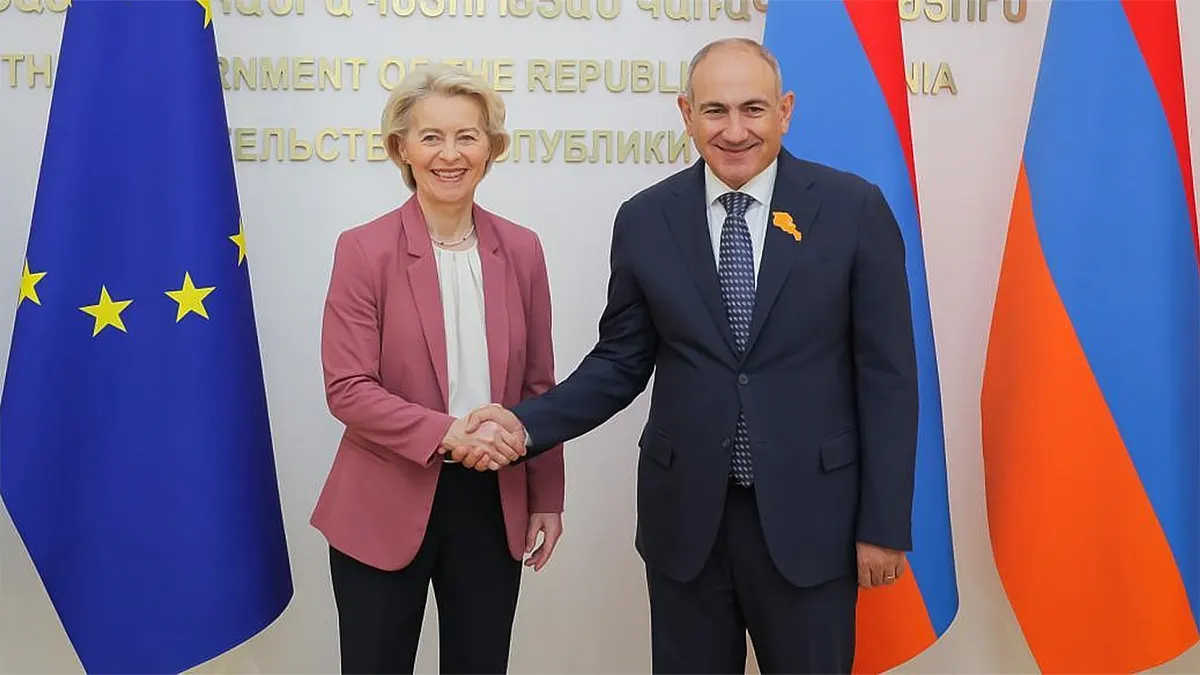
When Ursula von der Leyen landed in Yerevan, she didn’t come empty-handed. Standing beside Armenian Prime Minister Nikol Pashinyan, the European Commission President laid out a package of financial support and trade concessions designed to do one thing: give Armenia a way out from under Russia’s economic thumb.
Von der Leyen didn’t mince words about what Armenia is up against. She described Moscow’s ongoing pressure campaign as “nothing short of economic coercion,” and framed the EU’s response as a direct counterweight “when pressure mounts on our partners, the European Union steps up.”
€18 Million Now, With a Much Bigger Deal on the Table
The first announcement was straightforward: an additional €18 million in funding, aimed at helping Armenia diversify and strengthen its trade capacity. The money could go toward setting up an export promotion agency or simply boosting the ability of Armenian businesses to sell abroad. This isn’t new money out of nowhere, it’s the final installment of a €52 million support package the two leaders had already agreed to during a phone call in early June.
The bigger news came next. Von der Leyen unveiled a proposal for “autonomous trade measures” that would liberalize almost 80% of Armenian exports to the EU, making them tariff-free. In practical terms, that opens the door to the European single market 450 million consumers for products that Armenia used to send almost exclusively to Russia.
The sector-specific numbers are striking. Under the proposal, 99% of Armenia’s fresh fruits, vegetables, and plants and more than 90% of its beverages and spirits, including Armenian brandy, would gain tariff-free access to the EU. Von der Leyen pointed to a recent uptick in Armenian flower shipments arriving in European markets as an early, tangible sign of the shift already underway.
Energy Is the Next Front
Trade isn’t the only area where Armenia is dangerously exposed. Its energy system runs almost entirely through Russian infrastructure, and the EU says it’s ready to help change that too.
A team of EU energy experts is set to arrive in Armenia soon to share lessons learned from similar diversification efforts in Ukraine and Moldova. Alongside the advisory push, the EU is funding new electricity interconnectors to strengthen regional energy networks, including €25 million specifically earmarked for the Caucasus transmission network.
Why Armenia Needs This So Badly
To understand why this package matters, it helps to look at just how much leverage Russia holds over Armenia’s economy and how openly it has been using it.
Energy is Moscow’s sharpest weapon. Russia supplies somewhere between 80% and 90% of Armenia’s natural gas, and Gazprom directly owns and operates the pipeline network that distributes it inside the country. Russia has also floated the idea of scrapping the discounted gas prices it currently offers Yerevan, a move that would send domestic energy costs soaring. On top of that, Armenia’s Metsamor Nuclear Power Plant, which generates roughly 30% to 40% of the country’s electricity, depends entirely on Russia’s Rosatom for fuel and technical support.
Then there’s what might be called “sanitary diplomacy.” After Armenia froze its participation in the Russian-led CSTO military alliance and joined the International Criminal Court, Russian regulators suddenly began citing “phytosanitary violations” in Armenian goods. The resulting bans hit exactly the products Armenia relies on most for trade with Russia brandy, produce, fish, and flowers. Since Russia still accounts for roughly 35% of Armenia’s total foreign trade, these sudden restrictions have left farmers and exporters holding unsellable stock.
Russia has other levers too. Armenia’s membership in the Russian-led Eurasian Economic Union (EAEU) could be jeopardized if it keeps integrating with Europe, Moscow has warned. There have also been quieter threats to cut commercial flights between Yerevan and Moscow, and to tighten conditions for the large population of Armenian migrant workers in Russia, whose remittances are a significant piece of Armenia’s economy.
None of this happens in a vacuum. For decades, Armenia’s closed borders with Turkey and Azerbaijan left it few options besides leaning on Russia for trade, energy, and security. That history is exactly why Moscow’s current pressure campaign carries so much weight and why the EU’s offer lands at such a critical moment.
Pashinyan’s Response: Urgency and History
Pashinyan welcomed the announcements enthusiastically, but his message carried a sense of urgency more than celebration. Because the EU’s trade measures still need approval from the European Parliament and member states, he pushed for speed, noting that Armenia’s harvest season is already underway and farmers need those tariff-free export routes open now, not months from now.
He also framed the deal as historic. Once approved, Armenia would become the first country that is neither an EU candidate nor a formal free-trade partner to receive this kind of trade liberalization, a distinction he described as a strong vote of confidence in Armenia’s political trajectory. He thanked von der Leyen for backing the country’s democratic institutions, calling the partnership a foundation for even closer EU-Armenia ties.
The timing matters politically, too. Pashinyan just came off a win in Armenia’s June 2026 general elections, a vote widely seen as a referendum on whether the country should stay tied to Russia or pivot toward the West. Concrete EU support gives him something to point to as proof that his pro-Western strategy is paying off.
A Careful Balancing Act, Not a Clean Break
Pashinyan’s broader strategy could be summed up as diversification without total decoupling. He has moved decisively away from Moscow politically and militarily effectively pulling Armenia out of the CSTO, pushing Russian FSB border guards out of key checkpoints including Yerevan’s airport, and bypassing Russia entirely to initial a peace framework with Azerbaijan at the White House in August 2025.
But economically, Armenia still can’t afford a clean break. With up to 90% of its gas and its only nuclear plant’s fuel coming from Russia, and Russia still controlling over 30% of its foreign trade, Pashinyan has been careful to say Armenia isn’t looking to manufacture a crisis with Moscow.
That’s precisely why the EU’s package matters so much right now. It gives Armenia a concrete alternative not a way to sever ties with Russia overnight, but a real path toward reducing the leverage Moscow currently holds, one trade deal and energy interconnector at a time.