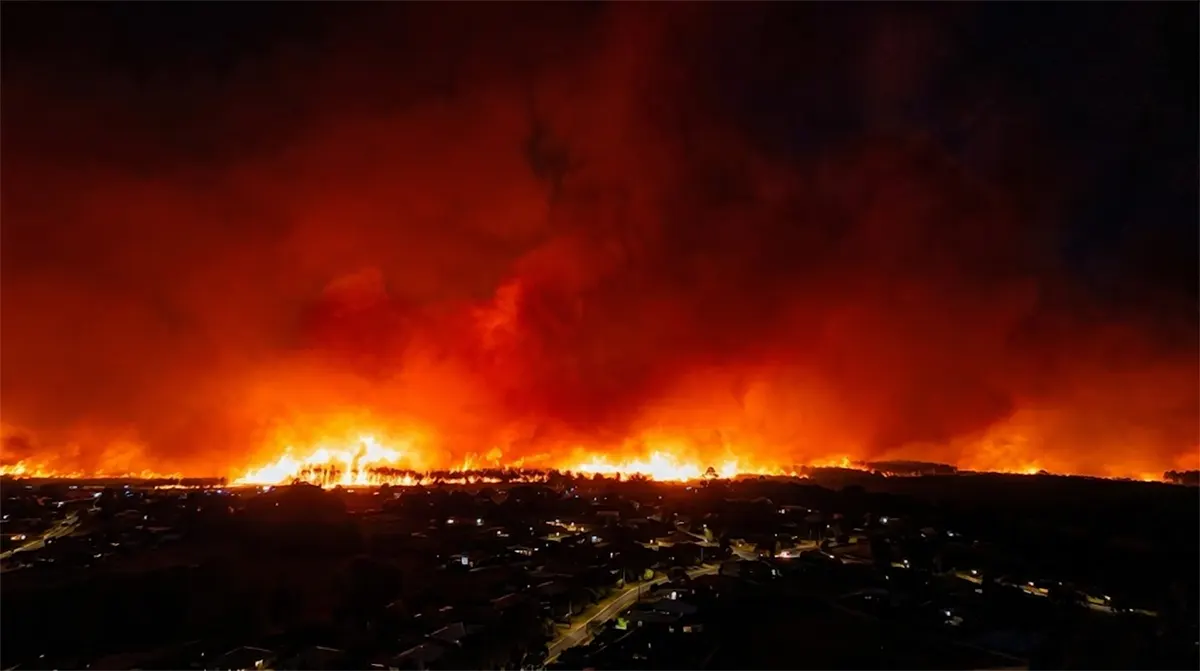
A brutal heatwave gripping Southern Europe has ignited some of the most destructive wildfires the region has seen in years, forcing entire towns in France and Spain to empty out almost overnight. From boats ferrying stranded tourists across a smoke-choked bay in France to soldiers deploying on the outskirts of Madrid, the crisis has escalated into a full-blown international emergency, with both governments now leaning on the European Union for help.
France’s Cap-Ferret Peninsula Empties Out by Sea
In southwestern France, the situation around the Gironde department has turned chaotic. Authorities ordered a full, village-by-village evacuation of the Cap-Ferret peninsula, and more than 60,000 residents and tourists scrambled to get out. With coastal roads blocked by smoke and flames, many stranded vacationers had no choice but to escape by water, boarding small water taxis, boats, and ferries bound for the town of Arcachon.
The fire itself has been staggering in scale, having already scorched more than 125 square kilometers, roughly 31,000 acres, of pine forest, and destroyed dozens of homes and campsites along the way. When strong, shifting winds pushed flames past containment lines near Lège-Cap-Ferret, French officials activated the FR-Alert emergency system, a national warning tool reserved for the most severe threats. Hundreds of firefighters, backed by water-bombing Canadair aircraft, are still battling the blaze.
Spain Declares Its First-Ever National Wildfire Emergency
Just across the border, Spain is facing an equally dire situation, but with a historic twist: the government has declared a national wildfire emergency for the first time ever. The declaration came after multiple uncontained fires merged into a single massive front near Madrid and the neighboring Ávila province.
Two rapidly spreading blazes combined west of the capital, pushing around 18,000 residents out of surrounding towns and villages. Behind it all is an unrelenting heatwave, with temperatures topping 39°C (102°F) and extended dry spells drying out the landscape. So far, more than 1,140 square kilometers, about 440 square miles, have burned across Spain this year, more than five times the area lost during the same period in 2025.
Overwhelmed by the scale of the disaster, both France and Spain have formally requested emergency aerial and ground firefighting support from fellow EU members through the EU Civil Protection Mechanism.
Why This Keeps Happening: A Season of Waves, Not One Fire
It’s easy to assume this is one continuous blaze that firefighters simply can’t put out, but that’s not quite accurate. Southern Europe, especially Spain, Portugal, and southwestern France, tends to experience repeated flare-ups throughout the summer heatwave season rather than a single ongoing fire.
The pattern works like this: bone-dry soil and dense pine forests act as natural tinder. Firefighters manage to contain or extinguish one wave of fires, but the next heat spike and shift in wind conditions sparks brand-new blazes in nearby areas days or weeks later. The evacuations now underway in Cap-Ferret and around Madrid represent a fresh surge, triggered by the latest round of record heat, making this one of the most intense, multi-wave wildfire seasons the region has ever faced.
The Wider Danger Zone: Greece, Portugal, and Italy on Alert
While France and Spain are bearing the brunt of the emergency, they’re not alone. Several other countries across the Mediterranean and Iberian Peninsula are dealing with their own fire risks:
Greece is seeing high-risk, active fires in West Attica near Mandra, just west of Athens, along with areas around Thessaloniki. Factory fires and extreme smoke warnings have forced residents indoors as ground and aerial crews scramble to respond.
Portugal experienced massive burns earlier in this wave, with central regions like Vouzela losing more than 12,000 hectares. Conditions have stabilized somewhat, but the country remains on high alert amid what officials describe as “powder-keg” conditions.
Italy and the Balkans, including Croatia’s Hvar island and parts of Albania, are under high heat warnings that have triggered localized scrub and forest fires alongside severe heat-health advisories.
From Dry Fuel to Open Flame: How a Heatwave Becomes a Wildfire
Starting a fire requires three basic ingredients: fuel, weather, and a spark. A heatwave supplies the first two, but it typically takes something else, whether human activity or nature, to strike the match.
Weeks of temperatures above 40°C (104°F) bake trees, grass, and pine needles until they lose nearly all their moisture, turning entire forests into tinderboxes. At the same time, heatwaves drop humidity and drive strong, dry winds, conditions that let a single small flame explode into an uncontrollable firefront within minutes.
The actual ignition source usually falls into one of three categories. Accidental human actions cause the vast majority of wildfires, around 80 to 85 percent, and can include anything from an overheated car exhaust parked on dry grass to sparks from farm equipment, downed power lines, or even a piece of discarded glass acting like a magnifying lens. Arson and negligence, such as unattended campfires or illegal rubbish burning, account for another share. And in some cases, natural causes like dry lightning, strikes from summer thunderstorms with too little rain to douse the resulting spark, set the blaze off entirely on their own.
In short, the heatwave turns the forest into dynamite, but it still takes a spark, most often human error or lightning, to set it off.
The Human Toll: Nearly 200,000 Displaced and Dozens of Lives Lost
The scale of displacement across the region is staggering. In southwestern France alone, over 141,000 people, both residents and summer tourists, have been forced from their homes, including roughly 44,000 evacuated from the Cap-Ferret peninsula. In central Spain, more than 25,000 people have fled towns west of Madrid and in Ávila province, while another 20,000 residents in nearby municipalities were ordered to shelter indoors due to hazardous smoke levels.
The fires have also proven fatal for those fighting them. At least three firefighters have died battling the blazes in France and Italy, including one on the island of Sicily, and more than 40 firefighters have been treated for injuries, heat exhaustion, and smoke inhalation in Gironde alone. Fortunately, rapid early-warning systems and boat evacuations meant no civilian deaths were confirmed in the current Cap-Ferret or Madrid fronts, though an earlier blaze in southern Spain claimed 13 lives.
Beyond the flames themselves, the underlying heatwave has been quietly lethal in its own right. France alone recorded over 5,700 excess heat deaths during the recent temperature peaks, a stark reminder that extreme heat often causes more harm than the fires it fuels.
Governments Mobilize Military and International Aid
With local fire departments overwhelmed, both countries have escalated their response to a near wartime footing. In France, Interior Minister Laurent Nuñez deployed military reinforcements and hundreds of additional civilian firefighters, while the government mobilized municipal ferries, state emergency craft, and private water taxis for a complete maritime evacuation of Cap-Ferret. President Emmanuel Macron formally triggered the EU Civil Protection Mechanism, acknowledging that local resources had been stretched to what he called “extreme tension.”
In Spain, Prime Minister Pedro Sánchez ordered the military’s specialized Emergency Military Unit (UME) directly to the frontlines to protect Madrid’s outer perimeter and help contain the merged blazes in Ávila. Authorities also issued emergency alerts ordering more than 20,000 residents in heavily smoke-affected zones to remain indoors with windows sealed.
The European Union, meanwhile, has stepped in to coordinate cross-border support. Croatia and Portugal sent water-bombing Canadair and Air Tractor aircraft to France, while the Czech Republic and Slovakia deployed heavy-lift Black Hawk helicopters. Italy and Greece dispatched fleets of Canadair water-dumping planes to reinforce efforts around Madrid and Ávila.
What began as a series of local wildfires has effectively become a joint military-civilian rescue operation, propped up by international air support as Southern Europe braces for what could be more waves of fire before the summer heat finally breaks.