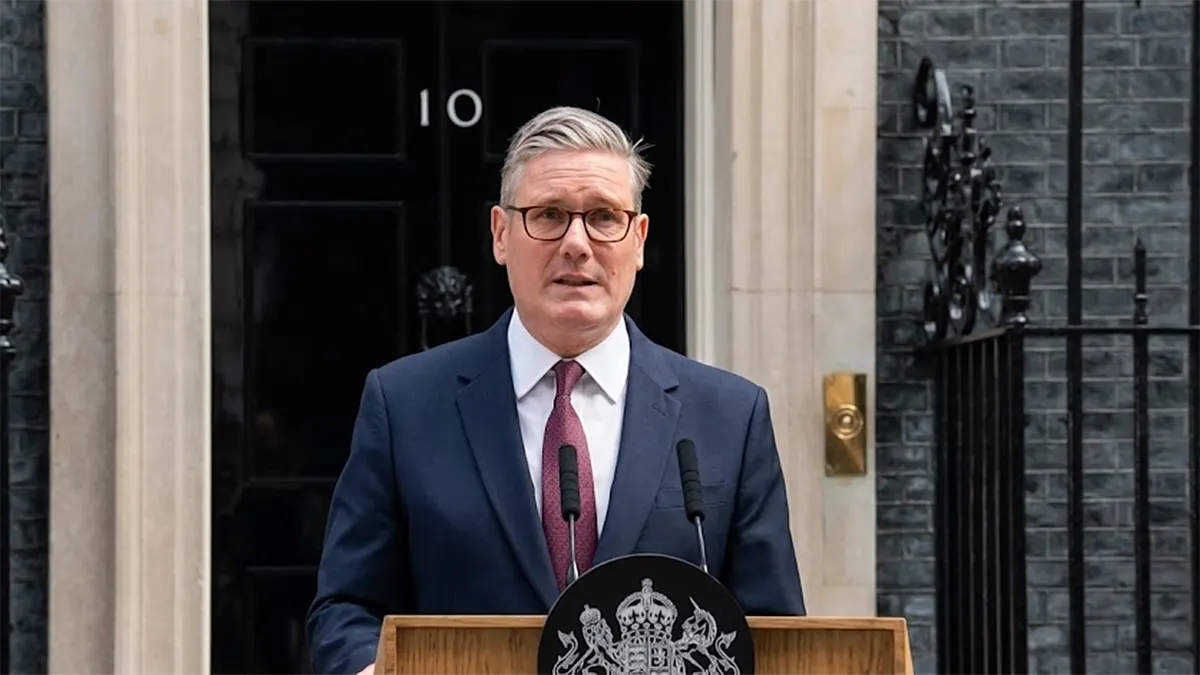
Keir Starmer stood outside 10 Downing Street and delivered the words few expected so soon, he was resigning as leader of the Labour Party, effectively ending his tenure as Prime Minister just two years after Labour’s sweeping landslide victory in July 2024.
It wasn’t one dramatic moment that brought him down. It was a slow accumulation of setbacks bad poll numbers, unpopular policies, costly reversals that finally reached a tipping point the moment Andy Burnham walked back into Westminster.
One By-Election Changed Everything
The spark that lit the fire came from an unlikely place: a by-election in Makerfield. Burnham, the former Mayor of Greater Manchester, won a parliamentary seat and instantly became a rallying point for Labour MPs who had long been growing restless under Starmer’s leadership. His return to Westminster didn’t just send a message, it galvanized a movement inside the party.
But the Makerfield result didn’t happen in a vacuum. Labour’s polling had been collapsing for months, driven down by a series of self-inflicted wounds. The government had cut winter fuel payments for pensioners and pushed through welfare reductions moves that tore into Labour’s traditional image as the party that protects the most vulnerable. When public backlash forced Starmer into a reversal, it didn’t help. Instead of appearing responsive, he looked weak and indecisive.
The appointment of Peter Mandelson as UK Ambassador to the United States added more fuel to the fire. For many inside the party, it crystallized a wider concern: that the leadership was out of touch and drifting without a clear direction. Political commentators pointed to what they called “the blankness”, a government that couldn’t articulate what it stood for, leaving voters with nothing to hold onto except their frustration.
And then there was the economy. A surge in global energy prices triggered by conflict in the Middle East and the closure of the Strait of Hormuz hit British households with a fresh wave of cost-of-living pain that Starmer’s government was powerless to absorb. Growth stayed flat. Everyday life didn’t improve. Labour’s polling dropped to around 19–20%, while Nigel Farage’s Reform UK surged to nearly 30%. The arithmetic was existential for sitting MPs if Starmer led them into the next election, many believed they simply wouldn’t survive it.
By the weekend before his resignation, key Cabinet ministers including the Home, Foreign and Transport Secretaries had reportedly urged Starmer to step aside rather than drag the party through a bruising leadership challenge. He got the message.
In an emotional statement outside Downing Street, Starmer didn’t shy away from what had happened:
“The question my party is asking now is whether I am best placed to lead us into the next general election. I have heard the answer of my parliamentary party to that question, and I accept that answer with good grace.”
He’s Resigning Twice, Just Not at the Same Time
Here’s where things get slightly unusual: Starmer is resigning as Labour leader immediately, but he won’t be leaving Downing Street just yet. Under the UK’s unwritten constitution, the country must always have a Prime Minister. A leader can’t simply walk away and leave the office vacant. So Starmer retains the full legal powers of the Prime Minister attending international summits, handling national security, running the government day to day until Labour officially picks his replacement.
This also means there’s no need for a snap general election. Because the Labour Party won a commanding majority in 2024, they retain the constitutional mandate to govern until the next statutory deadline in 2029. When a new Labour leader is chosen, that person automatically becomes Prime Minister, no public vote required.
The mechanics of the handover are straightforward. Once a successor is confirmed, Starmer travels to Buckingham Palace and formally tenders his resignation to King Charles III. The King accepts, the new Labour leader arrives, and through a ceremony known as “kissing hands” they leave as Prime Minister. On that single morning, the transition is complete.
Andy Burnham Has the Numbers and Almost Everyone Knows It
The race to succeed him is already underway and it may not be much of a race at all. Nominations open officially on July 9, with the entire contest required to conclude before Parliament returns from its summer recess on September 1. Any candidate who wants to appear on the ballot needs the backing of 81 Labour MPs, that’s 20% of the parliamentary party.
Andy Burnham is the clear frontrunner, and his team already claims the support of roughly 200 MPs nearly half the parliamentary party. That leaves an almost impossibly narrow path for any challenger to clear the 81-nomination threshold.
Wes Streeting, who resigned as Health Secretary in protest of Starmer’s leadership weeks before the resignation itself, a deliberate move to free himself from Cabinet collective responsibility had positioned himself as a potential alternative. He represents the centrist, Blairite wing of the party and is well-regarded in Westminster circles for his policy sharpness. But public polling tells a different story: Burnham carries far broader national name recognition, particularly among working-class and northern voters that Labour is urgently trying to win back.
If Streeting decides to run anyway, he faces a three-sided problem. First, the numbers: scraping together 81 nominations when 200 MPs are already behind Burnham is a steep climb. Second, the optics: many Labour MPs are desperate to avoid the spectacle of a party tearing itself apart over a summer-long leadership battle, acutely aware of what that kind of public infighting did to the Conservatives. Third, the economics: Burnham is reportedly prepared to push for a review of public service privatisation and changes to the Treasury, a platform that centrist figures like Streeting could argue is too risky for business confidence, but one they’d need to convincingly make the case against.
The most likely outcome, political analysts agree, is a coronation. If Burnham runs unopposed if Streeting and others conclude they simply can’t hit the 81-MP bar then no full member ballot takes place. The leadership transition could happen as early as mid-July, weeks ahead of the September 1 deadline.
That possibility makes this one of the more unusual political handovers in recent British history: the prospect of the UK’s seventh Prime Minister in just over a decade taking office without a single public vote being cast in the process.