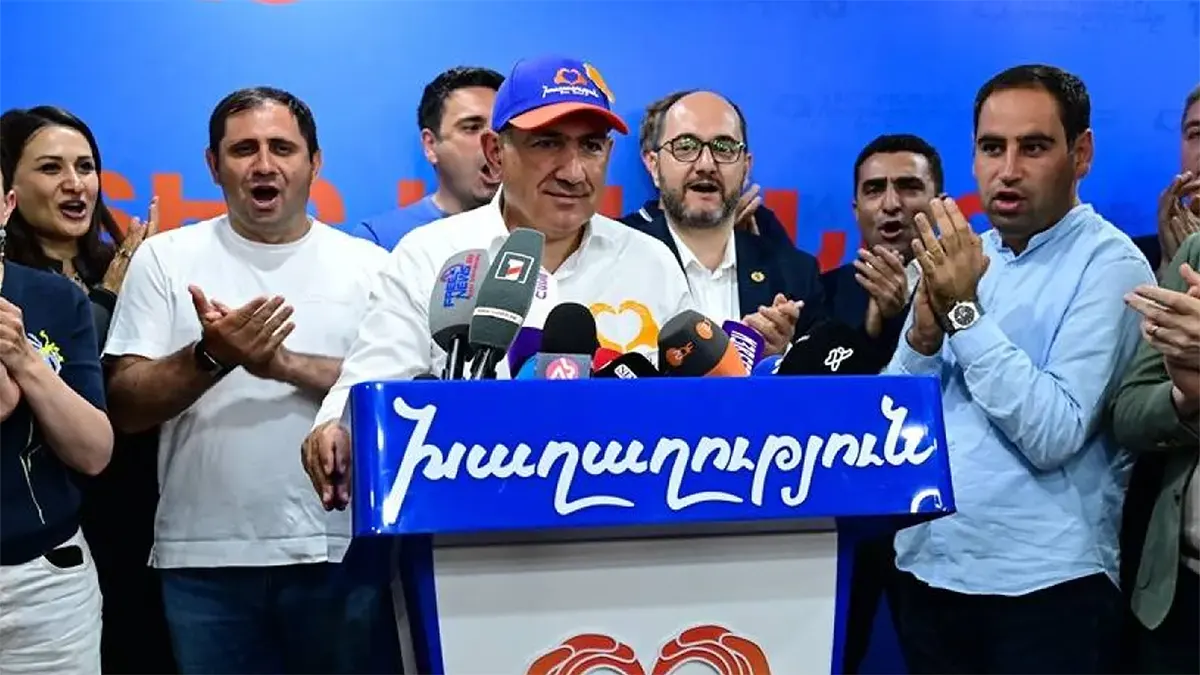
Armenia just handed Nikol Pashinyan another mandate but this election was never just about who governs Yerevan. It was a referendum on which direction the country faces: West toward Europe, or back toward Moscow. The answer came on June 7. And now, the real fight begins.
A Win That Wasn’t Quite Enough
Pashinyan’s Civil Contract party claimed 49.8% of the vote, a decisive plurality in a fractured field. Thanks to Armenia’s proportional seat-allocation rules designed to ensure governing stability, that translates to roughly 64 parliamentary seats, enough to form a government without coalition partners.
But there’s a critical catch.
Despite winning the election, Pashinyan fell just short of the constitutional majority he actually needed. That threshold matters enormously, it’s the key that unlocks the ability to call a national referendum on a new constitution, which is itself a prerequisite for two of his most consequential goals: a permanent peace treaty with Azerbaijan and formal pursuit of EU membership. Without it, both ambitions sit behind a locked door.
Who’s Pushing Back and Why It Matters
The opposition didn’t just lose gracefully. Three significant pro-Russian blocs collectively captured over 37% of the vote, and they’re not going quietly.
| Party / Alliance | Leader | Vote Share | Geopolitical Alignment |
|---|---|---|---|
| Civil Contract | Nikol Pashinyan | 49.8% | Pro-West / EU Integration |
| Strong Armenia | Samvel Karapetyan | 23.3% | Pro-Russia / Rebuild Moscow Ties |
| Armenia Alliance | Robert Kocharyan | 9.9% | Pro-Russia / Nationalist |
| Prosperous Armenia | Gagik Tsarukyan | 4.0% | Pro-Russia |
Samvel Karapetyan, a Russian-Armenian billionaire running the second-largest bloc immediately called the election “shameful,” alleging government repression and the arrest of campaign staff. Armenia’s Investigative Committee has since opened 59 criminal cases tied to voting irregularities, adding fuel to an already volatile post-election atmosphere.
Pashinyan’s Careful Balancing Act
Here’s where Pashinyan has to thread a very thin needle.
He pledged to continue “rapprochement with the West” that part was expected. What caught attention was his simultaneous confirmation that Armenia would remain inside the Russia-led Eurasian Economic Union (EAEU). It sounds contradictory, but it’s deliberate. Completely severing economic ties with Moscow overnight isn’t just politically risky, it could be economically catastrophic for ordinary Armenians.
This isn’t weakness. It’s the reality of governing a small country sandwiched between three powerful neighbors with long memories.
Moscow’s Response: Skepticism With a Sharp Edge
The Kremlin didn’t congratulate Pashinyan. Instead, Moscow’s response was a calculated blend of legitimacy challenges and quiet threats.
Kremlin spokesperson Dmitry Peskov noted that Moscow is “taking note of reports regarding numerous violations” careful language, but clearly designed to plant seeds of doubt. Foreign Ministry spokesperson Maria Zakharova went further, arguing that Civil Contract failed to win a “monopoly on power” and that its approval rating has declined compared to previous cycles.
More pointedly, Zakharova framed the Armenian government’s arrests of opposition figures as state “repression” against pro-Russian political forces a framing that positions Moscow as a protector of Armenian citizens rather than an outside actor.
Russia’s Real Leverage: Three Pressure Points
The Kremlin doesn’t need to send tanks. It has quieter, more devastating tools.
Economic Chokepoints
Armenia’s economy is deeply entangled with Russia’s. Moscow has already signaled that closer EU ties are “incompatible” with EAEU membership benefits. Beyond that, Russia controls two immediate levers: its agricultural watchdog Rosselkhoznadzor can and has imposed sudden “sanitary” bans on Armenian food exports like wine, fruit, and dairy whenever tensions spike. And Armenia is almost entirely dependent on Russian natural gas, imported through Russian-owned pipelines at subsidized rates. A price hike or a “maintenance pause” hits Armenian households directly.
Information Warfare
A leaked Russian intelligence document titled “Programme for Work in the ‘Anti-Pashinyan’ Direction for 2026” laid out Moscow’s subversion strategy in uncomfortable detail. It involves Russian-backed “Doppelgänger” media networks amplifying fears that Pashinyan’s Western alignment will trigger a new war with Azerbaijan, alongside false-flag social media operations designed to deepen civic distrust and political fatigue inside Armenia. Western intelligence agencies and Meta have both been actively tracking these networks.
Security Vulnerabilities
Armenia’s disillusionment with Russia’s Collective Security Treaty Organization (CSTO) which stood aside during border clashes with Azerbaijan is exactly why Pashinyan has been drifting West in the first place. But Russia still holds a physical card: the 102nd Military Base in Gyumri. Pashinyan has managed to push Russian border guards out of Yerevan’s airport and the Iranian border crossing, but he has conspicuously avoided demanding the Gyumri base close, a sign of just how carefully he’s managing the military dimension.
The most dangerous lever Russia holds, however, may be the passive one: by simply withholding any diplomatic or security backing, Moscow can implicitly signal to Azerbaijan and Turkey that interference on Armenia’s borders won’t be met with Russian resistance.
Europe Steps In
The European Commission isn’t waiting on the sidelines. In direct response to these vulnerabilities, Brussels recently announced a €50 million financial assistance package for Yerevan, bundled with a specialized cyber and hybrid threat defense team EUPM Armenia specifically tasked with protecting Pashinyan’s government from the kind of pressure Moscow is already applying.
It’s a meaningful commitment. But €50 million against Russia’s full economic and information arsenal is a beginning, not a solution.
What Comes Next
Pashinyan won. That matters. Armenia’s democratic process produced a clear result, and the country’s westward momentum is real and validated.
But the road ahead involves managing a domestic opposition with deep Russian backing, navigating Moscow’s economic and informational pressure, closing a peace deal with Azerbaijan without the constitutional tools to seal it, and keeping the lights on literally while pivoting away from Russian energy dependency.
Armenia is moving West. The question is how much it costs to get there.