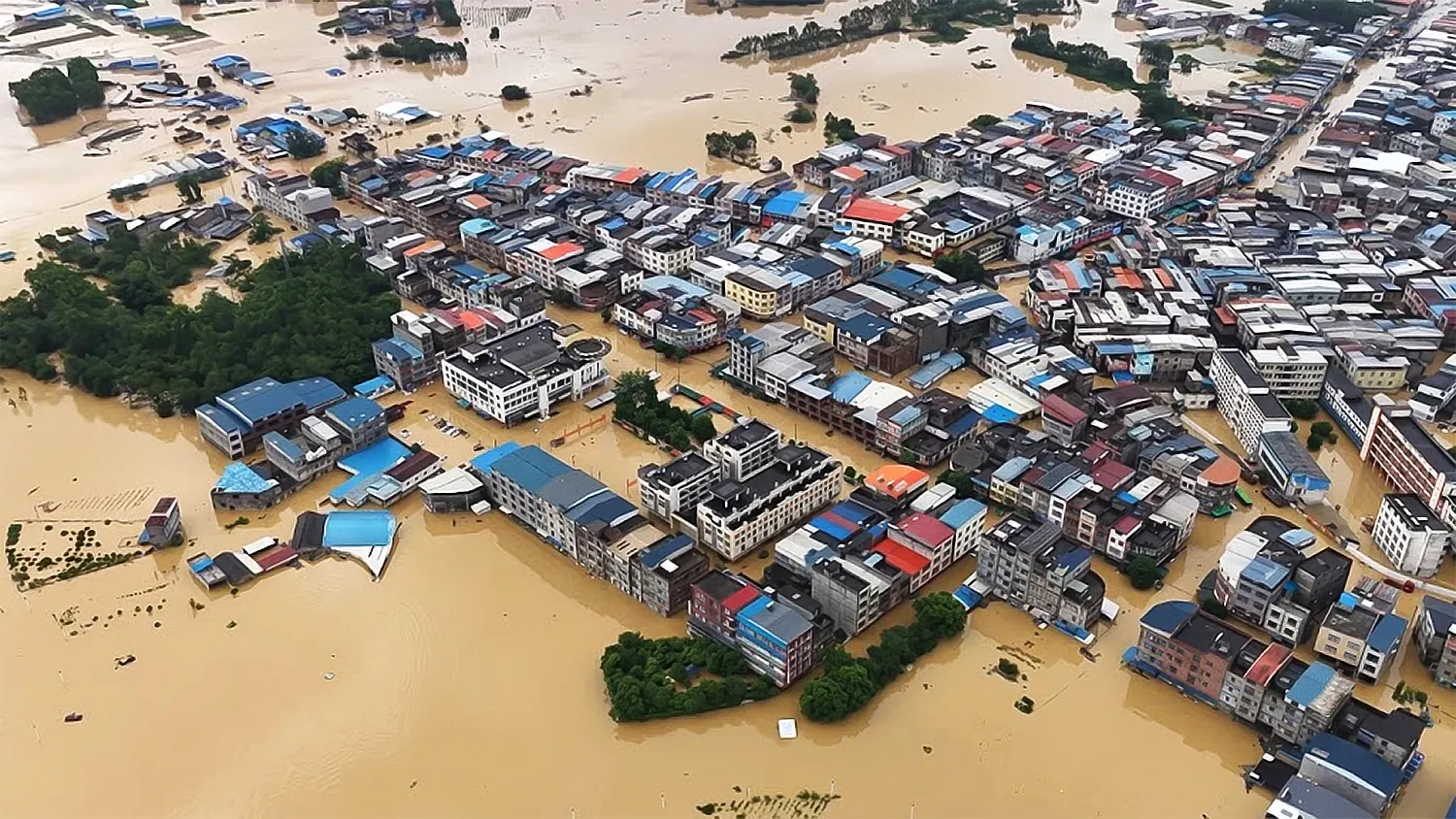
Typhoon Maysak has unleashed catastrophic flooding across southern China, leaving at least seven people dead, forcing tens of thousands from their homes, and causing widespread damage to critical infrastructure.
After making landfall over the weekend through Hainan Province and neighboring Vietnam, the weakened storm continued inland, where it combined with powerful seasonal monsoon winds. The result was days of relentless rainfall that overwhelmed rivers, reservoirs, and urban drainage systems across several provinces.
The Guangxi Zhuang Autonomous Region has emerged as the hardest-hit area, while separate rainstorms have also caused deadly flash floods in northern China.
Guangxi Faces the Worst Flooding in Decades
Authorities say more than 55,000 people have been directly affected in Guangxi, with around 48,000 residents evacuated as floodwaters rapidly spread through towns and cities.
The regional capital Nanning recorded at least two fatalities, while rescue operations continue in multiple flood-stricken communities.
Residents in several areas described the disaster as the worst flooding seen in more than 20 years, with streets transformed into fast-moving rivers and vehicles nearly submerged beneath rising water.
Among the worst-affected locations are Hengzhou, Binyang County, Fangchenggang, Dongxing, and Guigang, where floodwaters inundated residential neighborhoods, roads, and construction sites.
Reservoir Breach Raises Emergency Fears
One of the most serious incidents occurred at the Liulan Reservoir in Hengzhou, where a 50-meter breach developed after days of extreme rainfall pushed water levels beyond emergency limits.
Authorities were forced to open emergency floodgates as torrents of water surged downstream.
Nearby, the Yunbiao Reservoir also overflowed, increasing concerns over additional flooding in downstream communities.
Officials warned that already saturated ground and continued rainfall could place further pressure on reservoirs and flood-control infrastructure throughout the region.
Why the Flooding Became So Severe
Although Typhoon Maysak weakened after making landfall, the storm retained enormous amounts of moisture collected over the South China Sea.
As the storm system moved across Guangxi, it collided with seasonal southwest monsoon winds, creating intense cloudbursts that dumped extraordinary amounts of rain within a short period.
Because the ground was already soaked from seasonal rainfall, it could no longer absorb the additional water.
The excess runoff quickly overwhelmed drainage systems, caused rivers to overflow, and pushed reservoirs beyond their design capacity, ultimately triggering breaches such as the one at Liulan Reservoir.
Flooding Spreads Beyond Southern China
The impact of Maysak has extended beyond Guangxi into several neighboring provinces.
Heavy flooding has also been reported in Guizhou, Hunan, and Hubei, affecting cities including Ezhou, Huanggang, Huangshi, and Xianning.
Meanwhile, Hainan Province, where the typhoon first made landfall, experienced coastal disruptions and emergency closures before the storm moved inland.
Northern China Battles Separate Deadly Rainstorms
While southern China deals with Typhoon Maysak’s aftermath, northern China is facing a separate weather emergency.
Authorities confirmed five additional deaths after intense localized rainstorms triggered flash floods across Liaoning Province and Inner Mongolia.
In Fushun, Liaoning, record-breaking rainfall reportedly turned roads into deep lakes within hours, forcing thousands of residents to evacuate.
Mountainous areas of eastern Inner Mongolia also experienced destructive flash floods that swept away livestock and damaged communities.
Officials said these northern floods were not directly linked to Typhoon Maysak, but were caused by an unrelated system of severe thunderstorms.
China Expands Emergency Response
As conditions deteriorated, Chinese authorities significantly expanded disaster response efforts across the affected regions.
Flood-control alerts were raised to Level II across Guangxi, while cities including Nanning and Guigang escalated to Level I, the country’s highest emergency warning level.
The State Flood Control and Drought Relief Headquarters and the Ministry of Emergency Management dispatched national emergency teams to coordinate rescue operations.
More than 1,300 firefighters, 350 engineering and geological specialists, and units from the People’s Armed Police Force have been deployed to assist evacuation and rescue missions.
Emergency crews are using inflatable rescue boats, specialized vehicles, and communication drones to reach isolated communities and restore damaged communication networks.
To support recovery efforts, China’s central government has allocated 100 million yuan (approximately US$13.9 million) for urgent repairs to damaged roads, hospitals, schools, and water infrastructure.
Authorities have also released 150,000 emergency relief supplies, including tents, folding beds, clothing, blankets, and family emergency kits for residents displaced by the floods.
With rainfall expected to continue in several affected regions, officials warn that the risk of additional flooding and landslides remains high as rescue and recovery operations continue.