For years, the Kremlin kept the war at arm’s length from ordinary Muscovites. State media controlled the narrative. The front lines were hundreds of miles away. Life in the capital largely went on.
That changed on the morning of June 18, 2026.
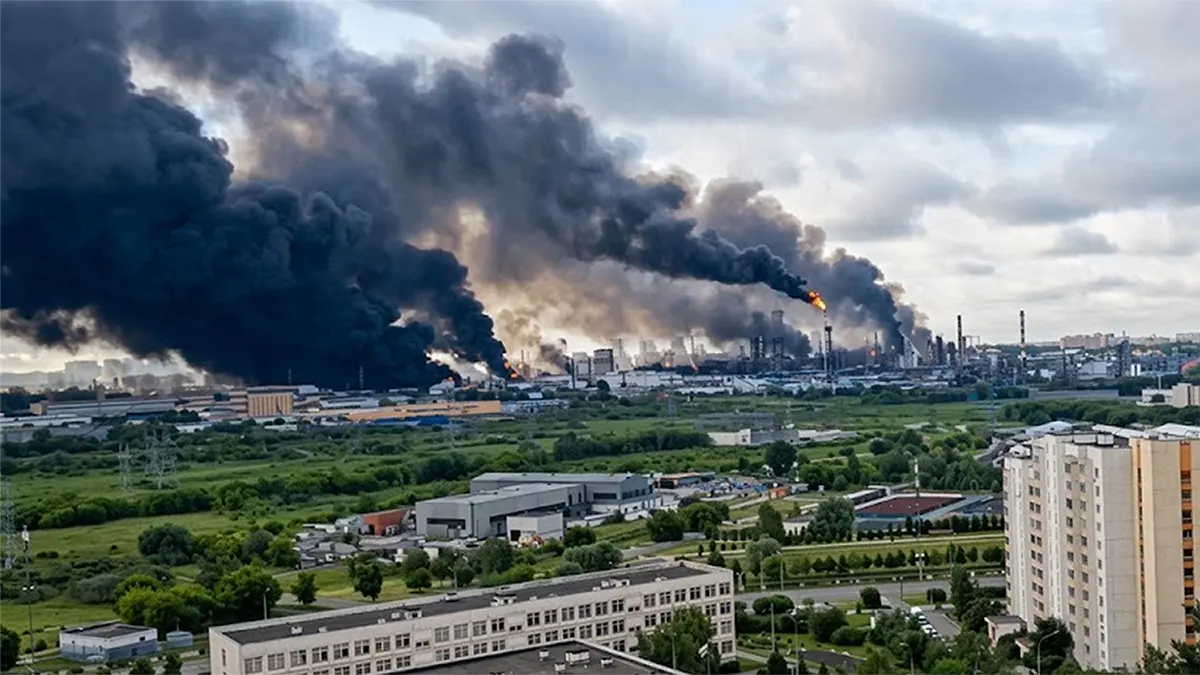
Ukraine launched the largest drone attack in the history of the conflict, sending hundreds of unmanned aircraft toward Russian territory in a single coordinated wave. Nearly 1,000 drones were tracked across the entire country. Close to 200 were aimed directly at Moscow. And several got through hitting one of the capital’s most critical energy facilities, two major commercial centers, and a residential high-rise, while thick black smoke rolled across the city skyline for millions to see.
What Ukraine Hit And Why It Chose These Targets
The centerpiece of the strike was the Moscow Oil Refinery in the Kapotnya district, located just 9 miles from the Kremlin.
This wasn’t a symbolic target. The Kapotnya facility supplies roughly 40% of Moscow’s gasoline and half of its diesel, the lifeblood of the capital’s daily transport network. Multiple drones broke through air defenses, detonating fuel storage tanks and triggering massive fireballs that sent columns of black smoke high enough to be seen across the entire city.
The refinery had already been struck two days earlier on June 16. After taking back-to-back hits, operations at the facility have ground to a halt. The consequences are immediate: Russia historically one of the world’s largest oil exporters is now being forced to import fuel by sea to cover the domestic gasoline shortages caused by Ukraine’s sustained, systematic campaign against Russian refinery infrastructure.
Beyond the refinery, the strike’s reach extended into civilian and commercial zones:
All four major Moscow airports were shut down. Sheremetyevo, Vnukovo, and two others suspended operations and evacuated passengers. Aeroflot alone canceled over 170 flights, stranding thousands of travelers mid-journey.
Two of Moscow’s largest commercial centers caught fire. The Mega Belaya Dacha shopping complex, one of the largest mega-malls in Europe had drone debris pierce its roof, sparking fires that emergency crews scrambled to contain. Nearby, the sprawling Sadovod market reported localized fires and structural damage from scattered fragments.
A residential high-rise was directly struck. In the suburban Zhukovsky district, roughly 25 miles from central Moscow, a drone hit a multi-story apartment block on Gagarin Street. The impact tore through the upper levels, destroying balcony slabs and damaging the fire escape staircase between the 23rd and 24th floors. Residents were evacuated into the night as smoke poured from the top of the building.
Across the wider Moscow region, drone debris set parked vehicles ablaze, pierced the roofs of private homes in Elektrostal, and caused structural damage to a local fitness center and industrial facilities in Lyubertsy. Regional authorities confirmed at least 17 people were injured primarily from flying glass, falling masonry, and smoke inhalation.
Zelenskyy’s Message Was Blunt
Ukrainian President Volodymyr Zelenskyy didn’t frame the strike as an escalation. He framed it as a receipt.
Earlier in the week, Russian missile strikes on Kyiv had heavily damaged a historic monastery complex more than 1,000 years old. The June 18 drone wave was Ukraine’s direct response.
“We don’t want this war, we never did,” Zelenskyy stated. “But if Ukraine burns, your Moscow will burn too.”
He described the bombardment as a “long-range sanction”, a term that signals a deliberate strategic shift. Ukraine is no longer treating drone strikes as a pressure tactic or occasional disruption. It is treating them as an economic tool, specifically designed to drain Russia’s domestic fuel supply and force the Russian public to absorb the cost of a war their government launched.
The “Black Rain” That Shook Moscow’s Psychological Bubble
For the residents living through it, June 18 wasn’t just a news story, it was a sensory shock.
In towns east of the capital, including Balashikha, residents woke to what they described as “black rain”, a fallout of dark, oily residue and soot blanketing cars, streets, and homes after the Kapotnya refinery’s fuel tanks detonated. Windows shook from the blast pressure. The air smelled of burning fuel.
“The war is here,” one Moscow resident wrote on social media. “The air is dark and smells of smoke.”
This is precisely the psychological shift Ukraine has been trying to engineer. For years, the Kremlin successfully insulated its capital population from the physical destruction unfolding inside Ukraine. State media kept the imagery at a distance. This strike made that distance impossible to maintain. The smoke wasn’t on television, it was hanging over the city.
Russia’s Air Defenses Were Overwhelmed And That Itself Is the Story
Moscow has the densest, most heavily layered air defense network in Russia. Systems are deployed not just around the city perimeter but on top of government buildings in the capital’s center.
And yet.
Verified footage circulating after the attack showed Ukrainian drones navigating Moscow’s airspace largely unchallenged. In one widely shared video, a Russian soldier is seen frantically attempting to engage a drone with a shoulder-launched Manpads missile system moments before it slammed directly into the Kapotnya refinery.
The explanation isn’t a single system failure. It’s math. A salvo of nearly 200 drones aimed at one city simply oversaturates any defense network, burning through interceptor missile stockpiles faster than they can be replenished. Russia’s air defense systems were firing but they were running out of things to fire.
This exposes a growing dilemma that has no clean solution. When air defense systems like the Pantsir or Tor successfully intercept a heavy, fuel-laden drone traveling at speed over an urban area, the wreckage doesn’t disappear, it becomes unguided debris raining down on the suburbs below. The shopping mall fires, the apartment building strike, the damage in Lyubertsy much of this was caused not by drones that got through, but by intercepted drones whose fragments had nowhere to go but down.
Moscow can defend itself or it can protect its civilians from falling wreckage. On June 18, it struggled to do both at once.
Why Ukraine Is Targeting Refineries Specifically
The Kapotnya strike isn’t an isolated choice. It’s part of a deliberate, long-running campaign.
Ukraine has been systematically targeting Russian oil refineries for months, and the logic is straightforward: hit the fuel supply, and you hit everything else. Military vehicles, generators, heating systems, civilian transport, all of it depends on refined petroleum. By taking refineries offline one by one, Ukraine is applying sustained economic pressure that bleeds Russia’s war capacity while simultaneously creating domestic shortages that affect ordinary Russians.
The fact that Russia is now importing fuel for a country that sits on some of the world’s largest oil reserves is a remarkable marker of how effective this campaign has been. It’s one of the clearest indicators yet that Ukraine’s long-range drone strategy is achieving genuine strategic results, not just headlines.
What This Signals About Where the War Is Heading
The shift in scale matters. Ukraine has moved away from sporadic, small-scale incursions and toward overwhelming, massed drone salvos including newer jet-powered hybrid cruise-drones with longer range and greater payload capacity.
This isn’t just a bigger version of the same tactic. It’s a different doctrine. The goal is no longer to sneak through occasionally and cause disruption. The goal is to flood Russian air defenses beyond their capacity to respond, ensure a meaningful percentage of the wave gets through, and systematically degrade the infrastructure that keeps Russian society and the Russian military functioning.
For the Russian public, the morning of June 18 delivered something the Kremlin has worked hard to prevent: a direct, visceral experience of the war they’ve been told is going well. The smoke over Moscow, the black rain in the suburbs, the shuttered airports, the evacuated apartment block none of it fits the official narrative.
Ukraine didn’t just hit a refinery. It hit the story Russia has been telling itself.