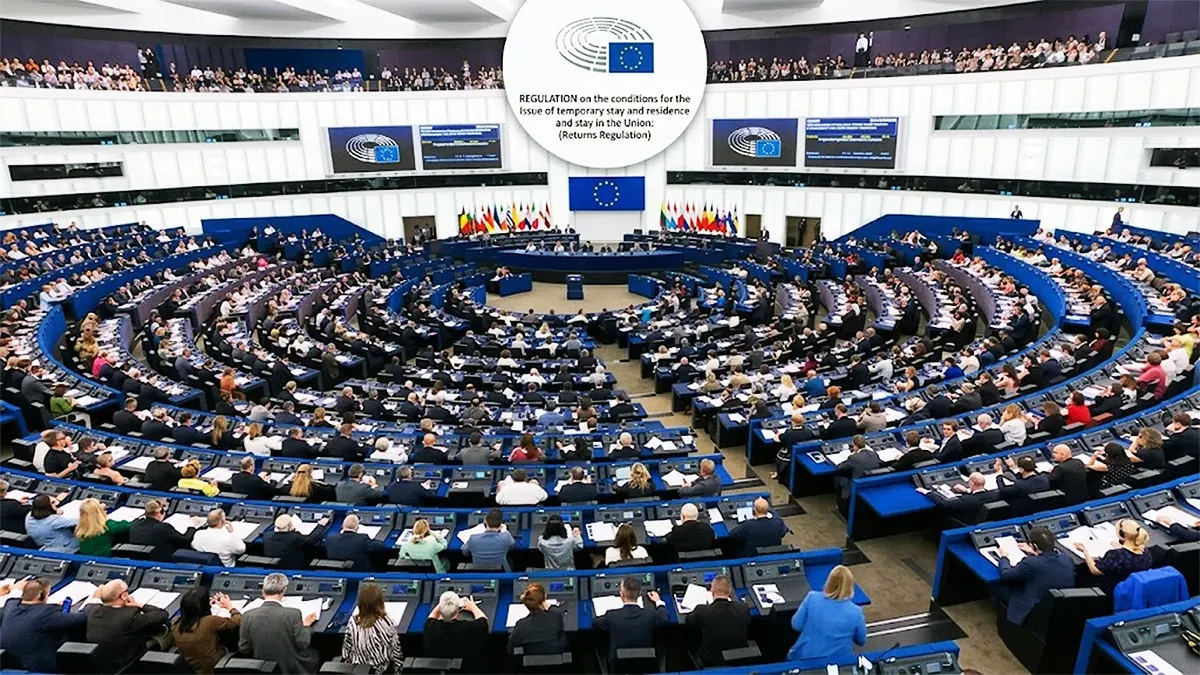
On June 17, 2026, the European Parliament voted 418 to 218 to pass the EU’s new Return Regulation, the most sweeping overhaul of Europe’s deportation system in nearly two decades. Within days of the broader EU Pact on Migration and Asylum taking effect on June 12, the bloc now has a complete legal machine for removing people it decides don’t belong within its borders.
But what does this law actually change, who does it target, and why is half of Europe furious about it?
The Old System Was Broken And the Numbers Proved It
For years, EU countries operated under the 2008 Return Directive, a set of guidelines, not hard rules. Each member state was free to write its own national laws around it, which meant a rejected asylum seeker in Italy faced a very different deportation process than someone in Germany or Sweden. The result was a fragmented, slow, and largely ineffective patchwork system.
The numbers tell the story: fewer than 30% of people officially ordered to leave the EU actually left. For EU officials, that figure wasn’t just an embarrassment, it was a crisis of credibility.
The new Return Regulation replaces that old directive with a single, directly binding rule that applies identically across all 27 EU member states at the same time. No more national variations. No more legal gaps to fall through.
What the New Law Actually Does
The change from a “directive” to a “regulation” is the foundation of everything else. A regulation doesn’t need to be translated into national law, it is the law, effective immediately across the entire bloc.
From there, the changes stack up quickly.
The automatic deportation trigger is perhaps the most significant procedural shift. Under the old system, a rejected asylum claim and a deportation order were two separate legal battles, authorities had to begin a brand-new bureaucratic process after each denial. Under the new regulation, the moment an asylum application is officially rejected, a deportation order is generated automatically. No buffer. No gap.
Detention windows have been dramatically extended. If authorities believe someone might flee or refuse to cooperate, they can now detain that person for up to 24 months, with an optional six-month extension bringing the maximum to 30 months. Previously, detention limits were far shorter and inconsistently applied.
Appeals no longer pause deportations. This is one of the most contested changes. Under the old rules, filing a legal appeal against a deportation order typically allowed a person to remain in the country while a judge reviewed the case. Under the new fast-track system, an appeal does not automatically halt removal. A person can be physically deported before a court ever rules on whether the order was legally valid.
A single deportation order now counts everywhere. If one EU member state issues a return order, every other member state recognizes it automatically. Moving from Germany to France or Belgium to avoid deportation is no longer a viable workaround.
Search and surveillance powers have been expanded. National authorities now have broader legal rights to search residences, personal belongings, and significantly electronic devices to establish identities and prepare for forced removals.
The Most Controversial Piece: Offshore “Return Hubs”
The regulation’s most debated mechanism is the legal framework for offshore deportation centers, facilities built entirely outside EU borders where rejected migrants can be held while authorities work out how to repatriate them to their home countries.
Previously, the EU could only deport someone to their home country, a country they’d physically passed through, or a country they explicitly agreed to go to. The new law removes that limitation. The EU can now send a person to any non-EU country that signs an agreement to take them even if that person has never set foot there before.
The specific hub locations haven’t been finalized yet. The law creates the framework; individual EU countries or coalitions of them are now negotiating bilateral agreements to host these centers. Countries currently in talks include Tunisia, Egypt, Libya, and Mauritania in North Africa; Rwanda, Ghana, Senegal, and Ethiopia in sub-Saharan Africa; and Montenegro, Armenia, and Uzbekistan in Eastern Europe and Central Asia.
The target timeline: first agreements signed by end of 2026, first hubs operational by 2027.
Who Gets Sent There and Who Doesn’t
The regulation targets what it formally calls “illegally staying third-country nationals”, non-EU citizens who either entered without authorization or overstayed a legal visa.
The group most immediately in the crosshairs are rejected asylum seekers. While a person’s asylum claim is actively being processed, they retain temporary legal protection and cannot be deported. The moment that claim is denied, their status flips automatically, they are reclassified as illegal migrants and become immediately eligible for transfer to an offshore hub.
For people coming from countries the EU classifies as generally “safe” such as Morocco, Tunisia, Bangladesh, India, Colombia, and Kosovo, the process is even faster. Their claims are fast-tracked at the border within 12 weeks, and because approval rates from these countries are very low, the fast-track is designed to funnel them from asylum seeker to deportation candidate almost upon arrival.
One group explicitly protected are unaccompanied minors, children traveling to the EU alone cannot legally be sent to offshore hubs under this law.
The situation for families, however, is murky and deeply contested. Human rights groups have flagged that unlike earlier drafts of the legislation, the final text does not explicitly exempt families with children from being sent to return hubs. This means entire family units parents and children together could potentially be transferred offshore.
Why the Vote Tore Brussels Apart
The regulation passed because the center-right European People’s Party (EPP) allied with right-wing factions in the chamber. The political fault line was stark: 418 for, 218 against, 30 abstentions.
Supporters, led by EU Migration Commissioner Magnus Brunner, framed the law as a necessary restoration of credibility. Their argument runs in three directions. First, they say the rule of law only means something if it can be enforced and a 30% return rate proves it currently can’t be. Second, they argue that fast, certain deportations break the business model of human traffickers: if migrants know they’ll be sent to an offshore hub rather than absorbed into Europe, fewer will pay thousands of euros to smugglers to cross the Mediterranean on dangerous boats. Third, they contend that housing, healthcare, and financial support for millions of asylum seekers strains public infrastructure, and that those resources should be prioritized for citizens and legal residents.
On the other side, left-wing, socialist, and green MEPs protested loudly some shouting “shame on you” from the chamber floor. Their objections center on the offshore hub model, which they argue is designed to move human beings beyond the reach of European courts and legal standards. Detaining families for up to 30 months, deporting people before their appeals are heard, and shipping migrants to countries they’ve never visited, critics say, strips away the most basic protections international law was built to guarantee.
Both arguments reflect genuinely different frameworks: one prioritizes the state’s right to control its borders and protect public resources; the other prioritizes the individual’s right to due process and protection from harm. Neither side is arguing in bad faith, they’re just starting from completely different premises.
What Happens Next
The legal framework is locked in. What follows is the machinery catching up.
EU member states are already adapting their domestic laws to align with the regulation. Diplomatic negotiations for hub host agreements are underway. The shared cross-EU database that will track deportation orders across all 27 nations in real time must be fully operational by mid-2028.
The broader EU Pact on Migration and Asylum, the “front door” screening system went live on June 12. Officials are now calling this Return Regulation the “back door lock”: a unified pipeline designed to ensure that if Europe says no, removal follows.
Whether that pipeline also ensures fairness and legal integrity is a question that will be fought in courtrooms, diplomatic halls, and European streets for years to come.