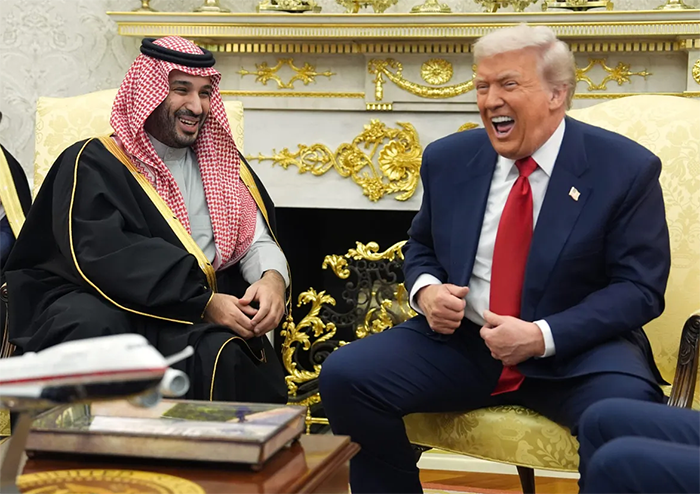
Washington — In a landmark meeting that signals a profound shift in U.S.-Middle East relations, President Donald Trump and Saudi Crown Prince Mohammed bin Salman (MBS) convened at the White House on Tuesday, November 18, 2025. The high-profile visit, marked by extravagant pomp, resulted in historic agreements on defense and economic cooperation, while notably sidestepping past controversies.
This meeting marked Crown Prince Salman’s first White House visit since the 2018 killing of journalist Jamal Khashoggi, a subject that was swiftly dismissed by President Trump when questioned by reporters.
Key Highlights and Outcomes
Pomp and Fanfare
The Crown Prince was greeted with a lavish welcome ceremony, complete with an honor guard on horseback, a red carpet, and a dramatic flyover by U.S. F-15 and F-35 fighter jets a precursor to the major defense announcements to come.
Economic Deals & a $1 Trillion Investment Pledge
The leaders focused heavily on economic cooperation, with Crown Prince Salman announcing a dramatic increase in the kingdom’s financial commitment to the U.S. economy.
- New Figure: The pledged investment was raised from a previous $600 billion to nearly $1 trillion.
- Focus Areas: The funds are earmarked for strategic American sectors, including a multi-billion dollar investment in American AI infrastructure and data centers, a short-term spend of $50 billion on semiconductors, and purchases of U.S. equipment like jet engines. A framework for cooperation on critical minerals was also established.
Defense, Security, and a Major Policy Shift
The most significant outcomes were in the realm of defense, representing a major departure from long-standing U.S. policy.
- F-35 Fighter Jet Sale: President Trump formally approved the sale of advanced F-35 stealth fighter jets to Saudi Arabia. This move, which involves a potential sale of up to 48 jets, breaks with the tradition of reserving the F-35 exclusively for Israel to maintain its military edge in the region.
- Major Non-NATO Ally: President Trump designated Saudi Arabia as a Major Non-NATO Ally (MNNA), granting it privileged access to U.S. military technology and financing.
- Broader Agreements: The two countries plan to complete a broader security agreement and proceed with a civilian nuclear partnership.
Normalization with Israel
President Trump expressed his hope that Saudi Arabia would soon join the Abraham Accords and normalize relations with Israel. MBS confirmed he was working towards normalization but insisted on a clear path toward a two-state solution for a Palestinian state as a prerequisite.
The Khashoggi Matter
When confronted by reporters about the 2018 murder of journalist Jamal Khashoggi, President Trump dismissed the U.S. intelligence community’s assessment, stating that Crown Prince Salman “knew nothing about it” and labeling the deceased journalist “extremely controversial.”
The meeting concluded with a black-tie dinner in the East Room, attended by prominent business and technology leaders like Elon Musk and Tim Cook.
🛩️ In-Depth: The F-35 Fighter Jet Sale
The formal approval of the F-35 sale to Saudi Arabia is a pivotal moment in U.S. foreign policy.
- Policy Shift: This decision fundamentally alters the U.S. commitment to maintaining Israel’s Qualitative Military Edge (QME) in the Middle East.
- Scale and Value: The deal for up to 48 F-35 jets, manufactured by Lockheed Martin, represents a multi-billion dollar agreement.
- Strategic Context & Concerns: The sale is widely seen as leverage to encourage Saudi-Israeli normalization. However, it has raised alarms in Israel and among Pentagon officials who fear it could compromise sensitive U.S. technology, given Saudi Arabia’s defense ties with China.
💰 In-Depth: The $1 Trillion Investment Pledge
Crown Prince Mohammed bin Salman’s massive investment pledge is anchored in Saudi Arabia’s long-term economic strategy.
- Economic Rationale: MBS stated the investment is based on “real opportunities” as Saudi Arabia aims to become a global hub for Artificial Intelligence. The commitment includes a signed declaration on civil nuclear energy cooperation.
- Analyst Scrutiny: It is important to note that the $1 trillion figure is a long-term commitment. Analysts have questioned the specific timeline and the Kingdom’s capacity to finance such a vast pledge alongside its other domestic projects, given its reliance on fluctuating oil revenues.
This meeting solidifies a strategic partnership focused on mutual economic gain and a shared security vision, setting a new course for American engagement in the Middle East.