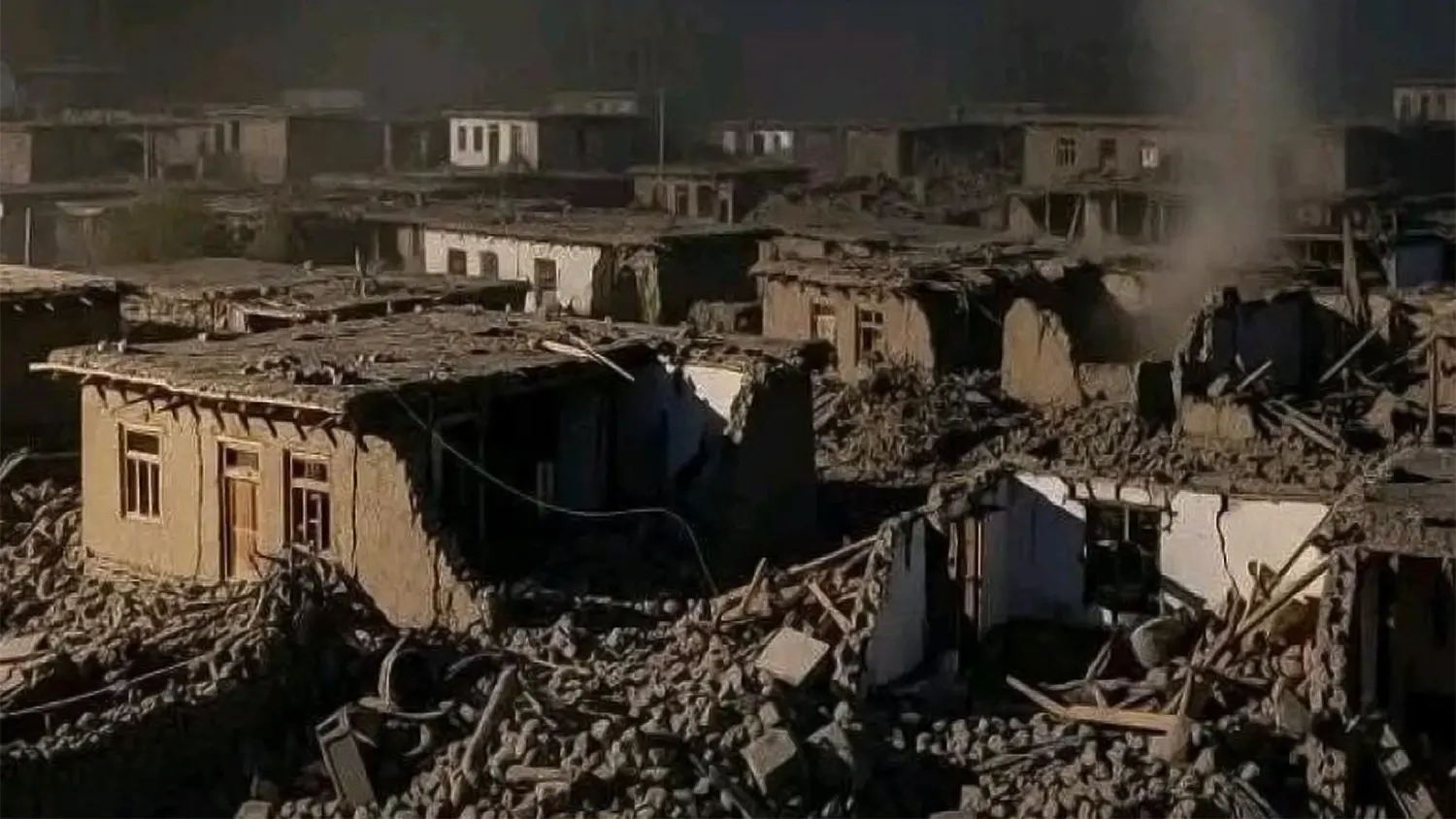
Late Tuesday night, the ground shook for just seconds and entire villages ceased to exist.
A magnitude 6.0 earthquake tore through eastern Afghanistan, collapsing thousands of mud and stone homes across the provinces of Kunar and Nangarhar, near the Pakistani border. At least 622 people are confirmed dead. More than 1,500 are injured. And with rescue teams still struggling to reach the most isolated communities, both numbers are expected to rise.
For a country already living through one of the world’s worst humanitarian crises, this is devastation layered on top of devastation.
Villages Reduced to Rubble in Seconds
The earthquake struck at a shallow depth of just 10 kilometers and that matters. Shallow quakes release their energy closer to the surface, which dramatically amplifies the destruction on the ground. In Afghanistan’s mountain communities, where homes are built from mud brick and stone with little structural reinforcement, even a moderate earthquake can be catastrophic.
That’s exactly what happened. Footage shared on social media showed flattened villages, collapsed rooftops, and residents digging through rubble with their bare hands, searching for anyone still alive.
“The world fell on us in an instant. We have lost everything,” one survivor from Nangarhar province said.
Getting Help In Is Its Own Crisis
Reaching the survivors is proving nearly as difficult as the disaster itself. The Hindu Kush mountain terrain remote, rugged, and poorly connected by road has forced authorities to rely heavily on helicopters for medical evacuations. In many areas, roads simply don’t exist or have been damaged by the quake.
Making things worse, a series of aftershocks followed the initial tremor, including one measuring 5.2 on the Richter scale. Each new shake threatens further building collapses and puts rescue teams at risk. Meanwhile, freezing nighttime temperatures have left survivors sleeping in the open, too afraid to return to damaged homes that could come down at any moment.
Afghanistan’s healthcare system already stretched beyond its limits after years of war, economic collapse, and international isolation is being pushed to the breaking point.
A Country That Was Already Drowning
It’s impossible to understand the scale of this disaster without understanding what Afghanistan was already going through before Tuesday night.
The United Nations estimated that over 23 million Afghans were dependent on humanitarian aid even before the earthquake struck. That’s more than half the country’s population relying on outside help just to eat, access basic healthcare, and survive the winter.
The Taliban government which controls the country but remains internationally unrecognized has formally appealed for international assistance, an acknowledgment that the scale of this disaster is beyond what it can handle alone.
“The Afghan people were already on the brink before this tragedy,” a UN official said. “This earthquake is a crisis layered on top of a crisis.”
Why Afghanistan Gets Hit So Hard, Every Time
This is not the first time and it won’t be the last. Afghanistan sits atop multiple active fault lines, making it one of the most seismically volatile countries in Asia. Earthquakes are not a rare event here; they are a recurring reality.
What makes each one so deadly is the combination of geology and poverty. Homes are built with whatever materials are available mud, stone, timber using methods passed down through generations, not engineered to withstand tremors. When the ground shakes, they fall. And when they fall in remote mountain communities with no nearby hospital and no paved road, people die who might otherwise have survived.
In June 2022, a 5.9 magnitude quake in Paktika province killed over 1,000 people. In 1998, major earthquakes in northern Afghanistan took more than 6,000 lives. The pattern is grimly consistent.
Aid Is Moving but the Real Test Comes Later
International relief organizations, including the UN’s OCHA and the Red Crescent Society, are mobilizing emergency supplies tents, medical kits, food rations. Neighboring Pakistan has offered condolences and logistical support. Donations are being collected by several reputable humanitarian organizations operating on the ground.
But emergency relief, as vital as it is, only addresses the first hours and days. Rebuilding entire communities homes, schools, clinics, livelihoods is a years long undertaking that requires sustained international commitment, not just an initial surge of attention.
That sustained commitment has historically been hard to secure for Afghanistan, a country that has struggled to attract consistent global support even in the best of times.
The Dust Is Still Settling
As of now, rescue teams are still working. The death toll is still climbing. Families are still waiting for news of missing relatives.
What is already clear is that eastern Afghanistan has suffered a blow it was completely unprepared to absorb not because the earthquake was unusually powerful, but because the country beneath it had almost nothing left to give before the ground started shaking.
The coming days will determine how many more lives can be saved. The coming months will determine whether the world pays attention long enough to help rebuild what was lost.