The headline sounds enormous. The U.S. Treasury, under Secretary Scott Bessent, has just ordered a sweeping directive to redirect billions in frozen and seized Iranian assets toward rebuilding war-damaged infrastructure across America’s Gulf allies Kuwait, Bahrain, the UAE, Saudi Arabia, Qatar, and Oman.
Iran’s negotiators immediately understood what that meant. Their best card at the peace table just got burned in front of them.
Iran Walked In Holding an IOU. Washington Just Tore It Up.
Days before the Treasury directive dropped, an advisor to Iran’s Supreme Leader went on CNN and made Iran’s position crystal clear: any deal to end this conflict starts with the U.S. releasing $24 billion in frozen assets. No money released, no mines cleared from the Strait of Hormuz. No money, no commercial shipping restored.
It was a sequencing demand, Iran wanted to get paid before it stopped squeezing the world’s most critical oil corridor.
Washington’s response wasn’t a counteroffer. It was a redirect. Instead of negotiating over that money, Secretary Bessent moved to spend it on the very nations Iran’s missiles had just struck.
That’s not a negotiating tactic. That’s a message.
What Actually Triggered This
The directive didn’t come out of nowhere. It directly followed a wave of Iranian ballistic missile and drone strikes on U.S. bases and Gulf partner cities. Kuwait’s military publicly confirmed engaging at least seven ballistic missiles over residential neighborhoods. Infrastructure damage across the region was significant energy facilities, maritime logistics hubs, and refinery complexes all took hits.
The International Energy Agency flagged that over 40 major energy assets across nine countries had been severely struck since the conflict erupted in February, triggering what analysts are already calling the biggest oil supply shock in modern history.
The repair bill? Energy research firm Rystad puts the five-year regional reconstruction cost at a minimum of $25 billion.
So Bessent’s team is now tasked with pulling final damage assessments from Gulf governments, with primary focus on:
- Kuwait — direct strikes on the Kuwait Petroleum Headquarters in Shuwaikh and the Al-Ahmadi refinery complex, which processes 450,000 barrels per day
- Bahrain — maritime facilities and logistics infrastructure destroyed in the recent missile barrage
- The wider Gulf Co-operation Council — including the massive Habshan gas processing facility in the UAE
The math is almost poetic in its provocation: Iran demanded $24 billion to come to the table. The repair bill is $25 billion. The U.S. is essentially saying the money was already spent by Iran’s own missiles.
The “All Available Authorities” Language Is Doing a Lot of Work
The directive instructs Treasury to evaluate “all available authorities.” That phrase is deliberately broad, and financial analysts are paying close attention to what it captures beyond the obvious.
This isn’t just frozen bank accounts. The scope expands to:
- Physical assets seized during the conflict — oil tankers intercepted by the U.S. Navy carrying sanctioned Iranian crude
- Approximately $500 million in sanctioned cryptocurrency frozen through OFAC enforcement actions
- Diplomatic properties and real estate held by sanctioned Iranian entities inside U.S. borders
The framing also significantly raises pressure on third-party allies countries like Japan, India, Qatar, and South Korea that are holding substantial frozen Iranian funds inside their own banking systems. The directive signals Washington will be coming to them next.
Here’s the Part the Headlines Are Getting Wrong
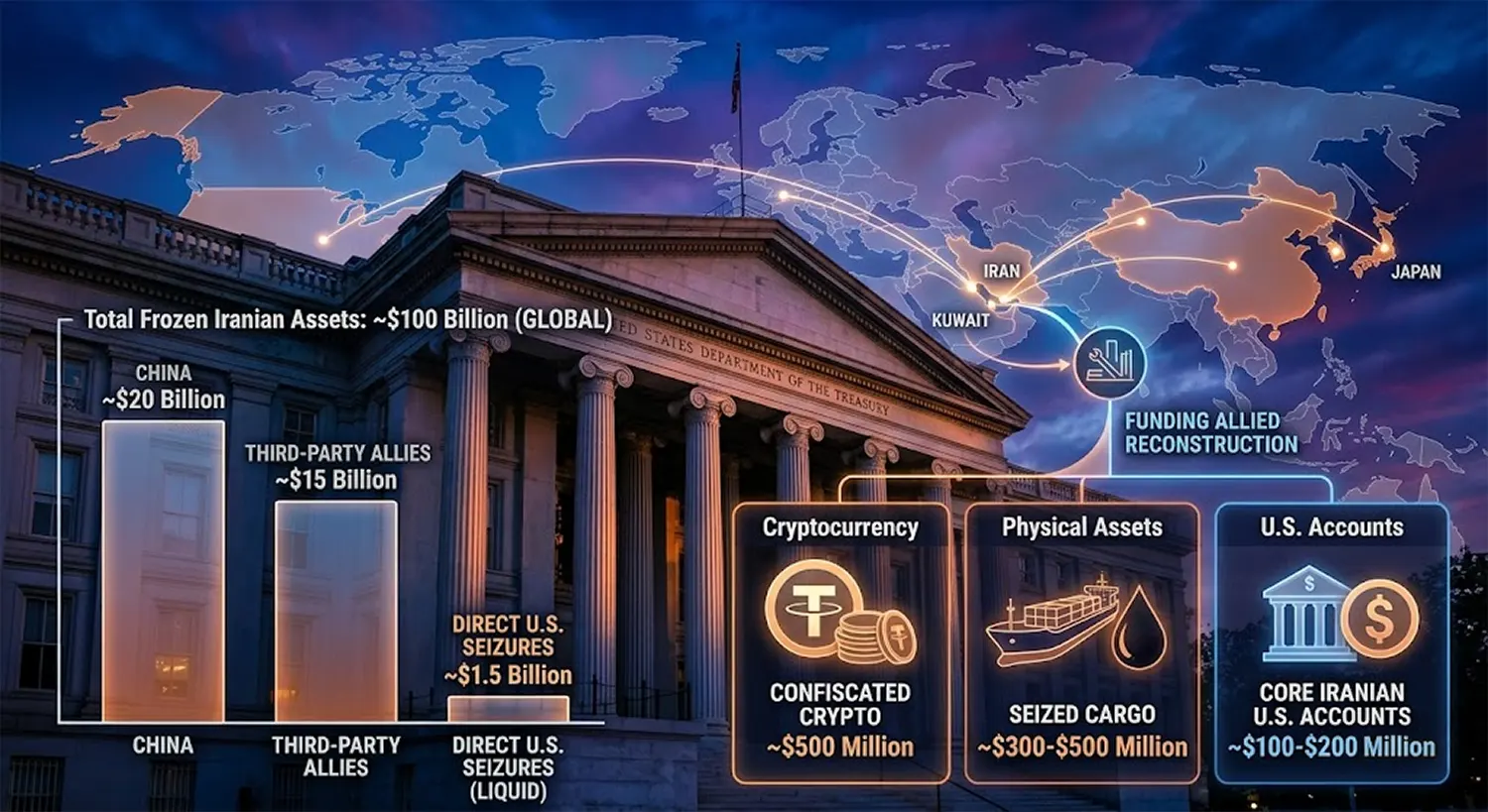
Iran supposedly has $100 billion in frozen assets globally. That number has been repeated so many times it’s started to feel like actual leverage for the U.S. side.
It isn’t. Not even close at least not immediately.
The real picture breaks down into three very different buckets, and only one of them is money Washington can actually spend right now.
The Money Washington Can Spend Tomorrow (~$1–1.5 Billion)
This is the number that actually matters for the short term, and it’s a fraction of the headline figure.
Seized cryptocurrency (~$500 million) is the most liquid pool. Under “Operation Economic Fury,” OFAC forced stablecoin issuer Tether to freeze over $344 million linked to illicit Iranian wallets, then extended enforcement to Iran’s largest crypto exchange, Nobitex, and a network of blacklisted digital wallets. This money can be converted to standard currency almost immediately.
Seized oil tankers and cargo (~$300–500 million) make up the second bucket. The U.S. has been actively intercepting Iran’s shadow fleet — vessels quietly moving sanctioned crude under falsified documentation. The recent seizure of the supertanker M/T Davina (also known as the Lenore), carrying roughly 2 million barrels of Iranian oil, is a prime example. Selling off intercepted cargo at current crude prices yields hundreds of millions that flow directly into U.S.-controlled accounts.
Core Iranian accounts inside the U.S. (~$100–200 million) round out the immediately available pile. Because the U.S. and Iran severed normal banking relations decades ago, there’s genuinely very little official Iranian state money sitting in American banks. What remains is mostly old diplomatic real estate, long-frozen legacy accounts, and property held secretly by sanctioned insiders. Real estate takes months to liquidate, so it barely qualifies as “liquid.”
Add it up honestly and Washington has about $1 billion to $1.5 billion it can actually deploy without asking anyone else for permission.
The Money That Needs a Diplomatic Fight (~$15 Billion)
Japan, South Korea, India, and various EU institutions are holding frozen Iranian funds. Because these are all U.S. allies deeply integrated into the Western financial system, Washington can lean on them hard.
But European and Asian banks are extremely cautious about the legal precedents involved in transferring sovereign assets for war reparations. Expect months of legal challenges, parliamentary debates, and stalling before a single dollar moves from Tokyo or Brussels into a Gulf reconstruction fund.
The Money Washington Will Never Touch (~$20 Billion)
About $20 billion in Iranian oil revenues sits in Chinese banks. The U.S. has zero jurisdiction over Chinese financial institutions. Beijing has no incentive to help Washington fund its Gulf allies. This money isn’t frozen in any practical sense that benefits U.S. strategy, it’s simply unreachable.
What the U.S. can do is cut off the flow of new money into those accounts. That’s precisely what the recent sanctions on the Qingdao Haiye Oil Terminal were designed to do block Chinese ports from continuing to import Iranian crude. It’s aggressive, but it starves future deposits rather than recovering existing ones.
So Why Talk About $100 Billion at All?
Because the number itself is the weapon.
When Secretary Bessent publicly frames this as redirecting $100 billion in Iranian assets, the goal isn’t accuracy, it’s psychological and diplomatic pressure. It signals to Iran that their entire global economic safety net is theoretically at risk. It signals to third-party countries holding Iranian funds that Washington expects cooperation. And it signals to Gulf allies that the U.S. is treating their reconstruction as a non-negotiable priority, not an afterthought.
The realistic outcome is something far smaller in the short run: a few billion dollars assembled from crypto seizures, intercepted oil cargoes, and whatever Qatar or Japan can be pressured into redirecting enough to demonstrate commitment and keep reconstruction moving, but nowhere near the full $25 billion repair bill.
Iran, for its part, walked into indirect peace talks mediated by Pakistan demanding money the U.S. just declared off the table. The ceasefire already fragile has taken visible strain, with continued military exchanges and drone intercepts flaring near the Strait of Hormuz even as negotiators are still technically in the room.
The $100 billion figure is largely a bluff. But a well-executed bluff, aimed directly at the one thing Iran was counting on to give it negotiating leverage.