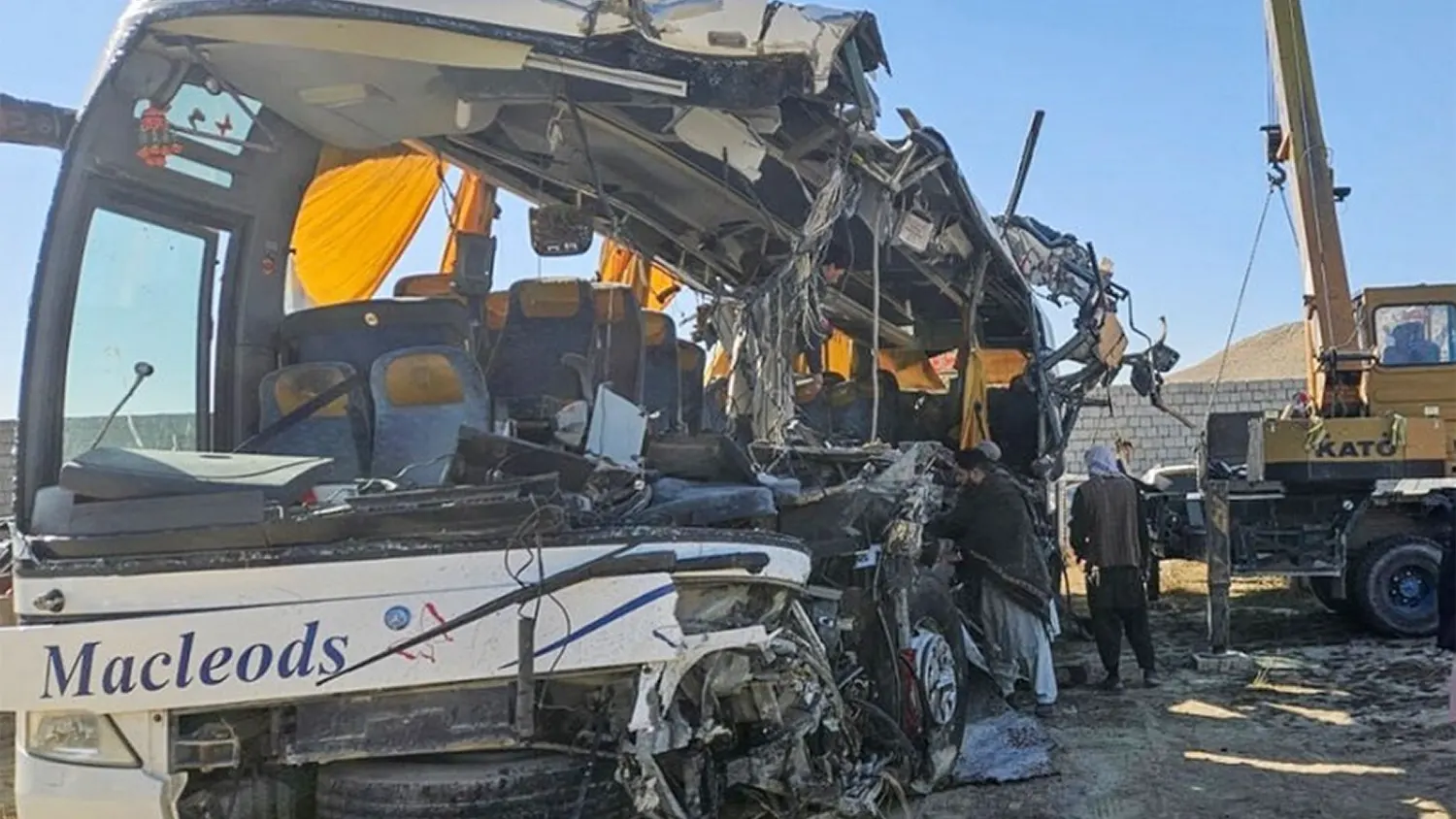
At least 76 people are dead, among them 17 children, after a bus carrying Afghan migrants freshly deported from Iran erupted in flames following a catastrophic collision on a highway in Herat province. It is being described as one of the deadliest road accidents in Afghanistan’s recent history and it did not happen in isolation.
The victims were not simply passengers on a bus. They were people who had already been uprooted once forced out of the country they had called home for years only to die on the road back to a homeland that was not ready to receive them.
How the Crash Unfolded
The tragedy struck on one of western Afghanistan’s main highways, a well worn route used by Afghans crossing back from Iran. The bus, packed with recently deported migrants, collided with a fuel truck and a motorcycle in a violent, multi vehicle impact.
The result was immediate and catastrophic. A massive fire broke out, engulfing the bus within moments. Nearly all of those on board perished. Afghan officials have attributed the crash to reckless driving and excessive speed, a grim but familiar finding in a country where road safety enforcement has effectively collapsed under years of conflict and institutional breakdown.
The scale of the loss is staggering. The scenes from Herat are a brutal reminder that in Afghanistan, danger does not end at the border.
Who Were the Victims?
Understanding this crash requires understanding who was on that bus and why.
According to the United Nations Migration Agency, more than 1.5 million Afghans have been forcibly returned from Iran and Pakistan in 2025 alone. Both neighboring countries, facing their own economic strains and political pressures, have been systematically expelling Afghan migrants many of whom have lived there for decades, raised families, and built lives far from the country of their birth.
The deportations have not been gentle. Reports from human rights organizations document harassment, abuse, and inhumane conditions during the removal process. People are stripped of the lives they built and placed on buses or trucks headed toward a border crossing and whatever lies beyond it.
What lies beyond it, for most, is an Afghanistan ill-equipped to absorb them. Crippling poverty, unemployment levels among the highest in the world, and an almost total absence of functioning social services under the Taliban administration await those who return. For the overwhelming majority, this is not a homecoming. It is a fall into uncertainty.
A Crisis Hiding in Plain Sight
The Herat bus crash has brought international attention but the underlying crisis it reflects has been building for months. Mass deportation at this scale, pushing vulnerable people into an already overstretched and destabilized nation, was always going to produce human suffering. The only question was what form that suffering would take.
On August 20th, it took the form of a burning bus on a highway in Herat, with 76 people including 17 children who never made it home.
The convergence of forced migration, crumbling infrastructure, and absent governance creates conditions where tragedies like this are not anomalies. They are, devastatingly, predictable.
The Accountability Question
Afghan officials have pointed to driver error as the cause of the crash. That may be accurate. But driver error does not exist in a vacuum. It exists within a system where road safety laws are unenforced, vehicles are poorly maintained, highways are in disrepair, and the people traveling them are among the most vulnerable on earth exhausted, displaced, and with nowhere else to go.
The neighboring governments driving the deportation policies have largely remained silent. The international community, which has largely disengaged from Afghanistan since the Taliban takeover in 2021, has offered condolences.
Condolences are not policy. And policy on deportations, on humanitarian aid, on infrastructure support is what this moment demands.
Seventy-six people boarded a bus after being told they were no longer welcome in the country they had made their home. They never arrived. The world owes them more than silence.