A leaked internal Pentagon email, first described to Reuters on April 24, 2026, has ignited one of the most serious diplomatic rifts between the United States and its European allies in the 76 year history of NATO. The document, reportedly drafted by top Pentagon policy adviser Elbridge Colby, outlines a range of punitive measures including the possible suspension of Spain from the alliance after Madrid refused to allow American forces to use its military bases or airspace for offensive operations against Iran.
The revelation has sent shockwaves through Western capitals and raised an urgent question that few thought they would ever have to answer: Can the U.S. actually remove a NATO member from the alliance? The short answer, according to legal experts and NATO officials, is no. But what Washington may lack in legal authority, it appears determined to compensate for with raw diplomatic pressure.
Why Spain said no
The roots of this standoff trace back to February 28, 2026, when the United States and Israel launched an air campaign against Iran. Spain, governed by Prime Minister Pedro Sánchez and his Socialist led coalition, immediately drew a firm line. Madrid refused to allow U.S. forces access to Naval Station Rota and Morón Air Base, two of America’s most strategically vital military installations in Southern Europe and blocked overflight rights for offensive strikes.
Sánchez’s position rests on a clear legal argument: the U.S.-Israeli operation against Iran was launched without a UN Security Council mandate, which, in Spain’s view, places it outside the boundaries of international law. Under those circumstances, Spain argues it is legally obligated not to facilitate direct military participation. It is a stance that has proved popular at home, with polls showing a domestic boost for the Prime Minister even as Washington’s frustration grows.
What the leaked Pentagon email actually proposes
The Colby email lays out several options for dealing with allies that have denied the U.S. what the Pentagon calls ABO rights, Access, Basing, and Overflight. The proposals range from symbolic to genuinely alarming:
Suspending Spain from NATO. The email acknowledges this would be largely symbolic, given that NATO’s founding treaty provides no legal mechanism for expulsion or suspension. Nevertheless, the document suggests it would send a powerful message to other wavering allies.
Removing Spanish officials from NATO leadership roles. A more immediately actionable step would be stripping Spanish officers and diplomats of prestigious positions within the alliance’s command structure, a move that could be carried out unilaterally by the U.S. and its closest partners.
The Falklands gambit. Perhaps the most eyebrow raising proposal involves the United Kingdom. The email suggests the U.S. could quietly reconsider its long standing diplomatic support for Britain’s claim to the Falkland Islands as a way to pressure European allies into compliance. The suggestion has already caused deep unease in London.
The legal reality: NATO’s “one way door”
Despite the fiery rhetoric, NATO officials were quick to clarify the legal landscape on Friday. The alliance’s founding Washington Treaty, signed in 1949, was deliberately written without any mechanism for expelling or suspending a member. This was not an oversight
it was an intentional safeguard to protect smaller nations from being bullied by more powerful ones.
How NATO membership works
Under Article 13, the only way to leave NATO is voluntarily, a member must give one year’s notice to the U.S. government (the treaty’s depositary). No member can be forced out. Any change to the rules would require a unanimous consensus vote which Spain, France, Germany, and others would almost certainly block.
This puts the U.S. in an awkward position. Unable to expel Spain formally, the Pentagon appears to be exploring a strategy of making Spain a “member in name only” freezing it out of sensitive intelligence briefings, excluding it from high level decision making, and using bilateral pressure to isolate Madrid from its allies.
The “War Department” and the paper tiger accusation
The language coming out of Washington has done little to calm nerves. Pentagon Press Secretary Kingsley Wilson declined to deny the existence of the leaked email and instead issued a statement that rattled diplomats on both sides of the Atlantic. Wilson said the “War Department” a term not officially used since 1947 is ensuring the President has “credible options” to ensure allies “do their part” and are “no longer a paper tiger.”
“The War Department will ensure that the President has credible options to ensure that our allies are no longer a paper tiger and instead do their part.” Pentagon Press Secretary Kingsley Wilson, April 24, 2026
The deliberate use of “War Department”, a phrase evoking a total war footing signals that the Trump administration views the Iran conflict not as a limited engagement, but as the defining lens through which all alliances must now be judged. Calling European allies “paper tigers” is a direct attack on their credibility, accusing them of talking tough on collective defense while refusing to provide the practical military cooperation Washington demands.
Sánchez pushes back and plays it smart
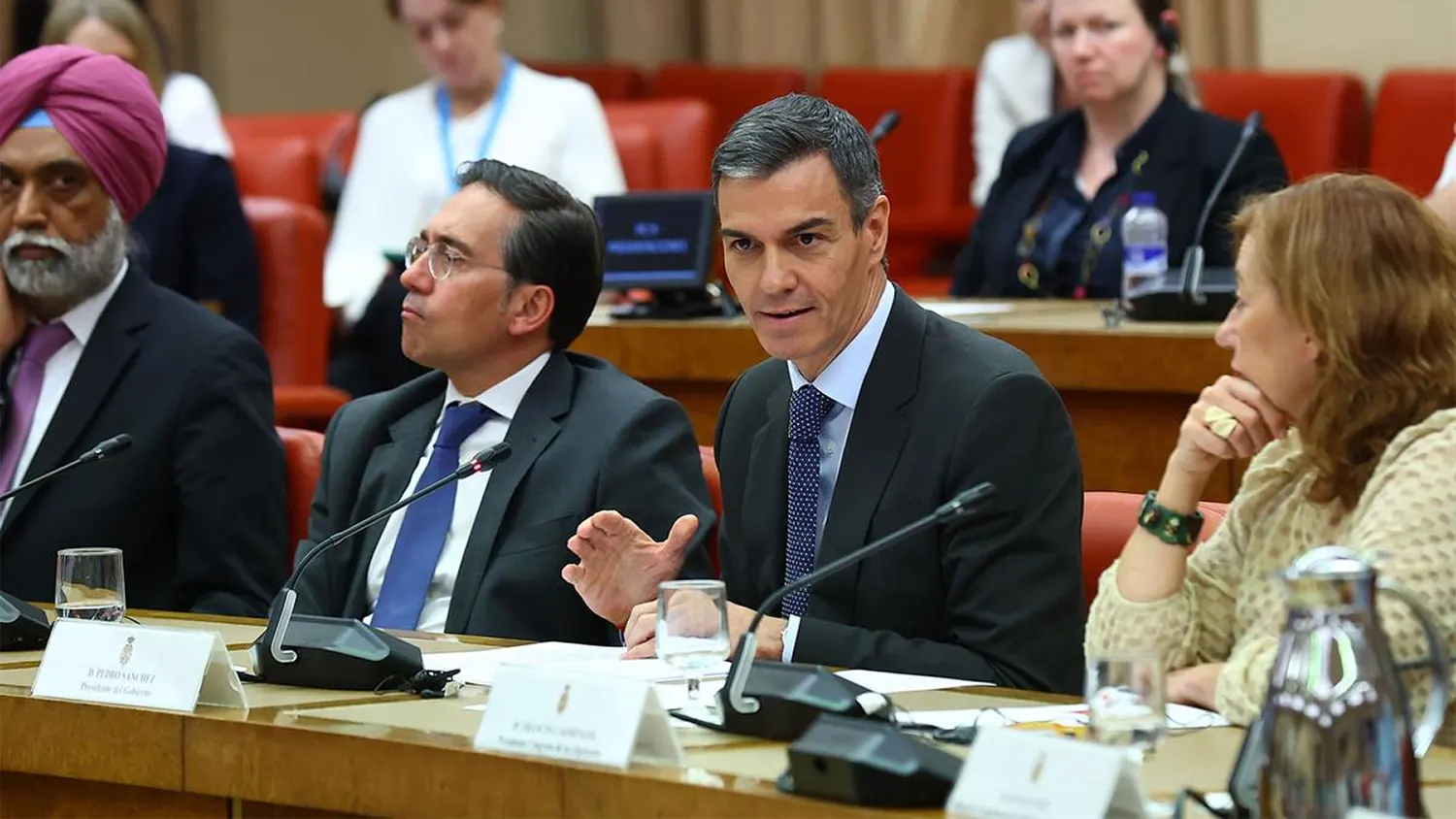
Speaking from an EU summit in Nicosia, Cyprus, Sánchez dismissed the leaked email with a phrase that has since become a rallying cry for European institutionalists: “We do not work based on emails. We work with official documents and official positions.”
It is a strategically shrewd response. By refusing to engage with the substance of a leaked, unofficial document, Sánchez forces the Trump administration into a corner: either escalate to a formal, legally binding ultimatum which would expose the U.S. to significant legal and diplomatic blowback or quietly back down.
His broader argument carries weight beyond Spain’s borders. Sánchez has repeatedly stated that international law must be applied consistently “from Ukraine to Gaza and beyond” and that NATO is a defensive alliance, not a blank check for offensive military operations in the Middle East. He insists Spain is a “reliable” NATO member precisely because it meets its spending and defense commitments, arguing that reliability does not mean subservience.
Europe closes ranks
The EU has not stayed silent. The Party of European Socialists (PES) and European Council President António Costa have both expressed full solidarity with Spain, framing the U.S. pressure not as a bilateral dispute but as a direct threat to the strategic autonomy of the entire European Union. The episode has accelerated conversations, already well underway, about reducing European dependence on American security guarantees.
A “Mediterranean Bloc” is quietly forming around Spain’s position. France and Germany are watching closely. The concern in Brussels is not just about Spain, it is about what precedent a successful American intimidation campaign would set for every other member that might one day choose to act according to its own reading of international law.
What happens next
Analysts describe this moment as a stress test for the 76 year old alliance. President Trump has separately hinted at the possibility of the U.S. withdrawing from NATO entirely if allies fail to meet his demands regarding the Iran conflict, a threat that would have been unthinkable just a decade ago.
In the near term, the most likely U.S. moves are not formal and legal but informal and punishing: intelligence blackouts, exclusion from key planning sessions, and quiet diplomatic retaliation on unrelated issues, the Falklands warning being a preview of that playbook. Whether Europe blinks or holds firm will define the shape of the transatlantic relationship for years to come.
As Sánchez put it before leaving the Cyprus summit: “We cannot play Russian roulette with the lives of millions.” The ball, for now, is firmly in Washington’s court.