The death of one of the world’s most powerful drug lords has pushed Mexico into a dangerous new phase.
On February 22, 2026, Nemesio Oseguera Cervantes better known
as El Mencho was killed during a military operation in Jalisco.
As the longtime leader of the Jalisco New Generation Cartel (CJNG),
he controlled one of the most violent and sophisticated criminal networks in the Western Hemisphere.
His death triggered an immediate wave of cartel retaliation across Mexico, including road blockades, arson attacks, and deadly ambushes against security forces.
Although the streets have since been cleared, the real crisis may only be beginning. With El Mencho gone, Mexico now faces the possibility of a cartel power struggle that could reshape the country’s criminal landscape.
The Root of the Conflict: Who Was El Mencho ?
For more than a decade, El Mencho built CJNG into one of the most feared cartels in the world.
Operating from the western state of Jalisco, the organization expanded rapidly across Mexico and into international drug markets. Its reputation for extreme violence allowed it to challenge older cartels and seize valuable trafficking routes.
Unlike many criminal groups that operate through loose alliances,
CJNG was highly centralized around El Mencho himself.
He maintained tight control over both the cartel’s finances and its paramilitary units.
Because of that structure, his death did not simply remove a leader
it removed the central pillar holding the organization together.
The Catalyst: The Operation That Killed El Mencho
The operation that ended El Mencho’s life was the result of months of intelligence coordination between Mexican and U.S. agencies.
Mexican Special Forces tracked the cartel leader to Tapalpa, a mountainous town in Jalisco. During a high risk raid on February 22,
a fierce shootout broke out.
Official records confirm that El Mencho died from multiple gunshot wounds to the chest, abdomen, and legs.
His body was later buried on March 2 in Zapopan, a suburb of Guadalajara, inside a golden casket surrounded by anonymous floral arrangements. Some displays were shaped like roosters
a reference to his nickname, “The Lord of the Roosters.”
Even in death, the message from CJNG supporters was clear:
the cartel’s legacy would not disappear quietly.
Operation “Epic Fury”: The Immediate Wave of Violence
The killing triggered what authorities called Operation Epic Fury,
a week long surge of cartel retaliation.
Across more than 20 Mexican states, cartel fighters launched coordinated attacks designed to paralyze infrastructure and spread fear.
The tactics were dramatic and highly visible:
- More than 250 roadblocks created using burning hijacked vehicles
- Gas stations, banks, and Oxxo convenience stores set on fire
- Ambushes targeting Mexican National Guard patrols
- Attacks on transportation routes and supply convoys
The violence quickly spilled into major cities and tourist destinations.
In Puerto Vallarta, one of Mexico’s most popular resort hubs, access roads were blocked by burning trucks and international flights were temporarily suspended.
Tourists were instructed to “shelter in place” while security forces attempted to restore order.
By the end of the week, more than 70 people had been killed, including at least 25 members of the National Guard.
Narco Blockades and the Message to the State
The cartel’s response was not random violence. It was strategic theater.
Arson attacks focused on symbols of state authority and commerce government banks, gas stations, and major retail chains.
By burning these targets in public view, the cartel was sending a direct message: the state could eliminate a leader, but it could not easily eliminate the system.
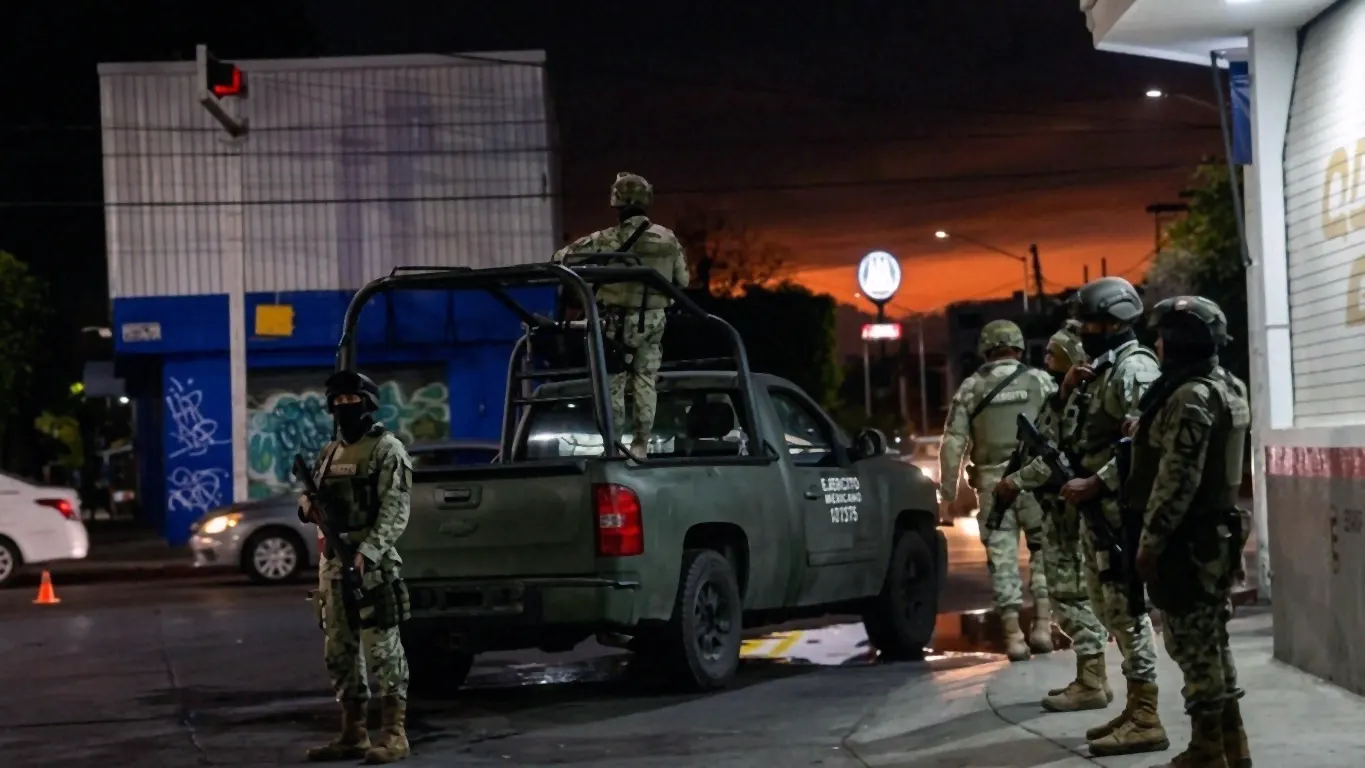
Although the Mexican military has now cleared most roadblocks,
constant patrols remain in place on federal highways, particularly across western Mexico.
The psychological impact of the attacks continues to linger.
Mexico’s Military Response: A “Fortress” Strategy
In response to the chaos, the government deployed roughly 10,000 troops across Jalisco, Michoacán, and Guanajuato.
The strategy focuses heavily on the border region where these states meet an area security officials call the “Triangle of Fire.”
Checkpoints have been established along major highways, particularly Federal Highway 15D, the key corridor connecting Mexico City to the Pacific coast.
Military commanders describe the operation as an “Iron Curtain” strategy designed to stop cartel convoys from moving weapons or fighters between regions.
For now, the presence of soldiers has restored a fragile calm.
But experts warn that troops are effectively holding a lid on a boiling pot.
The Fight for Succession: “El 03”
The most closely watched figure in the unfolding cartel drama is Juan Carlos Valencia González, known within CJNG as “El 03.”
Valencia González is the stepson of El Mencho and a senior commander tied to the cartel’s Elite Group, its heavily armed enforcement wing.
Many analysts believe he is the leading candidate to take control of the cartel.
However, his path to leadership is far from guaranteed.
Regional commanders in states like Guanajuato and Veracruz are already showing signs of independence. Some have reportedly stopped sending profits to the cartel’s central leadership.
If those factions refuse to accept a new boss, CJNG could fracture into multiple competing groups each fighting for territory and drug routes.
The “Kingpin Strategy” Debate
While the death of El Mencho is being celebrated as a major victory, many experts warn that it could actually worsen violence.
Critics say the operation follows the controversial “Kingpin Strategy”
the idea that killing cartel leaders will weaken criminal organizations.
In practice, however, history shows that decapitation strikes often create power vacuums that lead to brutal internal wars.
Analysts at organizations such as the Atlantic Council and the Washington Office on Latin America have already described the operation as a potential “Pyrrhic victory.”
Their concern is simple: removing one powerful leader may unleash several smaller but more chaotic criminal groups.
Rival Cartels Are Already Moving
The power vacuum has also attracted attention from CJNG’s biggest rival.
The Sinaloa Cartel is reportedly testing the cartel’s weakened defenses in several states, including Zacatecas and Nayarit.
Cartel scouts have been observed probing CJNG territory, searching for vulnerable routes and local allies.
If the organization fragments, Sinaloa could attempt to absorb key trafficking corridors potentially creating a new cartel superpower.
The World Cup Factor: Protecting Mexico’s Image
Another factor shaping the government’s response is the upcoming
2026 FIFA World Cup.
Mexico will host several matches, including games in Guadalajara, one of the cities most affected by recent violence.
With millions of visitors expected in June, the government faces intense pressure to restore stability.
Security officials privately describe the troop deployment as
a “domestic shield” designed to reassure the world that Mexico remains safe for international travel.
However, the heavy military presence has also created an eerie atmosphere in some areas.
Local business owners in Guadalajara and Puerto Vallarta report that tourism has sharply declined, with some districts described as
“ghost towns.”
The Growing Role of the United States
Behind the scenes, the operation that killed El Mencho relied heavily on intelligence cooperation with the United States.
The newly created Joint Interagency Task Force–Counter Cartel
(JIATF-CC), headquartered in Tucson, Arizona, provided surveillance, signals intelligence, and operational analysis.
The task force operates under United States Northern Command and includes personnel from several agencies:
- Department of Homeland Security
- Department of Justice
- U.S. intelligence community
- Military analysts and drone surveillance units
Importantly, no U.S. troops were physically present during the raid in Tapalpa.
Mexican forces carried out the operation themselves.
Washington’s “Mexico Next” Debate
Still, the situation has sparked a growing debate in Washington.
Some policymakers argue that Mexican cartels should be treated like terrorist organizations rather than criminal gangs.
If that shift occurs, the United States could legally justify direct military action against cartel targets.
This concept is increasingly discussed under the label “Mexico Next.”
Possible options include:
- Drone strikes on fentanyl laboratories
- Targeted strikes on cartel convoys
- Special forces missions to capture cartel leaders
So far, Mexico’s president, Claudia Sheinbaum, has firmly rejected any form of foreign military intervention.
But as cartel violence continues and political pressure grows in Washington, the boundary between intelligence cooperation and direct action may become increasingly blurred.
What Happens Next ?
For now, the streets of western Mexico are calmer than they were a week ago.
Roadblocks have been removed. Airports have reopened.
Troops continue patrolling the highways.
But beneath the surface, Mexico is entering a fragile and uncertain phase.
Three scenarios now dominate security analysts’ forecasts:
- A successful succession under El 03, keeping CJNG largely intact.
- A violent internal cartel war, as regional commanders fight for power.
- Territorial invasion by rival groups, particularly the Sinaloa Cartel.
Each scenario carries the risk of prolonged instability.
The Bottom Line
The death of El Mencho removed one of the most powerful figures in global organized crime.
But eliminating a kingpin does not automatically eliminate the system that sustained him.
In fact, the coming months may determine whether Mexico has weakened one cartel or inadvertently triggered a new and more chaotic phase of cartel warfare.
For now, the country’s security forces are trying to keep the lid on a volatile situation.
The real test will be whether Mexico can prevent the power vacuum from turning into another full scale cartel war.