
The European Union just handed down the largest financial penalty ever issued under the Digital Services Act, a €200 million fine against Temu, the Chinese e-commerce giant that has flooded European feeds and doorsteps with ultra-cheap goods since its explosive Western expansion. It eclipses the previous record of €120 million, which was levied against Elon Musk’s X.
But the fine is only the first move. The EU isn’t just penalizing Temu for what happened, it’s actively dismantling the economic infrastructure that made it possible.
Mystery Shoppers, Toxic Toys, and Exploding Chargers
The case didn’t start with lawyers. It started with shopping carts.
In an investigation launched in October 2024, the European Commission sent an independent testing organization on a “mystery shopping” exercise buying ordinary items off Temu and putting them through standard EU safety tests. What they found was damning.
A very high percentage of phone chargers completely failed basic electrical safety and insulation standards meaning they posed real, immediate risks of electric shock or fire to the person using them. Meanwhile, baby toys designed for infants were found to contain toxic chemicals far exceeding legal safety limits, while others had small, easily detachable parts that created severe choking hazards.
These weren’t fringe edge cases buried deep in the catalog. They were the kinds of everyday cheap items that Temu’s platform is built to surface and sell by the millions.
The Algorithm Was the Problem Not Just the Sellers
Temu’s default defense for bad products is a familiar one: blame the third-party sellers. The EU explicitly rejected that argument.
The Commission’s core finding was that Temu’s own platform mechanics actively amplified the reach of dangerous goods turning a compliance failure into a dissemination engine.
It worked in two specific ways:
First, the recommendation algorithm. Temu’s AI is optimized for one thing above all else: engagement around low prices. When a €3 unbranded phone charger gets clicks because it’s cheap, the system automatically promotes it pushing the listing into millions of users’ feeds, search results, and push notifications. Because safety checks weren’t happening before that amplification kicked in, the algorithm was effectively maximizing the visibility of hazardous products at scale.
Second, the influencer affiliate pipeline. Temu relies heavily on social media creators who run “Temu haul” content across TikTok and Instagram, driving traffic through personalized discount codes and direct product links. The problem: those links pointed directly to unvetted, high-risk items including the toxic baby toys flagged in testing. Because influencer content bypasses normal storefront browsing, it created a fast, unmonitored pipeline that delivered illegal goods straight to consumers, completely outside Temu’s internal compliance review.
The EU’s conclusion was clear: when your own systems are doing the promoting, you don’t get to blame the supplier.
“Box-Ticking” Why the Risk Assessment Failed
Under the Digital Services Act, any platform with more than 45 million monthly EU users is legally classified as a Very Large Online Platform and must actively assess and mitigate systemic risks. The EU ruled that Temu treated this obligation as a paperwork formality.
Three specific failures were cited:
- Vague, generic data — Temu’s 2024 risk assessment leaned on broad, industry-wide e-commerce statistics rather than evidence drawn from its own supply chain or consumer complaint data.
- No algorithmic accountability — The assessment made no attempt to analyze how Temu’s own recommendation systems and affiliate marketing programs were boosting the spread of non-compliant products.
- Minimized harm likelihood — The platform significantly underestimated the realistic probability of EU consumers actually encountering dangerous goods.
As Henna Virkkunen, Executive Vice-President of the European Commission, put it directly: “Risk assessments are not box-ticking exercises, they are the backbone of the DSA.”
Temu Pushes Back But the Clock Is Ticking
Temu has called the €200 million fine “disproportionate”, arguing that the ruling is based on 2024 data and doesn’t reflect the current state of its upgraded safety systems.
That argument may not matter much. The regulatory calendar is already set:
- By August 28, 2026, Temu must submit a legally binding remediation plan detailing exactly how it will overhaul platform governance.
- If that plan is deemed insufficient, the EU can impose daily fines of up to 6% of Temu’s global annual turnover an open-ended financial threat with no ceiling on cumulative damage.
- A separate, parallel investigation is still ongoing into whether Temu is actively facilitating the sale of illegal goods distinct from the risk-assessment failures that triggered this fine.
The €200 million is a record penalty. It may not be the last one.
The €3 Fee That Could Break the Business Model Entirely
While the DSA fine targets platform safety, the EU is simultaneously going after the economic engine that makes Temu’s prices possible in the first place.
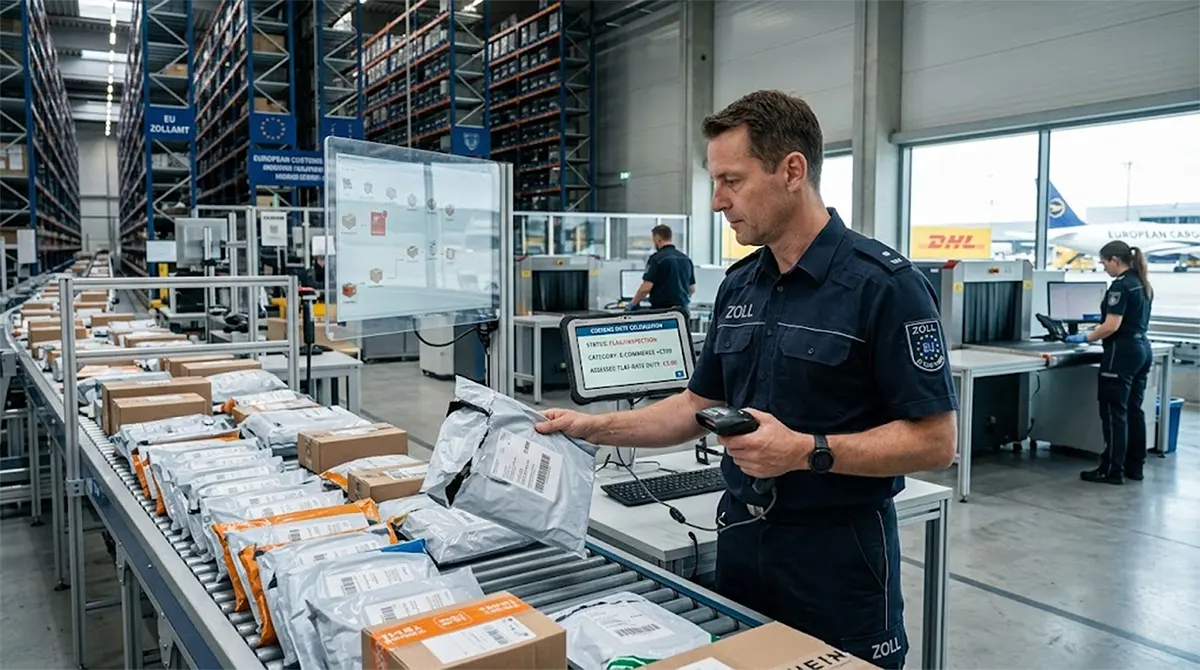
Currently, any package shipped directly from China to a European home is completely exempt from import duties if the total declared value is under €150. This loophole has been the foundation of the direct-from-factory, ship-to-doorstep model that powers Temu and Shein. In 2024 alone, roughly 4.6 billion low-value parcels entered the EU over 90% from China overwhelming customs authorities trying to screen them.
Starting July 1, 2026, that changes. The EU is introducing a flat €3 customs fee on every e-commerce package under €150 from non-EU origins. For consumers, that fee will either appear as a line-item charge at checkout or be absorbed into the item’s displayed price.
The math hits hardest at the very bottom of the price range. A €2 gadget becomes a €5 purchase. A €4 item approaches €7. The psychological pricing that makes impulse buying so frictionless on these platforms starts to break down fast.
The EU has also designed the fee to kill “package splitting” fraud where sellers deliberately divided a €300 order into three €100 shipments to stay under the duty threshold. Since the new fee applies per item category rather than per box, splitting shipments no longer saves money.
This interim €3 fee is itself just a bridge:
| Phase | Timeline | What Changes |
|---|---|---|
| Current system | Until June 30, 2026 | €0 customs duty; shoppers pay local VAT only |
| Interim phase | From July 1, 2026 | €3 flat-rate fee per item category |
| Full reform | Expected 2028 | Exemption eliminated entirely; standard percentage tariffs apply to everything |
What the EU Is Actually Trying to Do
It’s worth separating the two tracks here, because they’re often conflated.
The €200 million fine was strictly about illegal and dangerous products, phone chargers that shock, baby toys that poison. The EU doesn’t care if something costs €3 or €30. It cares whether it’s safe. Temu failed that test, and then failed to build the systems that would catch those failures before products reached consumers.
The customs reform is a separate, structural play. Its goal is to level the competitive playing field between Chinese direct-shippers and European retailers who pay full import duties, compliance costs, and logistical overhead. A local European shop importing t-shirts in bulk pays customs on every shipment. Temu was shipping millions of individual t-shirts duty-free, factory to doorstep, at a price no domestic business could match.
The EU is betting that adding friction, financial friction will gradually push consumer behavior back toward platforms and businesses operating within European regulatory and tax frameworks. Shoppers will pay slightly more in the short term. European retailers, in theory, get a fairer fight.
For Temu, the combined pressure record DSA fines, an ongoing illegal goods investigation, daily penalty exposure, and an eroding price advantage amounts to a regulatory siege on multiple fronts at once. The platform that built its identity on “shop like a billionaire” is now learning what it costs to sell in Europe.