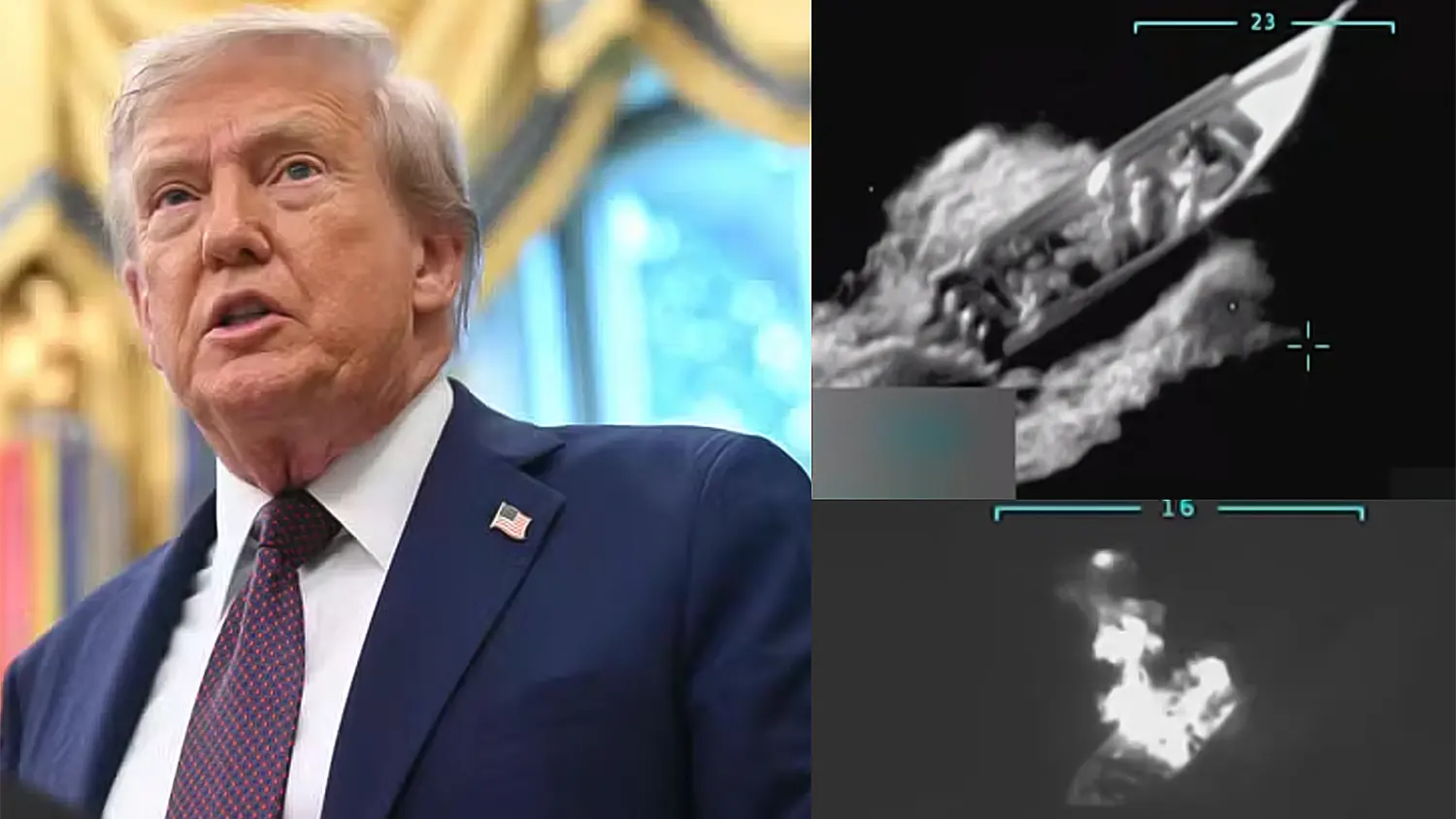
The United States just destroyed a vessel in international waters and killed 11 people aboard it. The White House calls them narcoterrorists. Critics are calling it something else entirely.
President Donald Trump announced that the US military carried out what his administration described as a “kinetic strike” on a boat in the Caribbean Sea allegedly loaded with narcotics headed for American shores. The vessel, according to the White House, was being operated by members of Tren de Aragua, a powerful Venezuelan criminal syndicate that the Trump administration has officially designated as a Foreign Terrorist Organization (FTO).
Trump posted video of the strike on Truth Social footage appearing to show a drone-fired missile hitting the boat at high speed. He followed it with a pointed statement directed not just at cartels, but at a head of state.
“We will not stand by while narco-terrorists attempt to poison our communities,” Trump said. “This is a warning to cartels, traffickers, and their enablers, including Nicolás Maduro. Your time is up.”
Who Is Tren de Aragua and What’s Their Connection to Maduro?
To understand why this strike matters beyond the immediate body count, you need to understand what Tren de Aragua actually is.
The gang didn’t start as a regional powerhouse. It grew out of Venezuela’s prison system one of the most violent and overcrowded in the world before expanding far beyond its origins. Today it operates across Venezuela, Colombia, Peru, and parts of Central America, with alleged involvement in drug trafficking, human smuggling, extortion, and arms dealing.
Trump has gone further than most, asserting that Tren de Aragua operates under the direct influence of President Nicolás Maduro’s government, a claim Caracas has consistently and forcefully denied. The FTO designation tightens that accusation into official US policy, and it puts Maduro’s government in Washington’s crosshairs in a way that goes well beyond sanctions.
Caracas didn’t take the strike quietly. Venezuelan Defense Minister Vladimir Padrino López announced the mobilization of naval and ground forces along the country’s coast and borders in response, calling the strike a “flagrant act of aggression” and an “illegal intervention in international waters.”
“The United States is manufacturing threats to justify military aggression,” Padrino López said in a televised address. “Venezuela will not tolerate violations of its maritime domain.”
This Is a Major Shift in How the US Fights Drug Trafficking
For decades, American counter-narcotics efforts in Latin America relied on a mix of intelligence sharing, sanctions, interdictions, and pressure on foreign governments. Direct lethal military strikes on drug vessels in international waters are a different category of action altogether.
The Pentagon has been quietly expanding its presence in the Caribbean in recent months, citing rising drug smuggling activity through maritime routes connected to Venezuelan and Colombian networks. The Tren de Aragua strike signals that the US is now willing to use lethal force not just surveillance or seizure as a counter-narcotics tool.
Analysts warn that this shift carries significant risks. A region already dealing with political instability, economic collapse, and mass migration doesn’t need another destabilizing force and unilateral US military action, however targeted, tends to generate exactly that.
The Legal Questions Nobody Has Fully Answered
The Trump administration insists the strike was lawful authorized under existing counterterrorism statutes and maritime law enforcement agreements. But legal scholars aren’t in agreement, and the questions they’re raising are serious ones.
Was congressional approval required? Was there sufficient international oversight? And critically who exactly were the 11 people killed?
Human rights organizations have flagged the near-total lack of transparency around the operation. No independent verification of the vessel’s cargo. No third-party confirmation of who was aboard. No clarity on whether those killed were combatants under any recognized legal definition.
“If these individuals were combatants, there needs to be clear legal justification under international law,” said Maria Dominguez, a Latin American policy analyst at the Council on Hemispheric Affairs. “But if they were not, this could set a dangerous precedent.”
The United Nations is reportedly reviewing the situation. On Capitol Hill, Republican lawmakers praised the strike as a bold move in the war on drugs, while several Democratic leaders demanded classified briefings on the intelligence and legal reasoning behind it.
What This Means for the Region and Beyond
Zoom out, and the picture gets more complicated.
Venezuela’s military mobilization in response to the strike however symbolic it may prove to be raises the temperature in a region where US-Venezuela relations are already at a historic low. Any miscalculation, any incident in those waters, could escalate quickly.
There’s also the precedent problem. If the US can strike a vessel in international waters based on its own intelligence and legal interpretation, other countries will take note including those who might apply similar logic in ways Washington wouldn’t welcome.
And domestically, the politics are straightforward: this plays well for Trump’s base. The imagery of a drone strike on a drug boat, framed as a direct blow to cartels and a warning to Maduro, hits every note of the administration’s border security and tough on crime messaging.
Whether it makes American communities safer or simply makes the conflict more dangerous and legally murky is a question that will take much longer to answer.