
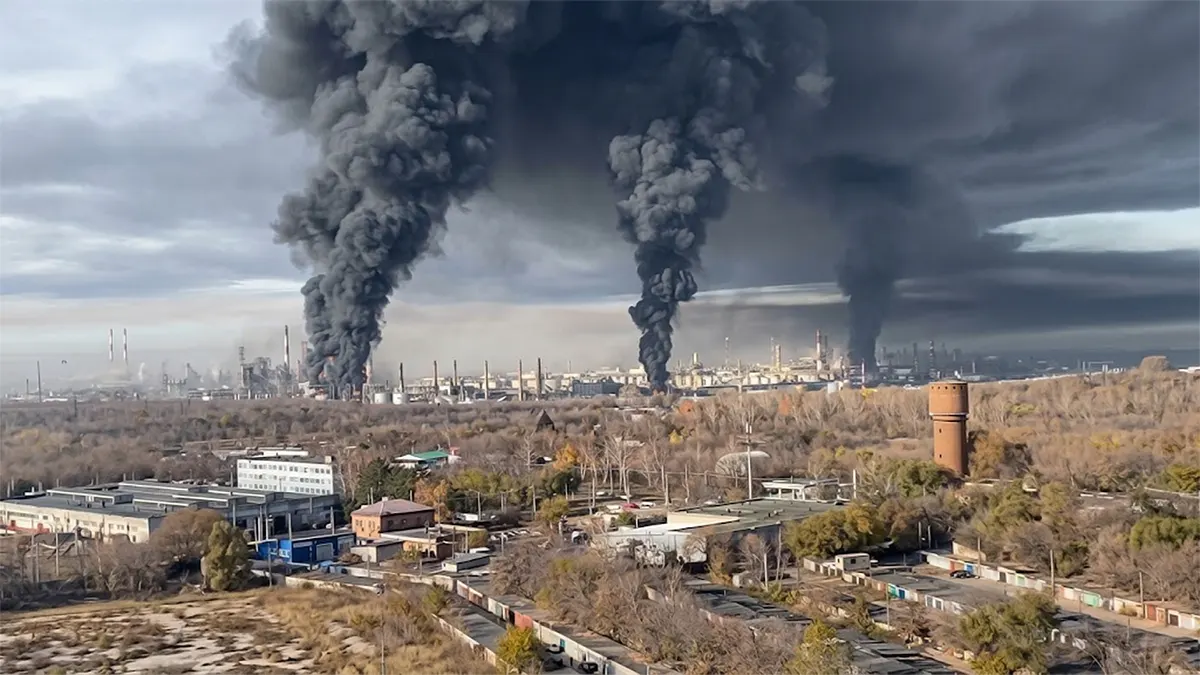
Ukrainian long-range drones struck Russia’s Novokuybyshevsk oil refinery in the Samara region overnight on October 30, 2026, as Kyiv continued its campaign against Moscow’s energy infrastructure. The attack came amid a wider wave of drone strikes across Russia that killed at least three people, including two emergency responders in Samara, according to regional authorities. The latest incident highlights growing pressure on Russia’s oil-refining industry, which has faced repeated attacks, production disruptions and domestic fuel shortages.
At a Glance
| Category | Details |
|---|---|
| Event | Drone attack on Russian oil infrastructure |
| Date | October 30, 2026 |
| Location | Novokuybyshevsk, Samara Oblast, Russia |
| Target | Novokuybyshevsk Oil Refinery |
| Operator | Rosneft |
| Annual processing capacity | Approximately 8.3–8.8 million tonnes |
| Reported casualties | At least three deaths across multiple locations |
| Wider impact | Pressure on Russian refining and fuel supplies |
| Ukrainian position | Part of a broader campaign against Russian military-related infrastructure |
Novokuybyshevsk Refinery Identified as Target of Overnight Attack
The attack took place during a large-scale drone operation against Russian territory on the night of October 29-30.
Samara regional Governor Vyacheslav Fedorishchev confirmed that Ukrainian drones had attacked the region, saying air defence systems and emergency personnel were responding to the incidents. He did not initially identify the industrial facilities involved.
However, independent Russian outlet Astra identified the Novokuybyshevsk Oil Refinery as one of the targets after examining videos and photographs circulating online. The footage reportedly showed large plumes of smoke rising from an industrial facility. The Moscow Times+2
Russia’s Deputy Prime Minister Alexander Novak subsequently confirmed that drones had targeted three oil refineries and one gas chemical complex overnight. He acknowledged that at least one facility had suffered minor damage but did not disclose the names of the affected plants. The Moscow Times
The distinction is important: although the Novokuybyshevsk refinery was identified by independent monitoring sources, Russian officials have not publicly confirmed the extent of damage specifically at that facility.
Two Emergency Responders Killed in Samara
The overnight attacks also resulted in fatalities.
According to Governor Fedorishchev, two people were killed while responding to fires at industrial facilities in the Samara region. The governor did not specify whether the victims were refinery employees or emergency service personnel from a particular facility.
A third fatality was reported in Russia’s Bryansk region, where a 19-year-old was killed in a separate airstrike.
Consequently, the reported death toll of at least three covers incidents in two different Russian regions. There is no independently confirmed breakdown establishing how many casualties occurred inside the Novokuybyshevsk refinery itself. The Moscow Times
Why the Samara Oil Refinery Cluster Matters
The Samara region is one of Russia’s important oil-processing centres. Its industrial network includes three major Rosneft facilities:
- Novokuybyshevsk Refinery: An important producer of gasoline, diesel and other petroleum products, with annual processing capacity of approximately 8.3-8.8 million tonnes.
- Kuibyshev Refinery: A major Volga-region facility with a design processing capacity of around 7 million tonnes annually.
- Syzran Refinery: Another important component of Rosneft’s regional refining network.
Together, the facilities form a significant part of Russia’s refining infrastructure in the Volga region.
The Novokuybyshevsk refinery has been targeted repeatedly. Its large processing capacity makes it strategically important to Russia’s domestic petroleum supply and industrial economy. Ukrinform+3
Why Primary Processing Units Are Important
Oil refineries depend on crude distillation units to separate raw petroleum into different components that can subsequently be processed into usable fuels.
Damage to these units can significantly reduce refinery output, particularly when fires affect essential equipment or supporting infrastructure.
Ukraine’s wider campaign has increasingly targeted both primary and secondary processing equipment. According to the International Energy Agency (IEA), damage to more complex secondary units, including catalytic crackers, hydrocrackers and hydrotreaters, can take considerably longer to repair than damage to basic crude distillation equipment.
The IEA estimates that repairs to seriously damaged secondary processing units can take an average of six to eight months. IEA
However, there is currently no verified evidence that the October 30 attack destroyed specific AVT-5, AVT-9 or AVT-11 units at Novokuybyshevsk. Those equipment-specific claims should not be attributed to this particular incident without further confirmation.
Ukraine’s Drone Campaign Has Reached a Wider Network of Russian Refineries
The Samara attack is part of a sustained Ukrainian effort to disrupt Russia’s oil-processing infrastructure.
According to the IEA’s September 2026 assessment, Ukraine’s campaign intensified significantly during the first eight months of the year, with Russian refineries struck approximately once every three days on average.
By late August, only five of Russia’s 32 major refineries remained untouched by Ukrainian drones, according to the agency.
The IEA’s refinery strike tracker subsequently recorded 28 refineries hit and 211 confirmed strikes as of October 16, 2026. The figures cover major facilities and count confirmed attacks rather than every attempted or intercepted drone operation. IEA+1
Some of the repeatedly targeted facilities include:
- Ryazan Oil Refinery, near Moscow.
- Novokuybyshevsk and Syzran refineries in Samara.
- Kuibyshev Oil Refinery in Samara.
- Lukoil-Nizhegorod refinery in Nizhny Novgorod.
- Lukoil-Volgograd refinery in Volgograd.
- Moscow Oil Refinery in the Kapotnya district.
The strategy places pressure on Russia’s ability to process crude oil domestically rather than simply disrupting its crude exports.
Russian Fuel Shortages Highlight the Economic Impact
Ukraine’s attacks have coincided with significant disruptions in Russia’s domestic fuel market.
In an assessment published on September 17, the IEA reported that Russian refinery throughput fell to approximately 3.8 million barrels per day in June 2026, around 30% below the same period a year earlier.
The agency also estimated that gasoline production had fallen 20% compared with 2025, while diesel output was down nearly 30%.
These disruptions contributed to government restrictions on petroleum exports to protect domestic supplies. IEA
The shortages became particularly visible during the summer.
In August, Reuters reported that fuel stations in Moscow had reintroduced purchase limits amid shortages and strong seasonal demand.
The restrictions varied between companies:
| Fuel retailer | Reported gasoline purchase limit |
|---|---|
| Gazprom Neft automated stations | 40 litres |
| Gazprom Neft other stations | 60 litres |
| Rosneft | 30 litres |
| Tatneft | 50 litres |
| Lukoil | Restrictions introduced; exact limit not disclosed |
Reuters also reported that Russia had restricted fuel exports, relaxed fuel quality requirements and begun importing petroleum products to strengthen domestic supplies. Reuters
Refinery Output Had Started Recovering Before the Latest Attack
Despite the pressure, Russia’s refining industry had shown signs of recovery before the October 30 incident.
Reuters reported on October 27 that Russian refineries increased crude processing by approximately 25% during the second half of October compared with the beginning of the month.
The recovery followed a reported pause in sustained Ukrainian attacks on refinery facilities after mid-October, alongside efforts by Washington to revive negotiations between Moscow and Kyiv.
Russian Deputy Prime Minister Alexander Novak also said that refineries were bringing processing units back online.
Industry sources estimated that national refining throughput had recovered to approximately five million barrels per day by the second half of October. Reuters
The October 30 attack therefore represents a renewed challenge to an industry that had begun restoring production capacity.
It remains too early to determine whether the latest strike will reverse the recovery or trigger further restrictions on domestic fuel supplies.
Moscow Faces Growing Pressure to Defend Its Energy Infrastructure
Repeated Ukrainian drone attacks have also created a significant air-defence challenge for Russia.
The country’s oil infrastructure is spread across a vast territory, making it difficult to provide comprehensive protection for every refinery, storage facility, pipeline installation and industrial complex.
The expansion of Ukraine’s long-range drone capabilities has increased the number of Russian industrial facilities potentially exposed to attacks.
The IEA documented Ukrainian strikes reaching as far as the Omsk refinery, approximately 2,500 kilometres from Ukraine’s border, illustrating the growing geographical reach of the campaign. IEA
Russia has responded by strengthening protection around strategic facilities and using air-defence systems and mobile fire groups to intercept incoming drones.
Moscow has also sought to restore damaged refining capacity, maintain domestic fuel supplies and limit the economic consequences of attacks.
However, the October 30 incident demonstrates that Russia’s energy infrastructure remains vulnerable despite these defensive measures.
A New Challenge for Russia’s Energy Sector
The attack on the Novokuybyshevsk refinery comes at a critical moment for Russia’s petroleum industry. After months of Ukrainian drone attacks, production disruptions and domestic fuel shortages, Russian refineries had begun increasing output again in October.
The latest strikes threaten to complicate that recovery, although the full extent of the damage in Samara remains unclear.
With Ukraine continuing to demonstrate the ability to reach strategic industrial facilities deep inside Russian territory, Moscow faces the challenge of protecting its energy infrastructure while maintaining the fuel supplies needed by its economy and armed forces.