
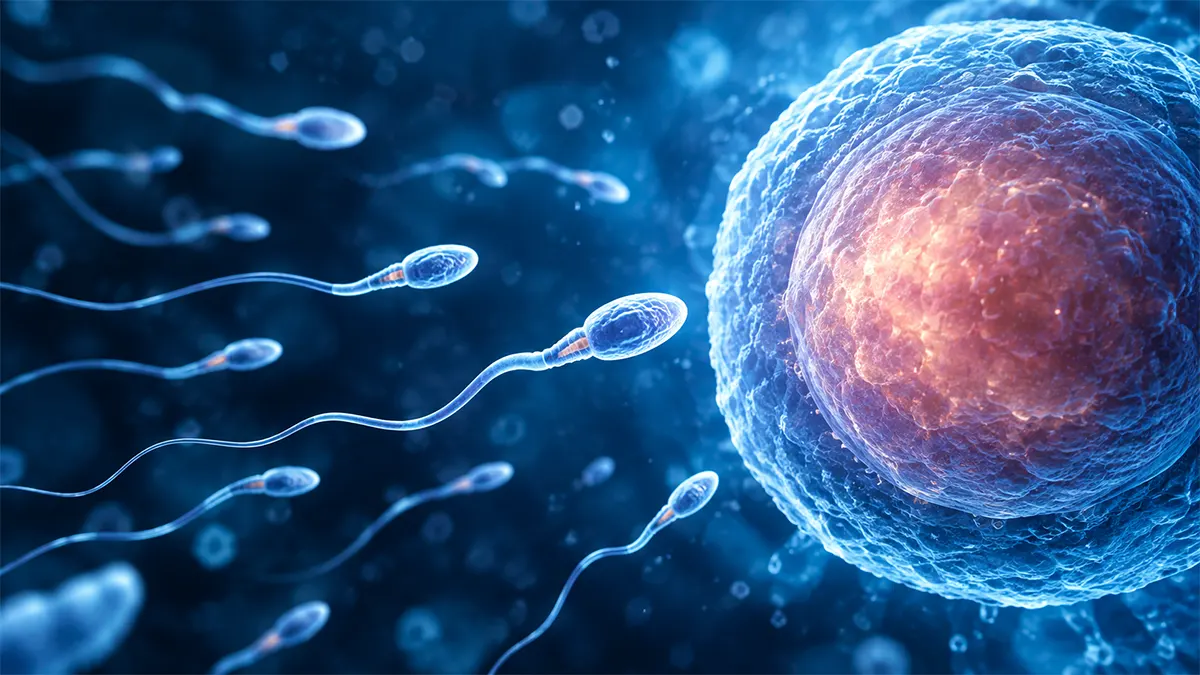
The human body is constantly producing sperm, but what happens to those cells when a man does not ejaculate for days, weeks or even months? Do they keep accumulating, eventually run out of storage space, or get recycled by the body?
The answer lies in the way the male reproductive system manages sperm production, maturation, storage and reabsorption. Contrary to some common beliefs, sperm do not accumulate indefinitely, and men do not need to ejaculate on a fixed schedule to remain healthy.
Understanding this process also helps explain why sperm counts can vary between ejaculations, what abstinence means for fertility and whether regular ejaculation offers any health benefits.
How the Body Produces Sperm Every Day
Sperm cells, also called spermatozoa, are produced in the seminiferous tubules inside the testes. This process, known as spermatogenesis, takes roughly two to three months from the early stages of development until sperm are fully formed.
Each sperm cell is specialized for reproduction. Its head contains genetic material, its midpiece contains energy-producing mitochondria, and its tail helps it move through fluid.
After leaving the testes, sperm enter the epididymis, a tightly coiled tube behind each testicle. There, they mature and develop the ability to move effectively.
The reproductive system continues producing sperm throughout adult life, although production varies with age, health, hormones and other factors.
Importantly, sperm production does not mean that every newly formed sperm immediately enters an ejaculation. Sperm move through a complex reproductive system in which maturation, storage and natural breakdown happen continuously.
What Happens If You Don’t Ejaculate?
When a man does not ejaculate, sperm remain in the reproductive tract for a time. However, the body does not store every sperm indefinitely.
Older sperm eventually lose their viability and are broken down and reabsorbed. Cells lining the epididymis help manage sperm and their breakdown products, while immune cells can also contribute to clearing cellular debris.
The body recycles components of these cells rather than allowing sperm to accumulate without limit.
This is a normal part of male reproductive physiology. It happens whether a man abstains for a short period or chooses not to ejaculate for a much longer time.
There is no single, precisely defined day when the body switches from storing sperm to recycling them. Sperm cells are at different stages of development and maturity, and their survival depends on conditions within the reproductive tract.
Do Billions of Sperm Build Up Inside the Body?
Sperm are microscopic, so it is easy to imagine that enormous numbers could be stored in a very small space. But estimating how many sperm are present at any given moment is more complicated than multiplying daily production by a supposed storage period.
The number of sperm in the reproductive tract varies between individuals and over time. It also depends on production, maturation, sperm movement and reabsorption.
For that reason, claims that every healthy man stores a particular number of billions or that the body reaches a specific storage limit after a set number of days should not be treated as universal medical facts.
The key point is that sperm do not accumulate endlessly. The reproductive system continually manages the cells being produced, matured, stored and broken down.
Nor is there evidence that a man must ejaculate to prevent his reproductive organs from becoming dangerously full.
Does the Body Reabsorb Sperm Every Day?
Yes, sperm that are not ejaculated can be broken down and reabsorbed as part of normal reproductive function. However, the exact rate varies, and it is not accurate to assume that the body always produces and reabsorbs precisely the same number of sperm every day.
The process is better understood as a changing biological balance than as a factory with an exact daily quota.
Think of it as a production line: new sperm are continually developing, some are maturing in the epididymis, and older cells are eventually cleared away. Ejaculation removes some sperm from the system, but it is not the only way the body manages them.
This turnover continues without requiring conscious action.
Can Unused Sperm Cause a “Backup” or Make the Testicles Burst?
No. Not ejaculating for weeks or months does not normally cause sperm to build up until the testes or epididymis burst.
The body has natural processes for handling sperm that are not ejaculated. Some men also experience nocturnal emissions, commonly known as wet dreams, in which semen is released during sleep. These are normal, but they do not happen to every man, and they are not a necessary way to prevent a dangerous buildup of sperm.
There is also no established rule that sperm storage becomes full after seven, 14 or 30 days, or that the body must automatically increase sperm reabsorption by a specific amount once a storage limit is reached.
Sperm production and hormonal regulation are more complex than that. The reproductive system is not a tank that inevitably overflows if it is not emptied.
What Happens to Sperm After Several Weeks Without Ejaculation?
During a period of abstinence, sperm continue to develop and mature, while older cells are gradually cleared from the reproductive tract.
The exact lifespan of an individual sperm inside the body is not defined by a universal two- or four-week deadline. Sperm development and transport take place over an extended period, and the fate of sperm already in the reproductive tract depends on their stage and local conditions.
Longer abstinence can affect a semen sample. It may increase semen volume and the total number of sperm collected in an ejaculation. At the same time, some measures of sperm quality, including motility and DNA integrity, can be affected by longer storage or abstinence.
These effects vary between individuals. It is therefore misleading to claim that sperm suddenly become unhealthy after a precise number of days.
For men undergoing fertility testing, following the laboratory’s instructions about abstinence is important because the interval since the last ejaculation can influence the results.
Why Does One Ejaculation Contain Millions of Sperm?
A single ejaculation can contain tens or hundreds of millions of sperm, although the amount varies substantially between men and between samples.
Semen is not made up entirely of sperm. Most of its volume comes from fluids produced by the seminal vesicles, prostate and other reproductive glands. These fluids help transport sperm and provide an environment that supports their function.
The number of sperm released in one ejaculation is not the same as the number produced in one day or the total number present in the reproductive tract.
This distinction explains why daily sperm production figures cannot be used to calculate exactly how many times a man can ejaculate before sperm counts decline. Ejaculation frequency, the time between ejaculations and individual reproductive function all affect the result.
What Happens If You Ejaculate Several Times in One Day?
Repeated ejaculation over a short period commonly results in a lower semen volume and a lower total sperm count in subsequent ejaculations. The reproductive system cannot instantly replace all the sperm released in each session.
However, this does not mean that a man has a fixed number of ejaculations available before his supply is exhausted. The changes depend on the individual, the interval between ejaculations and other biological factors.
Semen may still be released even when the number of sperm in a sample has fallen considerably, because much of the fluid comes from reproductive glands rather than from sperm cells themselves.
For men concerned about fertility, a semen analysis is more informative than trying to estimate sperm reserves from the number of ejaculations.
Does Abstinence Harm Sperm Health?
For most men, not ejaculating is not inherently harmful. There is no medical requirement to ejaculate daily, weekly or according to any other fixed schedule.
However, abstinence can influence semen-analysis results. The World Health Organization’s sixth edition of its semen-analysis manual, published in 2021, provides standardized procedures and reference limits for evaluating semen characteristics.
The lower reference limits include:
| Measure | WHO lower reference limit |
|---|---|
| Sperm concentration | 16 million per milliliter |
| Total sperm number per ejaculate | 39 million |
| Total sperm motility | 42% |
| Progressive motility | 30% |
| Normal sperm morphology | 4% |
These are statistical reference limits, not a simple pass-or-fail test for fertility. A man can have results above these values and still experience fertility problems, while a result below one threshold does not automatically mean he cannot father a child.
For fertility testing, clinics commonly ask patients to abstain for a specified period before providing a sample. Following those instructions helps make results more comparable.
Can Regular Ejaculation Reduce the Risk of Prostate Cancer?
Some observational studies have found an association between more frequent ejaculation and a lower risk of prostate cancer. One widely cited study published in JAMA in 2004 reported a lower risk of prostate cancer among men who reported higher ejaculation frequency in certain age groups.
However, an association does not prove that ejaculation itself prevents cancer. Other factors may contribute to the observed relationship.
The Mayo Clinic notes that there is no conclusive evidence that frequent ejaculation reduces prostate cancer risk.
Ejaculation may also provide temporary relaxation or help some people fall asleep, but these effects vary. There is no need to adopt a particular ejaculation schedule solely to gain these possible benefits.
What Lifestyle Factors Affect Sperm Quality?
Although abstinence itself is not generally harmful, several health and environmental factors can affect sperm production and quality.
Smoking and drug use: Tobacco and some recreational drugs can negatively affect reproductive health.
Alcohol consumption: Heavy alcohol use can interfere with hormonal function and may impair sperm quality.
Body weight and physical activity: Obesity and some associated metabolic problems can affect reproductive hormones and fertility. Regular moderate exercise can support overall health.
Heat exposure: Testicular function is sensitive to temperature. Frequent or prolonged exposure to high heat may affect sperm production in some circumstances.
Diet and general health: A balanced diet, adequate sleep and management of chronic health conditions support general reproductive health. No particular food or supplement guarantees improved fertility.
If pregnancy is a goal, persistent difficulties conceiving or concerns about sperm quality are reasons to seek medical advice rather than relying on lifestyle changes alone.
You Don’t Have to Ejaculate on a Schedule
When a man does not ejaculate for weeks or months, his body continues to produce and mature sperm while gradually breaking down and reabsorbing cells that are not released.
Sperm do not build up indefinitely, and there is no universal countdown after which the reproductive system becomes full or begins recycling sperm at a precisely defined rate. Wet dreams may occur, but they are not essential for maintaining reproductive health.
Regular ejaculation is a normal part of sexual activity, but abstinence is also generally safe. The best frequency depends on personal preference, comfort and reproductive goals not a supposed biological requirement to empty a sperm reservoir.
For men trying to conceive, understanding semen-analysis results and following clinical advice are more useful than relying on estimates of how many sperm are stored inside the body.