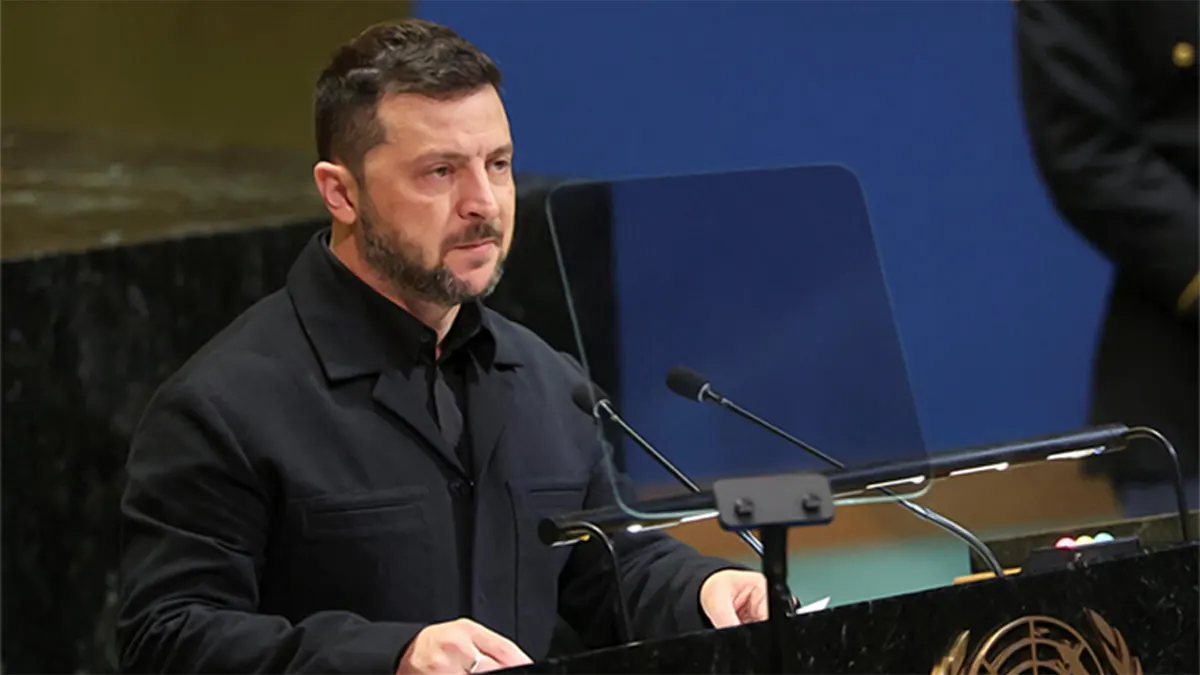
Ukrainian President Volodymyr Zelenskyy issued a serious warning at the United Nations General Assembly, saying the world may already be entering “the most destructive arms race in human history.”
But unlike past global military rivalries built around nuclear weapons, Zelenskyy said this new race is being driven by Artificial Intelligence and autonomous drones.
Speaking in New York on September 24, 2025, the Ukrainian leader warned that military AI systems are evolving at an alarming pace. He described a future where drones can independently identify targets, attack infrastructure, and even fight other drones without direct human control.
According to Zelenskyy, the technology is becoming cheaper, faster, and increasingly difficult for governments to regulate.
Why AI Weapons Are Raising Global Alarm
Security experts say autonomous weapons are especially dangerous because they can spread far more quickly than traditional military technology.
Developing nuclear weapons requires enormous industrial resources, rare materials, and years of research. AI-powered drones, however, can be built using commercially available technology and modified software.
That means not only governments, but also smaller groups and non-state actors, could potentially gain access to advanced autonomous weapons.
Experts also warn that these systems could lower the barrier to conflict. Because drones are cheaper and easier to replace than conventional military equipment, countries may become more willing to use them during regional disputes or political crises.
The Biggest Challenge Is Control
One major concern is that AI systems are extremely difficult to monitor once they are deployed.
Traditional arms control agreements relied on visible signs such as missile tests, nuclear facilities, or material stockpiles. Military AI systems operate very differently.
Software can be copied, hidden, modified, or secretly upgraded without obvious detection. This makes international inspections and enforcement much harder.
Another complication is the “dual-use” problem. Many AI technologies used in civilian industries including navigation systems, computer vision, and automation tools can also be adapted for military purposes.
Because of this overlap, experts say a total global ban on AI technology is unrealistic.
Calls Grow for “Meaningful Human Control”
International organizations and arms control groups are now pushing for stricter rules on autonomous weapons.
Several experts and humanitarian groups argue that humans must remain directly responsible for decisions involving lethal force.
The International Committee of the Red Cross has supported restrictions on weapons systems that can attack targets without what it calls “meaningful human control.”
That debate is now becoming a central issue inside the United Nations and international security discussions.
Proposed Steps to Slow the AI Weapons Race
While major military powers remain divided on the issue, policymakers are discussing several possible measures to reduce the risks of uncontrolled AI warfare.
Limiting Fully Autonomous Weapons
Some experts want an immediate ban on weapons capable of selecting and attacking targets entirely on their own.
Others support regulations that would still allow military AI systems but require direct human oversight before deadly force is used.
Tightening Export Controls
Governments are also considering stricter controls on advanced technologies linked to military AI, including specialized chips, sensors, and autonomous software systems.
The goal would be to slow the spread of weaponized AI without blocking civilian innovation.
Improving Transparency
Security analysts are calling for military AI systems to include audit trails, testing standards, and external oversight mechanisms.
These measures could help governments investigate incidents and reduce the risk of accidental escalation.
Strengthening Defensive Systems
Countries are also investing heavily in counter-drone technology and infrastructure protection.
Power grids, hospitals, communication systems, and transportation networks are increasingly seen as vulnerable targets in a future dominated by autonomous warfare.
A Turning Point for Global Security
Zelenskyy’s warning reflects growing fears that the world may be entering a new era of military competition where AI systems evolve faster than international laws can keep up.
Unlike previous arms races, autonomous weapons are developing in both military and commercial sectors at the same time, making regulation far more difficult.
Even experts who disagree on policy solutions largely agree on one point: delaying action could make the problem significantly harder to control in the future.
As governments continue investing in military AI technology, pressure is mounting for global leaders to create rules capable of preventing autonomous weapons from becoming the next major threat to international security.