As global attention shifts toward new crises in the Middle East, one question has quietly emerged in diplomatic circles: could the world’s focus on Ukraine begin to fade ?
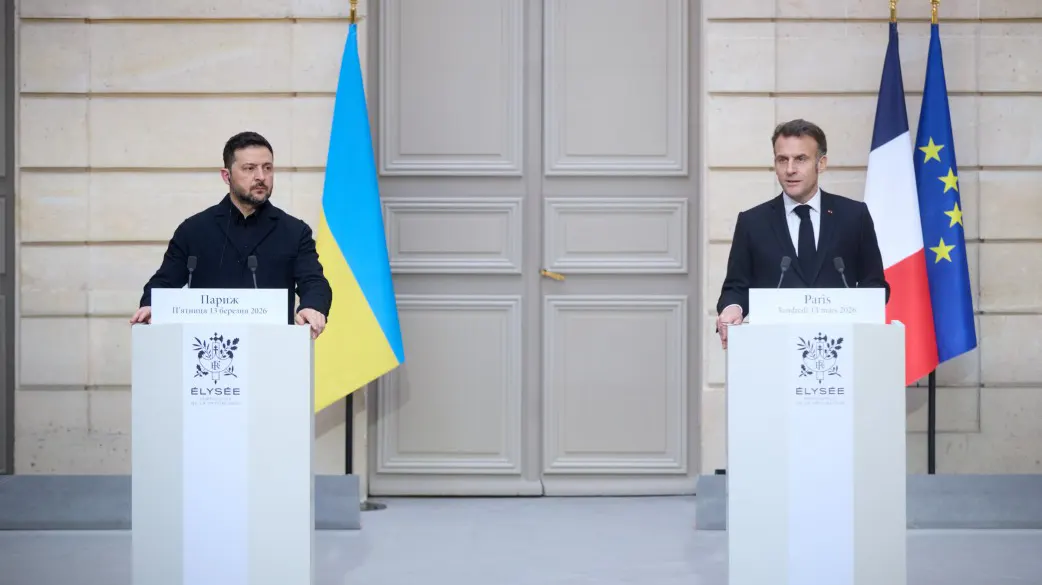
French President Emmanuel Macron and Ukrainian President Volodymyr Zelenskyy moved quickly to reject that idea during a high level meeting in Paris on March 13, 2026.
Their message was clear: Europe’s support for Ukraine remains firm, even as global security crises multiply.
The meeting addressed a range of urgent issues from military aid and sanctions policy to Ukraine’s long term future inside the European Union. But at its core, the discussions aimed to send a strategic signal to Moscow: the war in Ukraine will not be overshadowed by events elsewhere.
The Context: A War Entering Its Fifth Year
The meeting took place against the backdrop of a war that has now stretched more than four years since Russia’s full scale invasion in 2022.
Despite heavy losses on both sides, the front lines have largely stabilized. Russia still controls roughly 20% of Ukrainian territory, including large parts of eastern and southern Ukraine.
Yet the battlefield has not been static.
In recent months, Ukrainian forces have carried out localized counterattacks in western Zaporizhia and near Kupyansk, disrupting some Russian offensive operations.
These smaller scale advances have not dramatically changed the map, but they demonstrate that Kyiv still retains the ability to challenge Russian positions.
At the same time, the conflict has increasingly evolved into a war of attrition, defined by missile strikes, drone attacks, and long range bombardment.
This reality has made international military assistance and especially air defense,
one of Ukraine’s most urgent needs.
Paris Meeting Sends Message to Moscow
Against this backdrop, Macron and Zelenskyy used their Paris meeting to deliver a direct political message.
Russia, they argued, should not expect the Middle East conflict to weaken international support for Ukraine.
During a joint press conference, Macron warned that Moscow is “mistaken” if it believes global attention shifting to the Middle East will provide any strategic respite.
The statement comes as the region faces rising tensions linked to the war involving Iran and the resulting instability in the Gulf, which has disrupted global energy markets and diverted diplomatic attention.
However, Macron emphasized that France and its European partners remain focused on sustaining support for Ukraine.
European governments, he noted, have collectively provided around €200 billion in assistance to Kyiv since 2022, a figure that underscores the scale of the continent’s
long term commitment.
As a result of this continued backing, the meeting in Paris was less about announcing dramatic new policies and more about reinforcing a consistent strategic message:
Europe’s Ukraine policy will remain steady despite shifting global crises.
Sanctions Debate: Tension Over U.S. Oil Waiver
One of the most sensitive topics discussed during the meeting was the future of sanctions against Russia.
The debate was triggered by a recent U.S. decision to issue a temporary 30 day waiver allowing the sale of certain stranded Russian oil shipments. The move was designed to help stabilize global energy markets following disruptions caused by conflict in the Middle East.
President Zelenskyy openly criticized the decision.
He warned that the waiver could generate up to $10 billion in additional revenue for Russia, funds that could ultimately support Moscow’s military operations.
In unusually blunt language, Zelenskyy argued that easing sanctions even temporarily could backfire.
“Lifting sanctions only so that more drones will later be flying at you is not the right decision,” he said.
Macron, while acknowledging the limited and temporary nature of the U.S. measure, emphasized that France and its European partners remain committed to maintaining broad sanctions pressure on Russia.
The exchange highlighted an ongoing challenge for Western policymakers: balancing economic stability with the goal of limiting Russia’s ability to finance its war effort.
Military Cooperation: Ukraine’s Expertise Becomes a Strategic Asset
Beyond sanctions, one of the most significant developments discussed in Paris involved military cooperation particularly in the rapidly evolving field of drone warfare.
Over the past two years, Russia has relied heavily on Iranian designed Shahed drones, known in Russia as Geran, to conduct large scale attacks on Ukrainian cities and infrastructure.
As a result, Ukraine has gained extensive battlefield experience in countering
high volume drone attacks.
During the meeting, Zelenskyy confirmed that Ukraine is now sharing this operational knowledge with a growing list of international partners, including the United States and several countries in the Middle East and Gulf region.
More than ten countries have already requested Ukrainian assistance in building defenses against these types of low cost drone swarms.
This marks an important strategic shift.
Ukraine is no longer only a recipient of military aid, it is increasingly becoming a contributor to global security expertise.
The talks also addressed Ukraine’s urgent need for stronger air defenses. Leaders explored options for additional Franco-Italian SAMP/T missile systems and coordination with allies to supply more Patriot interceptor missiles.
However, a major challenge remains.
Global supplies of advanced interceptor missiles are limited, creating what analysts describe as a “say do gap” between political commitments and available equipment.
This shortage is one reason Ukraine has invested heavily in developing lower cost systems to intercept drones, creating layered defenses that combine advanced missiles with more affordable countermeasures.
Europe and Ukraine: The EU Membership Push
Beyond military issues, the Paris meeting also focused on Ukraine’s long term political future in Europe.
President Macron reiterated France’s support for Ukraine’s path toward membership in the European Union, arguing that Kyiv “deserves the opening of the first negotiating clusters.”
These clusters represent the first formal steps in the EU accession process, covering areas such as governance, economic policy, and legal reforms.
However, the process has not been straightforward.
Some EU member states most notably Hungary have slowed progress by raising political objections.
To address this challenge, European institutions have adopted what officials call a “frontloading” strategy.
Under this approach, Brussels provides Ukraine with the technical requirements for multiple negotiation clusters in advance, allowing reforms and preparations to move forward even before the formal political approval is granted.
This creates what analysts describe as a dual track process.
- Political Track: European leaders push for official negotiations at the European Council level.
- Technical Track: EU institutions continue preparing Ukraine for membership behind the scenes.
The strategy allows Ukraine’s integration process to continue moving forward despite political roadblocks inside the EU.
What Happens Next
As the war enters its fifth year, the broader geopolitical picture is becoming increasingly complex.
Russia continues to deepen its strategic partnership with Iran, including the production of Iranian-designed drones inside Russian territory. At the same time, Moscow has publicly called for a ceasefire in the Middle East while refusing to consider one in Ukraine.
Macron pointed to this contradiction during the Paris talks, arguing that Russia’s diplomatic messaging does not match its actions on the battlefield.
Meanwhile, global security challenges are multiplying.
Conflicts in the Middle East, tensions in Asia, and pressures on global energy markets are competing for political attention and military resources.
Yet despite these competing crises, European leaders appear determined to maintain a consistent strategy.
The meeting in Paris was designed to send a clear signal: Ukraine remains a central priority for Europe’s security policy.
The Stakes for Europe and Ukraine
Four years into the war, the conflict in Ukraine has evolved into a long term geopolitical struggle with global consequences.
Russia still controls large portions of Ukrainian territory, but Kyiv continues to resist with the help of international partners. At the same time, Ukraine is beginning to contribute its own battlefield expertise to the wider security community.
The Paris meeting between Macron and Zelenskyy reinforced a key message.
Even as new conflicts dominate headlines, Europe does not intend to step back from supporting Ukraine.
And as long as the war continues, the outcome will remain one of the defining security questions of the decade.