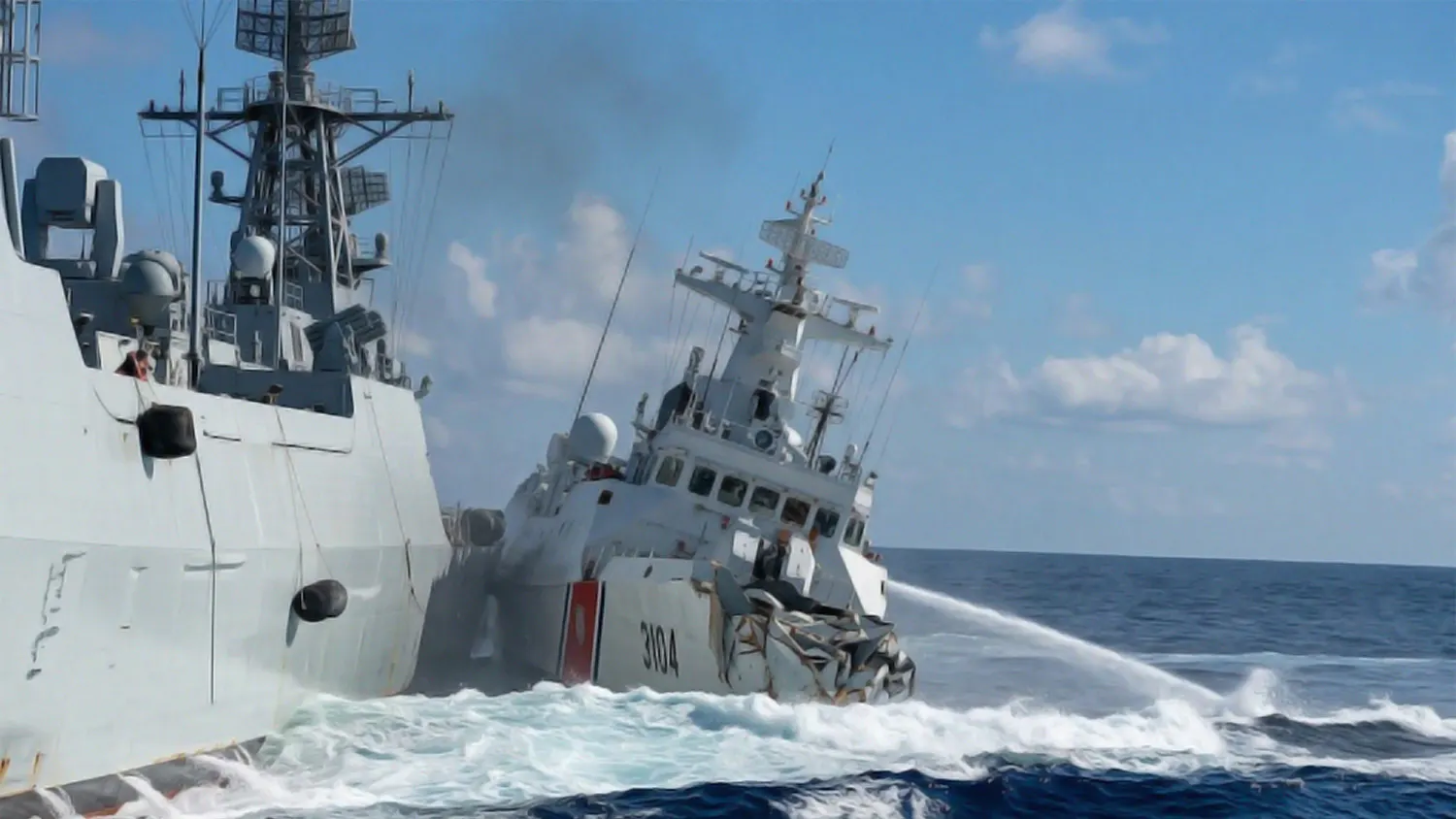
A fresh confrontation in the South China Sea has intensified tensions between China and the Philippines after vessels from both countries collided near the disputed Scarborough Shoal.
The incident, which took place on September 16, has triggered competing accusations from both governments and renewed international concern over growing instability in one of the world’s most contested maritime regions.
At least one crew member was reportedly injured, while a Philippine government vessel sustained significant damage during the encounter.
Philippine Supply Mission Ends in Chaos
The clash happened during a Philippine maritime mission aimed at assisting local fishermen operating near Scarborough Shoal.
According to Philippine authorities, the flotilla included more than 10 state vessels, among them the BRP Datu Gumbay Piang, which was delivering food, water, and fuel under the government’s “Kadiwa ng Pangulo sa Karagatan” program.
Officials said the mission was intended to support Filipino fishing communities working inside the country’s exclusive economic zone (EEZ).
However, the operation quickly escalated after Chinese vessels allegedly confronted the flotilla.
The Philippine Coast Guard accused Chinese forces of using high-powered water cannons against the BRP Datu Gumbay Piang for more than 30 minutes.
The water blasts reportedly damaged parts of the vessel’s bridge and captain’s cabin, shattered windows, and caused a short circuit that disrupted navigation systems.
One crew member was injured by flying glass during the incident.
Philippine officials also claimed a Chinese warship warned of possible live-fire exercises nearby, creating panic among civilian fishermen in the area.
“Our mission was peaceful. This was a hostile and disproportionate use of force,” a Philippine official stated.
China Rejects Allegations and Blames Manila
China strongly denied the Philippine accusations and offered a very different version of events.
In a statement, the China Coast Guard claimed that a Philippine vessel deliberately struck one of its ships during what Beijing described as a lawful maritime enforcement operation.
Chinese authorities argued that Philippine vessels had entered waters China considers part of its sovereign territory.
Beijing also released video footage that it says shows a Philippine vessel making contact with a Chinese coast guard ship, allegedly causing minor structural damage.
The Ministry of Foreign Affairs of the People’s Republic of China urged the Philippines to stop what it called “provocations” in the disputed waters.
Why Scarborough Shoal Matters
The disputed area, known internationally as Scarborough Shoal, remains one of the most sensitive flashpoints in the South China Sea.
The Philippines refers to it as Bajo de Masinloc, while China calls it Huangyan Island.
Located roughly 124 nautical miles from the Philippine island of Luzon, the shoal lies within the Philippines’ exclusive economic zone under international maritime law.
Despite its relatively small size, the area is strategically important because of:
- rich fishing grounds
- nearby shipping routes
- military positioning advantages
- regional influence in the South China Sea
In 2016, the Permanent Court of Arbitration in The Hague ruled in favor of the Philippines, rejecting China’s broad territorial claims in the South China Sea.
China refused to recognize the ruling and has continued maintaining a strong presence around the shoal using coast guard and maritime militia vessels.
International Pressure Builds Around Beijing
The latest incident has drawn reactions from several Western allies supporting Manila.
Officials from the United States, United Kingdom, Australia, and Canada released statements expressing concern over the confrontation and backing the Philippines’ maritime rights.
Marco Rubio described China’s actions as “coercive and destabilizing,” reaffirming Washington’s support for its Southeast Asian ally.
The collision also comes shortly after China declared Scarborough Shoal a “national marine reserve,” a move heavily criticized by Philippine officials who view it as part of Beijing’s broader effort to strengthen control over disputed territory.
Growing Risks in the South China Sea
The latest standoff highlights how rapidly tensions are increasing across the South China Sea.
With fishing boats, coast guard ships, and military vessels operating close to one another almost daily, analysts warn that the possibility of an accidental conflict continues to rise.
The Philippines has vowed to file another diplomatic protest and continue patrol missions in the disputed waters.
Meanwhile, China says it will strengthen maritime enforcement operations to defend what it considers its territory.
What was once largely a diplomatic dispute is increasingly becoming a dangerous contest involving military pressure, regional alliances, and strategic control of critical sea lanes.
As both sides continue to harden their positions, the South China Sea remains one of the world’s most volatile geopolitical flashpoints.