Three leaders. One military parade. A message that couldn’t have been clearer if it had been printed on a banner.
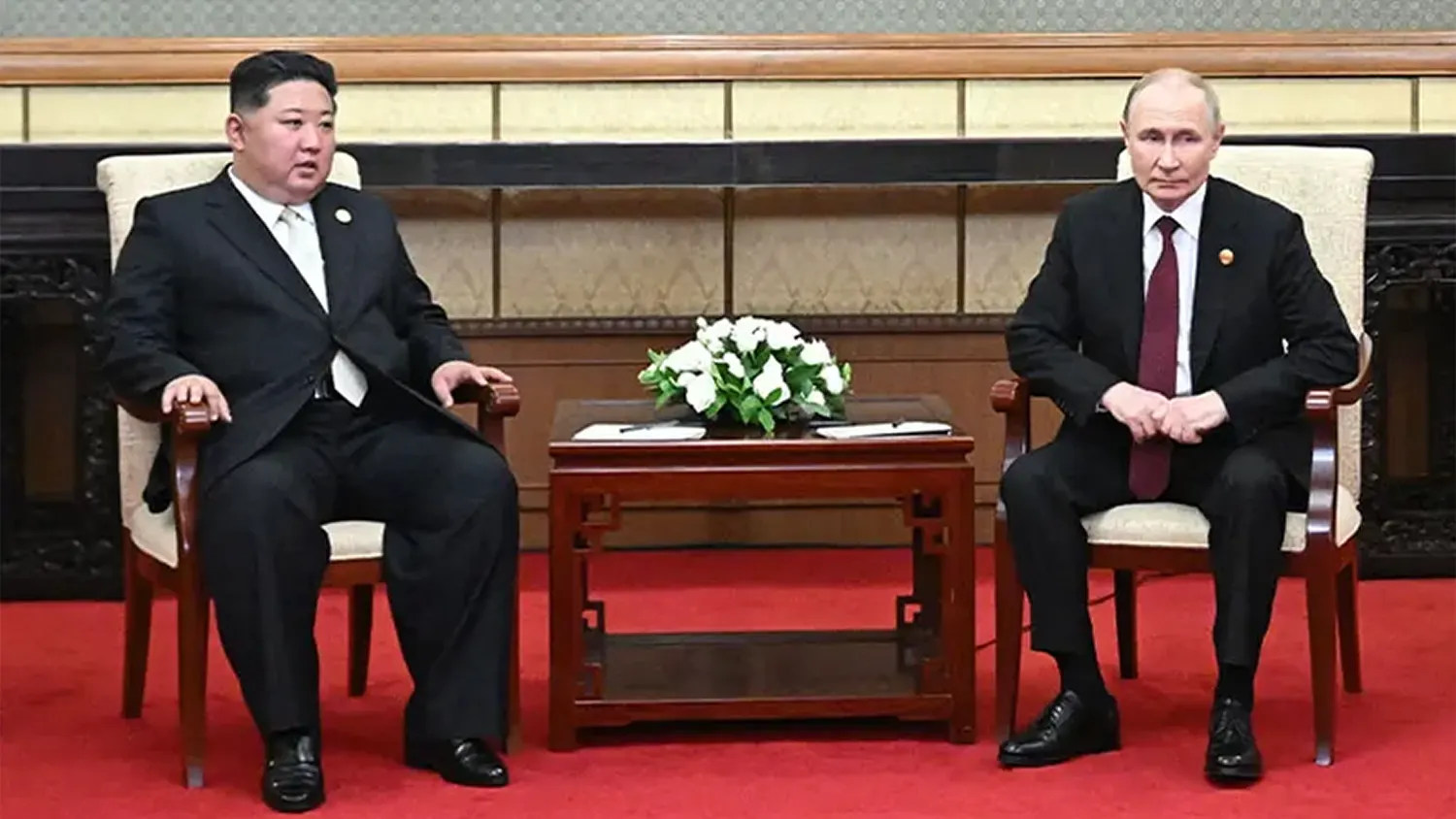
Russian President Vladimir Putin and North Korean leader Kim Jong Un met in Beijing this week for a bilateral summit that followed their joint appearance at a major Chinese military parade, the first time Kim, Putin, and Chinese President Xi Jinping have shared a multilateral stage together. For analysts tracking the shifting fault lines of global power, the optics alone were significant. The substance of what was discussed made it more so.
The meeting, held at the Diaoyutai State Guest House, produced a reaffirmation of the military and political partnership that has been quietly deepening between Moscow and Pyongyang and a very public signal that this alliance isn’t going anywhere.
Kim’s Pledge: “We Will Do Everything Possible to Help Russia”
Kim Jong Un didn’t choose ambiguous language. Standing alongside Putin, he described North Korea’s support for Russia’s war in Ukraine as a “fraternal duty” framing military cooperation not as a transaction, but as an ideological commitment between aligned powers.
The pledge builds directly on the June 2024 Strategic Partnership Pact signed by both nations, which formalized deeper cooperation across military, economic, and political lines. What was once a relationship of quiet, deniable arms transfers has now been openly declared as a full strategic alignment.
Putin, for his part, expressed gratitude for what he called “brave and heroic” North Korean troops. According to South Korean intelligence, approximately 15,000 North Korean soldiers have been deployed in support of Russian forces over the past year, alongside significant quantities of ballistic missiles, artillery, and other military equipment.
The Kremlin has stopped short of officially confirming troop numbers but Putin’s public praise of North Korean contributions during Ukraine’s cross-border offensive into Russia’s Kursk region left little room for doubt about their role.
“The valor of North Korean soldiers has not gone unnoticed,” Putin said. “We stand united in defending our sovereignty and our future.”
What China’s Role in All of This Actually Means
Beijing didn’t sign a military pact. It hosted a parade.
That distinction matters but so does what the hosting itself communicates. China has maintained its public position of not formally endorsing military involvement in Ukraine, carefully preserving its image as a neutral party. And yet, by providing the stage for this summit, by welcoming Kim and Putin into one of its most prestigious diplomatic venues, Beijing is signaling something.
At minimum, it signals tacit approval of closer cooperation among its authoritarian partners. At most, it raises the question of whether what the world is watching is the early formation of something more structured, a three-way strategic understanding between China, Russia, and North Korea that doesn’t need a formal treaty to have real consequences.
This was the first time all three leaders appeared together. That alone makes it historic. What they do next will determine whether it was also a turning point.
The Alliance That’s Reshaping the Global Map
Political analysts and military strategists have been cautious about the term “axis” its historical weight makes it easy to overuse. But the language being used now is shifting.
Increasingly, experts are describing the Russia–North Korea–China nexus as the early architecture of a counter-Western coalition, a loose but deepening alignment of powers that explicitly reject the US-led international order and are willing to back that rejection with military cooperation, economic ties, and shared political positioning.
“This is more than symbolic,” said Dr. Lina Park, a senior fellow at the Asia Security Institute. “We are witnessing the early architecture of a new geopolitical alignment one that explicitly rejects the current global order.”
The concerns this raises aren’t abstract. In Washington, Seoul, and European capitals, the fear is coordination that Russia, North Korea, and China could begin aligning their moves across multiple flashpoints simultaneously. Ukraine. Taiwan. The Korean Peninsula. Each is already a pressure point on its own. Together, they form a map of potential crises that Western governments are not fully equipped to manage all at once.
A New Cold War or Something More Unpredictable?
The Cold War had rules. Superpowers understood red lines, maintained back channels, and for all their hostility operated within a framework of mutually understood deterrence.
What’s forming now is less structured, and in some ways more dangerous for it. North Korea is a nuclear state with an unpredictable leader and an economy built around military output. Russia is a nuclear power fighting a land war in Europe with no clear exit strategy. China is a rising superpower walking a careful line between economic interdependence with the West and deepening political alignment with Moscow and Pyongyang.
The Beijing summit didn’t start a new Cold War. But it moved the pieces further along a board that is looking increasingly like one with the stakes just as high, and the guardrails considerably less reliable.
The West is watching. The question is whether watching is enough.