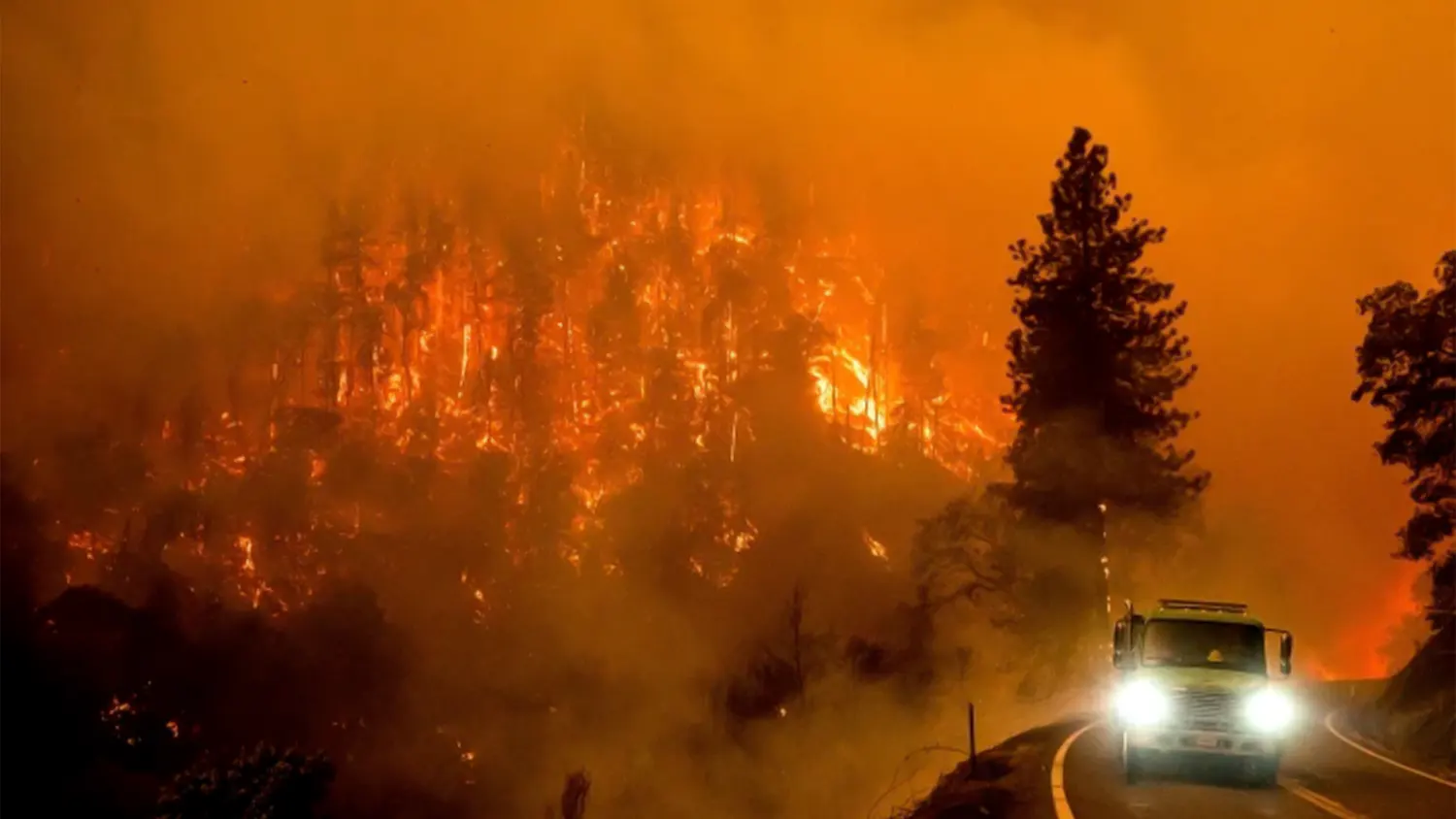
The orange skies have become familiar. So has the smell of smoke that lingers for weeks, the evacuation alerts pinging on phones in the middle of the night, and the aerial footage of hillsides consumed in minutes. But familiarity shouldn’t be confused with normalcy because what’s happening across the American West right now is anything but normal.
67 Fires, 733,000 Acres, and a Season That Never Really Ends
Right now, more than 67 large fires are burning simultaneously across the United States, tearing through over 733,000 acres of land. The raw numbers are staggering on their own. But the bigger story is the trajectory because this isn’t an anomaly. It’s a pattern that has been building for decades and accelerating with every passing year.
Two decades ago, wildfire season was a defined window, a few intense months, typically in late summer, after which things cooled down and the immediate crisis passed. That window no longer exists. Fire season now stretches across much of the year, igniting earlier in the spring and burning well into fall. In some parts of the West, fire weather has become a near year round condition.
The drivers are well documented: prolonged drought, record-breaking temperatures, and persistently low humidity have turned vast stretches of Western forest and grassland into ready fuel. What once might have been a manageable blaze now has everything it needs to become something far more dangerous fast-moving, unpredictable, and resistant to conventional containment.
The Cost Goes Far Beyond the Flames
The human experience of wildfire is hard to put into numbers. The psychological weight of evacuation grabbing what you can and leaving everything else behind doesn’t show up in budget reports. Neither does the particular grief of returning to a foundation where a home used to stand.
But the economic damage is massive and measurable, and it extends well beyond the fires themselves.
California’s TCU September Lightning Complex alone has destroyed over 94 structures and that’s just one fire among dozens. Across the West, the destruction of homes and buildings represents only the most visible slice of the financial toll. Wildfires disrupt tourism, devastate agriculture impacting everything from grape harvests to timber production and send insurance premiums spiraling in ways that are forcing homeowners into impossible choices about whether they can afford to stay in the communities they’ve lived in for years.
The long tail of wildfire damage is often overlooked too. Soil erosion, watershed contamination, and land rehabilitation can take decades and cost billions long after the news cameras have moved on.
Federal, state, and local governments are spending billions annually just on firefighting operations. And that number keeps climbing.
20,000 Firefighters and Still Not Enough
The scale of the current response is extraordinary. More than 20,000 firefighters are currently deployed across the country hotshot crews pushing into the most dangerous terrain on foot, smokejumpers dropping into remote areas inaccessible by road, engine teams defending structures on the perimeter, and air tankers laying down retardant lines across ridge after ridge.
Bulldozers are carving firebreaks around the clock, racing to get ahead of fire behavior that shifts with every change in wind.
And yet, the pressure has grown large enough that no single state can absorb it alone. California has formalized a fire compact with other Western states and Canadian provinces a resource-sharing agreement that acknowledges what firefighters on the ground have known for years: this is a regional crisis that demands a regional response.
Why “Fight Every Fire” No Longer Works
For most of the 20th century, the dominant philosophy in American wildland fire management was simple: suppress every fire, as fast as possible. It seemed logical. Fires are destructive, so stopping them protects people and land.
The problem is that this approach, applied for decades across millions of acres, created a massive unintended consequence. By eliminating the low-intensity fires that naturally cleared undergrowth, land managers allowed fuel to accumulate on an enormous scale. When fires do ignite now as they inevitably do, they have vastly more material to consume, making them hotter, faster, and far harder to control.
Experts have largely moved away from pure suppression as a strategy. The emerging consensus centers on proactive, long-term resilience built around three core approaches.
Prescribed burns — intentionally setting controlled fires under carefully managed conditions clear out the accumulated undergrowth that turns ordinary fires into catastrophic ones. It’s a practice with deep roots in Indigenous land stewardship that Western fire management largely abandoned and is now urgently trying to revive.
Mechanical thinning and forest restoration work alongside prescribed burns, using equipment to remove excess vegetation and replant with species better suited to fire-resilient landscapes. Combined with community education programs, the goal is to reshape not just the forests but how people live within them.
At the household level, creating defensible space — clearing vegetation around homes, using fire-resistant building materials, and having practiced evacuation plans has proven to make a measurable difference in whether a structure survives when fire reaches a neighborhood.
The West Is Adapting — But the Clock Is Running
None of this is easy, and none of it is fast. Prescribed burn programs face regulatory hurdles, liability concerns, and public skepticism. Reorienting decades of land management policy takes political will that has historically been difficult to sustain between fire seasons. And communities that have just survived one disaster aren’t always in a position to immediately start preparing for the next one.
But the alternative continuing to fight fires reactively while conditions keep deteriorating is no longer a real option. The math doesn’t work. The resources aren’t infinite. And the climate trajectory isn’t reversing on a timeline that allows for delay.
What’s happening in California, Montana, and across the West isn’t just a bad season. It’s the result of a warming world intersecting with decades of accumulated fuel, inadequate preparation, and the limits of a suppression-first mindset. The orange skies are a consequence and a warning.
The firefighters holding the line right now are doing extraordinary work under extraordinary pressure. But the longer-term fight, the one that determines whether future seasons look like this one or something worse will be won or lost not on the fireground, but in the policy decisions, land management choices, and community preparations made in the months and years between fires.
That fight is just getting started.