
Artificial intelligence is accelerating workforce restructuring across major industries, with recent data linking thousands of job cuts to AI driven automation and efficiency shifts.
At the same time, companies are increasingly adopting AI tools to streamline operations, raising urgent questions about job security, productivity, and the future structure of employment.
AI Job Cuts Are No Longer Theoretical
Recent labor data shows the scale of disruption is already visible in the economy. Reports from Challenger, Gray & Christmas indicate that companies in the United States are increasingly attributing layoffs to AI integration and automation strategies.
In one month alone, more than 10,000 private sector jobs were cut due to AI related restructuring, bringing total AI linked job losses since 2023 to over 27,000 positions.
But the real shift came when these cuts began appearing not as isolated cases, but as part of a broader corporate strategy to redesign entire workflows around automation.
Why Big Tech Is Cutting Jobs While Investing in AI
The technology sector illustrates the paradox most clearly.
Companies such as Microsoft have implemented large scale layoffs while simultaneously increasing investment in AI infrastructure, signaling a strategic shift in priorities.
What makes this even more significant is the reasoning behind it. Leadership teams increasingly describe these cuts as a way to reallocate resources toward AI driven productivity systems, rather than traditional labor heavy operations.
This raises a second question: which roles are most exposed to this transition?
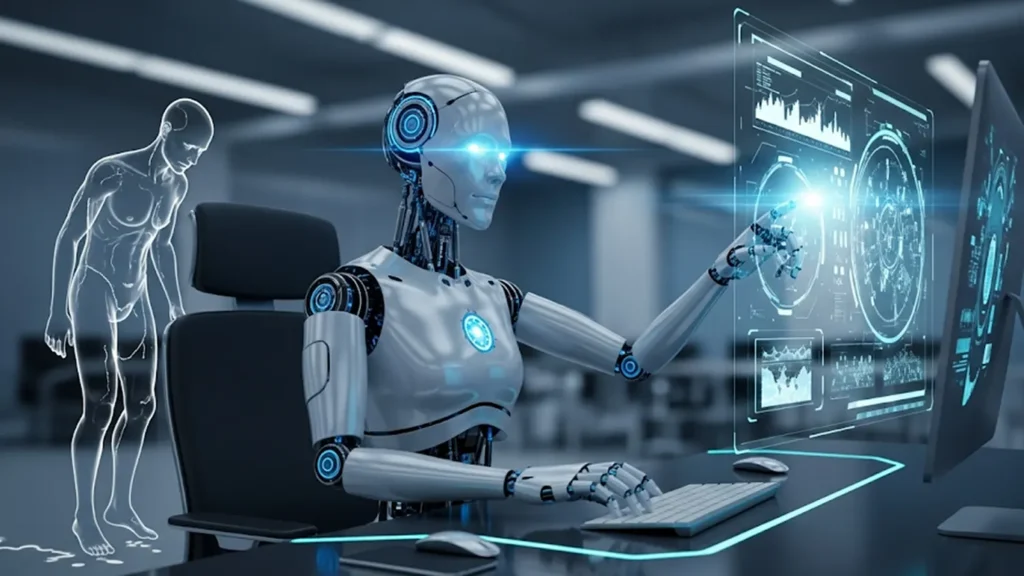
The Jobs Most at Risk in an AI Driven Economy
Research, including analysis from Microsoft, suggests that information based “desk jobs” are most vulnerable to automation.
Roles involving writing, translation, customer support, and sales communication are increasingly exposed because they rely heavily on tasks that AI systems can now replicate or accelerate.
Conversely, jobs requiring physical labor and manual dexterity, such as machinery operation or maintenance work, remain less immediately affected.
However, the shift is not always direct. In many cases, companies are choosing to freeze hiring and substitute AI tools instead of expanding teams, quietly reshaping workforce demand even without formal layoffs.
Automation vs. Augmentation: Two Competing Futures
Not all industry leaders agree on a purely replacement driven narrative.
Some executives, including Salesforce CEO Marc Benioff, argue that AI will function more as a tool for human augmentation rather than full automation.
In this view, AI handles repetitive or data-heavy tasks while humans focus on strategic decision making, creativity, and oversight especially given concerns about AI accuracy and reliability.
But this optimistic framing still coexists with an uncomfortable reality: even augmentation can lead to smaller teams and reduced hiring demand.
A Labor Market in Transition, Not Collapse
Despite concerns about displacement, some analysts point to a more complex outcome.
AI is not only eliminating roles, it is also reshaping demand in unexpected ways. In certain sectors, companies report rising wages for AI adjacent skills, particularly where human expertise is combined with machine efficiency.
This suggests a broader shift toward a rebalanced labor market, where value concentrates around workers who can effectively collaborate with AI systems.
The New Skills Defining Workforce Survival
As automation expands, the most valuable skills are shifting away from routine execution toward higher order capabilities.
Skills such as critical thinking, creativity, emotional intelligence, and complex problem solving are becoming central to long term employability.
What makes this even more urgent is the speed of change. Unlike previous industrial transitions, AI adoption is unfolding at a rapid, system wide scale, leaving little time for gradual adjustment.
A Workforce Being Redefined in Real Time
The rise of AI marks a structural transformation of work itself, not just a technological upgrade.
The key question is no longer whether AI will affect employment but how societies, companies, and workers will adapt to a system where automation is embedded in everyday operations.
As the transition accelerates, the future of work will likely be defined by a hybrid reality: one where human capability and artificial intelligence operate side by side, reshaping what productivity, value, and employment actually mean.