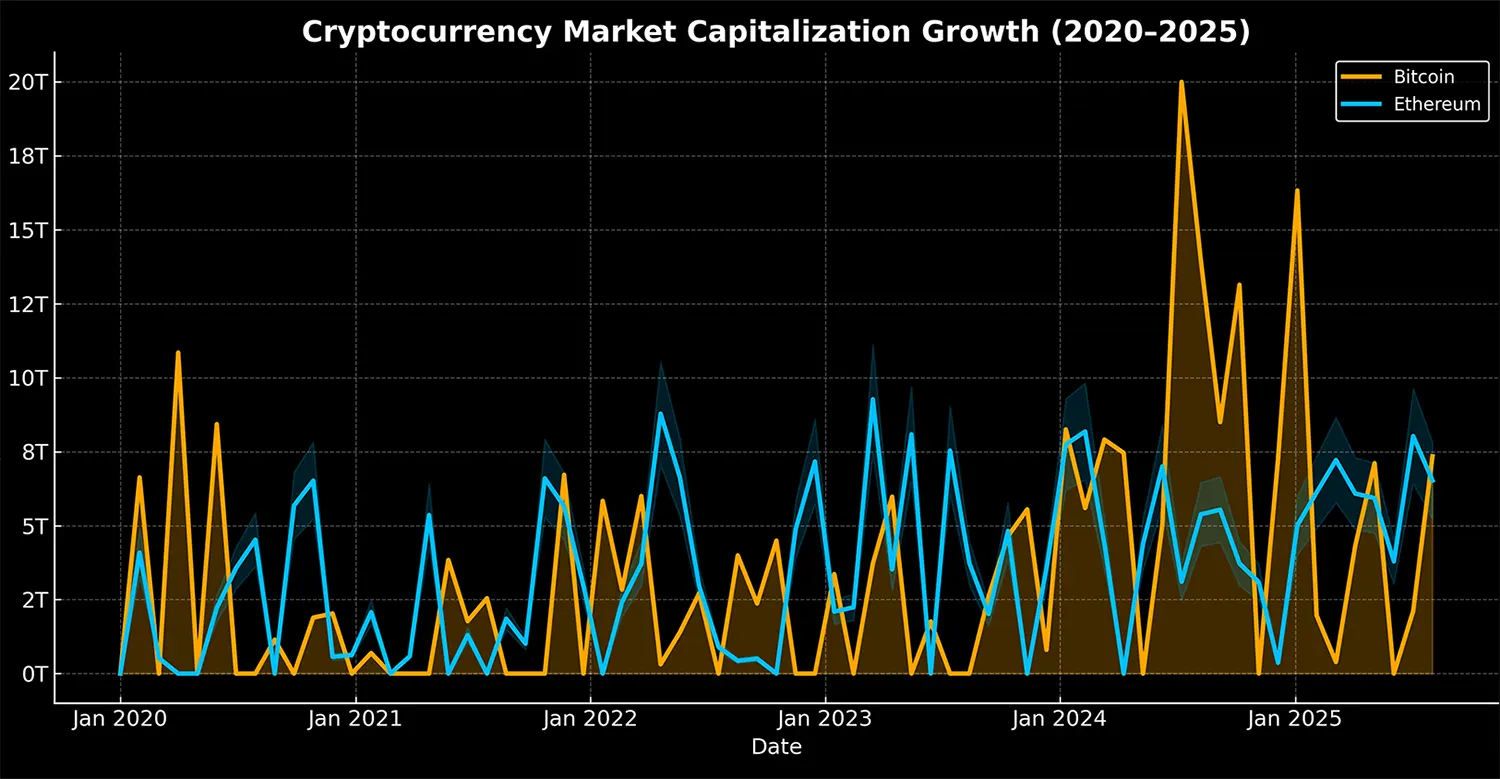
The global cryptocurrency market has crossed a historic milestone, with total market capitalization climbing above $4 trillion for the first time since the last major bull cycle.
Unlike previous rallies driven mostly by speculation, analysts say the current surge is being fueled by a combination of stronger institutional participation, improving economic conditions, clearer regulations, and growing real-world blockchain adoption.
From Bitcoin reaching new highs to expanding interest in stablecoins and decentralized finance, the crypto industry is entering a new phase of growth that many investors believe could reshape global finance.
Bitcoin Continues Leading the Market
Bitcoin remains the dominant force in the crypto market.
As of mid-September 2025, Bitcoin’s market capitalization has risen to roughly $2.3 trillion, with the asset trading near $116,000.
The cryptocurrency continues attracting investors looking for:
- long-term value storage
- inflation protection
- portfolio diversification
- exposure to digital assets
Despite increasing competition from alternative cryptocurrencies, Bitcoin still acts as the foundation of the broader crypto market.
Ethereum and Altcoins Gain Momentum
While Bitcoin remains the market leader, several major altcoins are also driving the rally.
Ethereum has seen strong growth thanks to increasing adoption in:
- decentralized finance (DeFi)
- tokenization projects
- smart contracts
- blockchain infrastructure
Ethereum’s market value has climbed to around $550 billion, helped further by growing inflows into Ethereum exchange-traded funds (ETFs).
Meanwhile, Solana continues attracting developers and investors due to its fast transaction speeds and lower costs, especially in gaming and decentralized application ecosystems.
XRP has also gained momentum as financial institutions expand cross-border payment partnerships using blockchain technology.
Other major digital assets, including BNB and stablecoins such as Tether, remain key parts of the growing crypto economy.
Interest Rate Expectations Are Fueling Risk Assets
One major reason behind the market rally is changing economic policy.
After years of aggressive interest rate hikes, investors now expect central banks, especially the Federal Reserve System, to begin lowering interest rates again.
Lower interest rates generally increase demand for higher-risk assets like cryptocurrencies because borrowing becomes cheaper and liquidity improves across financial markets.
As inflation cools and economic growth slows, many institutional investors are shifting more capital into digital assets in anticipation of a more favorable monetary environment.
Institutional Investors Are Entering the Market
The crypto market is also benefiting from rising institutional involvement.
The approval of spot Bitcoin and Ethereum ETFs in several major financial markets has made it easier for pension funds, asset managers, and traditional investors to gain exposure to crypto through regulated investment products.
Analysts estimate that billions of dollars have already flowed into these ETFs in 2025 alone.
This institutional participation is helping give the crypto market greater legitimacy and stability compared to earlier cycles dominated mainly by retail speculation.
Regulation Is Becoming Clearer
Regulatory clarity is another factor boosting investor confidence.
Governments and lawmakers in several countries have introduced frameworks aimed at defining how cryptocurrencies, exchanges, and stablecoins should operate.
One major development has been the passage of the GENIUS Act, legislation designed to establish clearer rules for stablecoins, digital asset custodians, and crypto exchanges.
For many large financial firms, this clarity reduces uncertainty and lowers the risk of sudden policy changes that previously discouraged investment in the sector.
Stablecoins Are Becoming More Important
Stablecoins continue playing a critical role in the crypto ecosystem.
Assets like USDT and USDC help investors move money quickly between traditional finance and crypto markets while maintaining price stability tied to fiat currencies.
The stablecoin sector now holds more than $170 billion in liquidity, supporting:
- crypto trading
- remittances
- decentralized finance
- international payments
As stablecoins become more integrated into traditional banking and payment systems, analysts believe they could become one of the most important pillars of the digital asset economy.
Risks Still Loom Over the Market
Despite the strong rally, the crypto market remains highly volatile.
Several risks could slow momentum or trigger major corrections, including:
- unexpected inflation increases
- delays in interest rate cuts
- stricter government regulations
- geopolitical instability
- cybersecurity breaches and hacks
Some analysts also warn that certain altcoins may be overheating after posting rapid gains in a short period.
Because crypto markets remain heavily influenced by investor sentiment, sharp price swings are still likely even during bullish periods.
The Crypto Industry Enters a New Era
Crossing the $4 trillion mark highlights how much the cryptocurrency industry has evolved over the past decade.
What was once viewed as a niche and speculative market is now increasingly connected to mainstream finance, institutional investment, and global payment systems.
While uncertainty and volatility remain part of the crypto landscape, many investors believe the industry is entering a more mature phase driven by infrastructure, regulation, and long-term adoption rather than hype alone.
Whether the rally continues may depend largely on economic policy, investor confidence, and how governments choose to regulate digital assets in the years ahead.