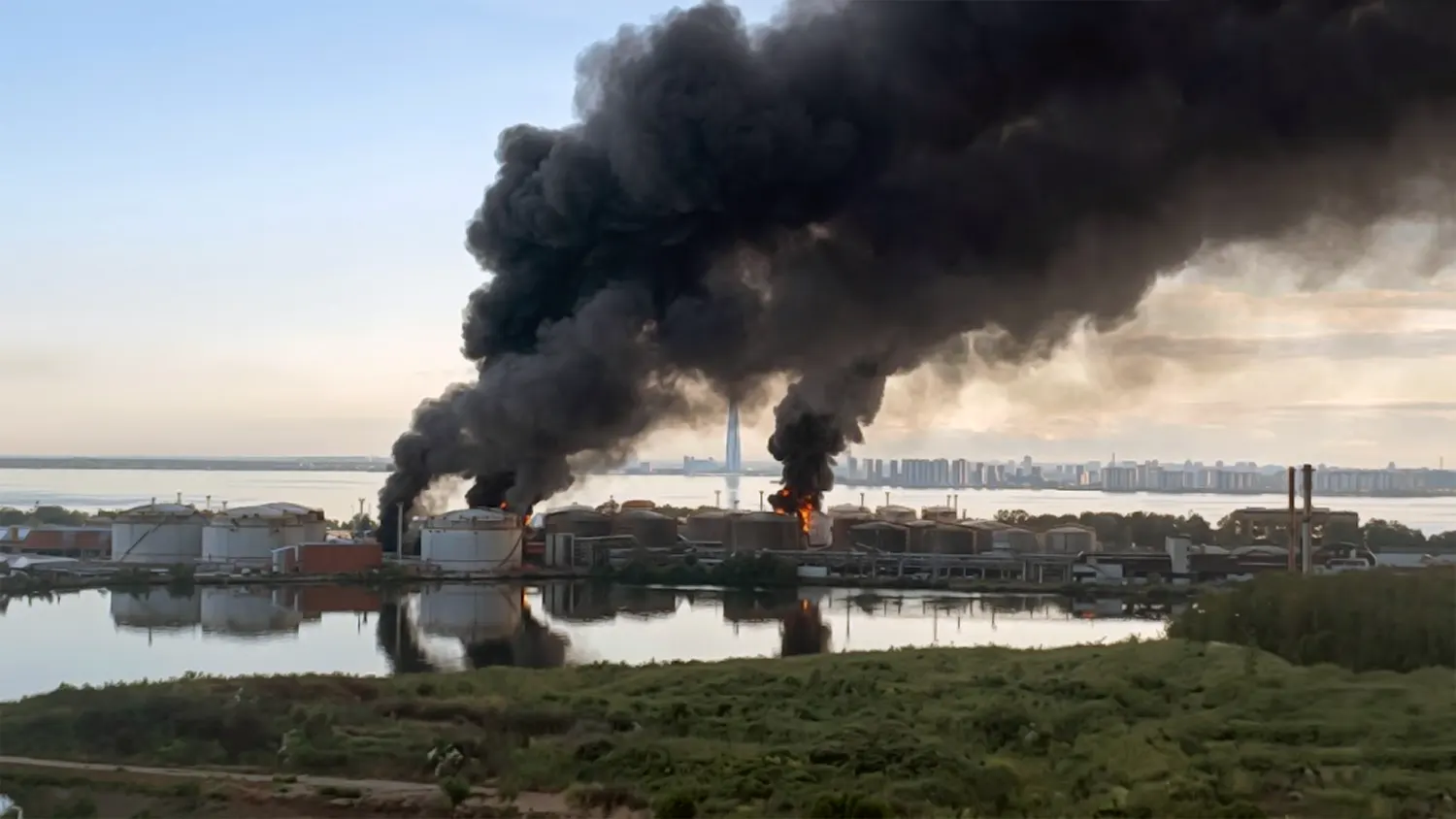
On the eve of Vladimir Putin’s flagship keynote address, thick black smoke was rising over St. Petersburg’s skyline visible directly from the convention center windows where hundreds of foreign delegates had just arrived. It wasn’t an accident. It was the point.
Ukraine launched a long-range drone strike of more than 1,000 kilometers (620 miles) hitting two of Russia’s most strategically significant targets in its second-largest city, at the exact moment Russia most needed to project calm, stability, and global relevance.
Putin’s “Russian Davos” Just Got an Uninvited Guest
Every year, the Kremlin hosts the St. Petersburg International Economic Forum (SPIEF), Russia’s premier prestige event, sometimes called “Russia’s Davos,” designed to showcase economic resilience and court foreign investment. Putin treats it as proof that Russia is not isolated, not broken, and very much open for business.
SPIEF 2026 was themed “Pragmatic Dialogue: the Path to a Stable Future.” Saudi Arabia sent a 200-person corporate and official delegation as the guest of honor. Chinese Vice President Han Zheng attended. The presidents of Uzbekistan and Tanzania were present. Even select German business groups showed up, quietly attempting to protect more than €100 billion in frozen assets. The forum has pivoted hard toward the Global South since Western leaders and CEOs began boycotting en masse following Russia’s 2022 invasion but the Kremlin has worked to make it count regardless.
Then the drones arrived.
Two Targets, One Message
Ukrainian President Volodymyr Zelenskyy confirmed strikes on two simultaneous targets:
The St. Petersburg Oil Terminal — one of Russia’s largest oil trans-shipment facilities on the Baltic Sea coast, serving as the primary gateway for Russian crude and refined products moving to international markets, handling tens of millions of tons annually. Setting it ablaze directly impairs Russia’s ability to load tankers, forcing a bottleneck back through its domestic pipeline system and critically, striking at the “shadow fleet” infrastructure Russia uses to move oil in defiance of Western sanctions.
The Kronstadt Naval Base and Shipyard — located on Kotlin Island in the Gulf of Finland, Kronstadt is the home port of Russia’s Baltic Fleet and its premier facility for repairing, maintaining, and outfitting surface warships and submarines. It is historically one of Russia’s most fortified and heavily defended coastal installations. Zelenskyy confirmed at least one warship was damaged in the strike.
Pulkovo Airport was forced to temporarily shut down and divert flights overnight. The smoke from the burning oil terminal was visible to arriving international delegates from the Expoforum Convention Center itself an unscripted, impossible-to-ignore backdrop to Russia’s carefully staged showcase of normalcy.
“Long-Range Sanctions” Ukraine’s Strategy in Plain Sight
Ukrainian officials have been deliberately candid about the logic behind these strikes, describing the drone campaign against Russian domestic infrastructure as “long-range sanctions.”
The reasoning is straightforward: a vast portion of Russia’s war machine is funded directly by oil export revenue. By systematically targeting refineries, depots, and trans-shipment hubs, Ukraine is attacking the financial pipeline that keeps Russian forces in the field. Hitting Baltic coast infrastructure specifically impairs Russia’s ability to move crude through its western export routes, the same routes it depends on to reach buyers who are willing to circumvent Western pressure.
Doing it at the exact moment Putin was preparing to deliver his flagship economic address was not coincidental. It was a deliberately timed, public demonstration that even Russia’s deep interior, its second-largest city, its most guarded naval base, its premier economic forum, is no longer beyond the reach of the war.
How Ukraine’s Drones Flew 620 Miles Into One of Russia’s Most Defended Cities
The operational achievement here deserves context. Flying an explosive-laden uncrewed drone more than 1,000 kilometers through heavily contested airspace, past electronic warfare jamming systems, into a city with layered air defense networks, and striking two distinct high-value targets with precision, this is not a simple task.
These drones fly extremely low to evade radar, using automated terrain-mapping and advanced navigation systems to hug the ground along the entire flight path. The successful strike on Kronstadt specifically a historically fortified island naval base proved that Ukrainian drones can now navigate complex coastal electronic warfare environments that Russia had considered reliable protection.
The strategic implication is significant. Every time Ukraine forces Russia to confirm a strike deep in its interior, Russia must divert defensive assets northward to protect Baltic Fleet infrastructure stretching its air defense capabilities thinner along the actual front line where it matters most.
The Kremlin’s Damage Control
Moscow’s response followed a familiar pattern: minimize the physical damage publicly, promise harsh retaliation, and keep the forum running.
Kremlin spokesperson Dmitry Peskov addressed the strikes on state television with a message calibrated more for the domestic audience than the international one: “The special military operation is being carried out precisely so that there are no such strikes. Russia will respond systematically.”
The word “systematically” was chosen carefully. It signals that Russia’s response will not be a single retaliatory strike, but a continuation and likely intensification of its ongoing missile and drone barrages against Ukrainian energy infrastructure and urban centers. It is a threat dressed as a policy statement.
Meanwhile, Russian state media worked to frame the damage as minor and the forum as proceeding normally even as the smoke that told a different story was still visible on the horizon.
Geography Is No Longer Russia’s Shield
For much of this war, Russia’s greatest advantage has been simple: size. The assumption that the vast depth of Russian territory offered natural protection that Ukrainian forces could never meaningfully reach Moscow, St. Petersburg, or the infrastructure that funds the war was a core part of the Kremlin’s strategic confidence.
That assumption is being systematically dismantled. St. Petersburg is Putin’s hometown. Kronstadt is a symbol of Russian naval history and pride. SPIEF is the event Putin uses to tell the world Russia is winning. Ukraine chose all three for maximum effect and the smoke rising over the Gulf of Finland, framed against the windows of Russia’s most important annual economic gathering, made the argument more clearly than any press release could.
Depth of geography no longer guarantees safety. That is the message. And it was delivered in front of an international audience that Russia had specifically invited to watch.