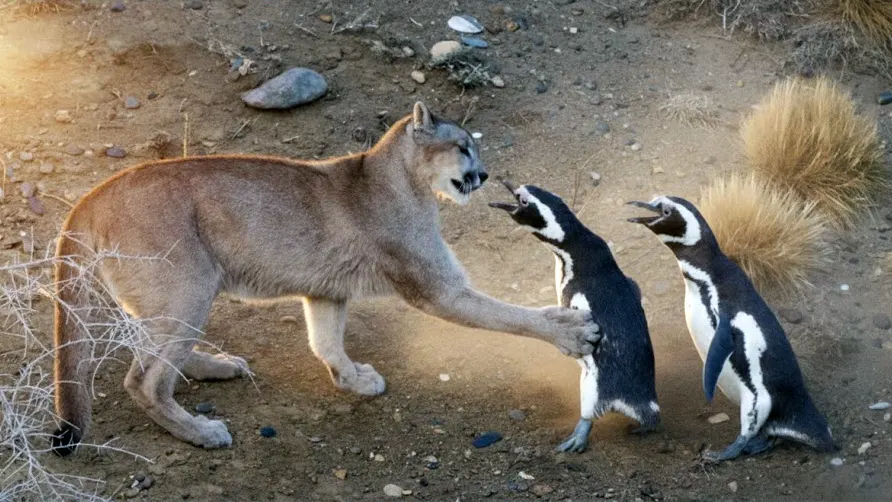
The Unintended Buffet
In the rugged, wind swept landscape of Santa Cruz, Argentina,
a biological collision is taking place that no scientist predicted.
For nearly a century, the Magellanic penguins of Patagonia thrived in a world without land predators. Emboldened by the absence of the Puma (Puma concolor), these flightless birds moved their nesting grounds from safe offshore islands to the vast mainland of Monte León National Park.
But the pumas are back. And they have found a landscape filled with thousands of defenseless, “snack sized” birds that have no evolutionary memory of how to hide from a land based killer.
The result is the Patagonia Puma Paradox: a conservation triumph that has led to the highest density of pumas ever recorded on Earth, fueled by the slaughter of over 7,000 penguins in a single study period.
The Great Predator Vacuum
To understand how we got here, we must look at the early 20th century. During the height of the sheep ranching era in Patagonia, pumas were viewed as a systemic threat to the economy. Settlers used poison, traps, and professional hunters (lioneros) to effectively extirpate the big cats from the coastal regions.
By the 1950s, the coast was a “predator vacuum.” Magellanic penguins, sensing the safety of the mainland, established massive colonies. This shift was a boon for the penguin population, which grew to over 93,000 breeding adults in Monte León alone.
However, in 2004, the creation of the Monte León National Park shifted the legal landscape. Sheep were removed, hunting was banned, and the pumas under federal protection began to recolonize their ancestral territory.
The “Surplus Killing” Crisis
A new study published in the Journal for Nature Conservation (February 2026), led by researchers from Oxford University’s Wildlife Conservation Research Unit (WildCRU) and the National University of Comahue, has quantified the carnage for the first time.
Between 2019 and 2023, researchers tracking 14 GPS collared pumas and monitoring 32 camera traps discovered a disturbing trend: Surplus Killing.
Unlike typical predation, where a hunter kills only what it can eat, the pumas at Monte León have been observed killing dozens of penguins in a single night and leaving the carcasses untouched. Over a four year window, an estimated 7,087 adult penguins were killed roughly 7.6% of the entire adult population.
“The number of carcasses showing signs of predation is overwhelming,” says lead author Melisa Lera. “The fact that they were left uneaten means pumas were killing far more than they required for food. It’s similar to a domestic cat in a room full of mice, the ease of the catch overrides the biological need for hunger.”
A New Social Structure for Pumas
The most shocking finding of the 2026 research isn’t just the death toll; it’s the way the pumas themselves are changing. Pumas are notoriously solitary, territorial animals. However, the “hyperabundance” of penguin prey has shattered their traditional social rules.
- World Record Density: Monte León now supports 13 pumas per 100 square kilometers the highest density documented anywhere in the world.
- Relaxed Territoriality: Because food is so easy to acquire, pumas are five times more likely to encounter and tolerate one another.
- Marine Subsidies: By dragging penguins inland, pumas are effectively transferring marine nutrients into the terrestrial soil, fertilizing the land in a way that hasn’t been seen in a century.
Scientists describe the colony as a “big salmon run,” where pumas congregate like grizzly bears at a river.
Is the Colony at Risk of Extinction?
For environmentalists, the central question is a difficult one: Should we protect the puma if it means losing the penguin?
The Oxford study utilized advanced demographic modeling to answer this. Surprisingly, the data suggests that pumas alone will not cause the colony to collapse. The Magellanic penguin population in Monte León remains stable, and in some areas, is actually growing.
The real threat is a “Compound Disaster.” The model showed that the colony only faces extinction if puma predation is combined with two external factors:
- Low Juvenile Survival: If less than 20% of chicks reach adulthood due to changing ocean currents.
- Climate-Driven Breeding Failure: If warming temperatures limit food availability in the Atlantic.
In this “worst-case scenario,” the 7.6% loss to pumas becomes the tipping point that could wipe out the colony in decades.
The Lesson for Global Conservation
The Patagonia Puma Paradox serves as a warning for rewilding projects worldwide, from the reintroduction of wolves in Europe to cheetahs in India.
“Restoring fauna does not mean bringing ecosystems back to the past,” warns ecologist Mitchell Serota. “It generates completely new interactions. We are bringing predators back to a radically different landscape than the one they left.”
This story highlights the delicate balance of the “Creditor Order” in nature. Every conservation “gain” comes with a cost.
In Patagonia, that cost is paid in feathers.