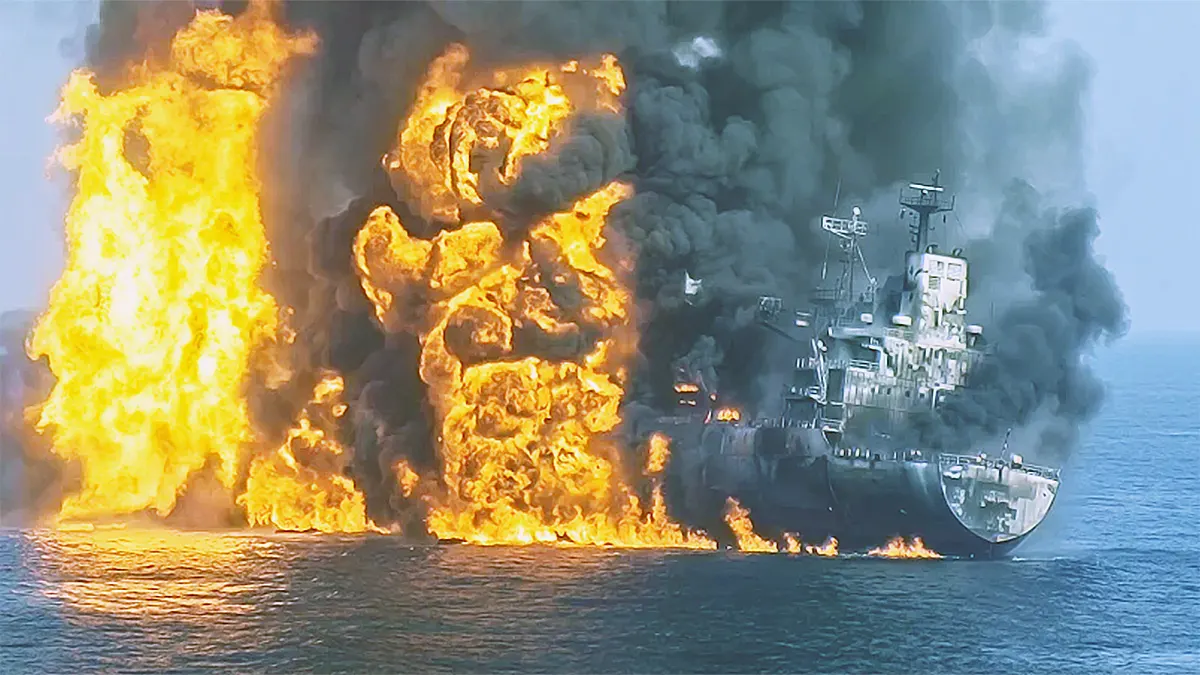
A Panama-flagged liquefied petroleum gas (LPG) tanker, Tara Gas, was engulfed in flames after being struck by projectiles near the Strait of Hormuz, forcing all 25 crew members to abandon ship in an emergency evacuation off the coast of Oman.
The incident, which unfolded between November 16 and 17, is part of a wider escalation of maritime attacks threatening commercial shipping through one of the world’s most important energy corridors.
The attack left one Indian seafarer missing and two others injured, while the remaining 22 crew members were safely evacuated to Khasab, Oman. No deaths have been officially confirmed.
With other commercial vessels also coming under attack in the same period, the incident has intensified concerns over the safety of international shipping and the continued movement of global energy supplies through the Strait of Hormuz.
Second Strike Forces Tara Gas Crew to Abandon Ship
The Tara Gas initially came under attack on November 16 near Khasab, in Oman’s Musandam Governorate. A projectile struck the vessel, reportedly triggering a fire in its engine room.
The situation deteriorated after the tanker was struck again, with a second missile attack reportedly causing flames to spread across the ship.
As the fire intensified, access to the vessel’s lifeboats and life rafts became blocked. With evacuation equipment no longer accessible, the captain ordered the crew to abandon ship immediately.
All 25 seafarers were forced to jump directly into the water. Nearby merchant vessels and Omani rescue teams subsequently assisted in recovering the survivors.
The emergency response was coordinated by Omani authorities, with assistance from the Indian Embassy in Muscat.
One Indian Seafarer Missing, Two Hospitalized
The Tara Gas was carrying 25 crew members, including 24 Indian nationals.
Following the evacuation, 22 crew members were safely brought ashore in Khasab. However, one Indian seafarer, identified as the vessel’s Third Officer, remains missing.
Two other Indian crew members sustained injuries and were hospitalized after being rescued.
The casualty breakdown is as follows:
- 22 rescued: Twenty-one Indian nationals and one non-Indian crew member were safely evacuated.
- Two injured: Both were hospitalized in Oman.
- One missing: An Indian Third Officer remains unaccounted for as search-and-rescue operations continue.
Although the incident resulted in serious injuries and one missing crew member, authorities have not confirmed any fatalities.
Responsibility for Tara Gas Attack Remains Unconfirmed
Despite the severity of the incident, no group has officially claimed responsibility for striking the Tara Gas.
Maritime monitoring organizations, including the United Kingdom Maritime Trade Operations (UKMTO) and Vanguard, have described the weapons involved as unidentified projectiles. Indian government statements condemning the attack have also stopped short of naming a specific perpetrator.
Iran’s Islamic Revolutionary Guard Corps (IRGC) has not claimed responsibility for the tanker attack.
However, the incident occurred amid growing military activity and repeated warnings from Iranian naval forces concerning commercial shipping through the Strait of Hormuz.
The IRGC Navy has warned tanker operators against entering areas it considers restricted. Iranian forces have also claimed that several vessels struck naval mines while attempting unauthorized transits.
These claims have not been independently verified, and no confirmed evidence has established an Iranian role in the Tara Gas attack.
At Least Three Commercial Vessels Attacked Within 48 Hours
The attack on the Tara Gas was not an isolated incident.
Between November 16 and 18, at least three commercial vessels were independently reported to have come under attack in the Strait of Hormuz and surrounding waters.
The incidents highlight the growing danger facing merchant ships operating near the strategic waterway.
On Phoenix: Crude Oil Tanker Struck on November 16
The Panama-flagged, UAE-owned crude oil tanker On Phoenix was struck by an unidentified projectile approximately three nautical miles off the Omani coast.
The impact reportedly triggered an engine room fire. However, all crew members were reported safe.
Tara Gas: LPG Tanker Engulfed in Flames
The Tara Gas was struck twice near Khasab, Oman, between November 16 and 17.
The second strike caused a major fire that forced the entire crew to abandon ship. One Indian seafarer remains missing, while two others were hospitalized.
ADNOC Logistics & Services Vessel Attacked on November 17
A vessel operated by UAE-based ADNOC Logistics & Services was also attacked while transiting the Strait of Hormuz on the evening of November 17.
The incident left one crew member missing and 11 others injured, adding to the growing number of casualties among commercial seafarers operating in the region.
Iran Claims Additional Tankers Hit Naval Mines
Beyond the three independently reported attacks, Iran’s Navy and the IRGC have made additional claims involving commercial vessels striking naval mines.
Between November 14 and 17, Iranian authorities claimed that at least five tankers had encountered sea mines in the southern Strait of Hormuz.
The allegations included two incidents over the weekend, one involving a supertanker that Iran claimed had sunk, followed by three additional alleged mine strikes on November 17.
However, these claims remain unverified.
Tehran has not publicly identified the vessels involved or provided independently verifiable evidence. Maritime monitoring organizations, including UKMTO, have not confirmed the additional incidents.
The distinction is important as the number of independently confirmed attacks remains lower than the total number of incidents claimed by Iranian authorities.
According to the Joint Maritime Information Center (JMIC), five confirmed attacks had occurred off Oman’s Musandam Peninsula since November 1. Meanwhile, the International Maritime Organization (IMO) had recorded 138 commercial shipping incidents across the Persian Gulf, Strait of Hormuz, and Gulf of Oman since the regional conflict began in late February 2026.
Strait of Hormuz Becomes a Maritime Flashpoint Between Iran and the United States
The growing number of attacks is unfolding against the backdrop of an increasingly complicated military standoff involving Iran and the United States.
The situation is characterized by two separate blockade strategies, each pursuing different objectives.
Iran Seeks to Restrict International Shipping
Since March 2026, Iran has sought to restrict maritime traffic through the Strait of Hormuz, particularly vessels associated with the United States, Israel, and their allies.
Tehran has asserted that ships must obtain Iranian authorization before transiting certain areas of the waterway.
Its enforcement strategy reportedly includes missile and drone attacks, vessel seizures, naval mine threats, and repeated warnings to commercial shipping operators.
Rather than relying exclusively on a conventional naval blockade, Iran has used asymmetric military pressure to increase the risks associated with commercial navigation.
The strategy also creates uncertainty among shipowners, insurers, and shipping companies, potentially discouraging vessels from entering the region even without a complete physical closure of the strait.
US Blockade Targets Iranian Ports, Not Global Shipping
The US naval blockade, meanwhile, has a different objective.
Reimposed in July 2026 after ceasefire negotiations stalled, the operation targets vessels entering or leaving Iranian ports. US forces have reportedly intercepted, boarded, diverted, or disabled ships as part of efforts to restrict Iran’s maritime trade and oil revenues.
The campaign is therefore not intended to shut down the Strait of Hormuz for international commercial shipping.
Washington’s broader strategy is to isolate Iran economically while maintaining access to international shipping routes.
In mid-November, the United States also expanded its enforcement efforts to Iran’s land borders and the Caspian Sea under an operation known as Task Force Iron Gate.
The result is a maritime standoff in which Iran seeks to restrict access to the wider waterway, while the United States attempts to maintain international navigation and simultaneously limit Iran’s ability to export goods and energy.
Commercial Ships Continue Transiting Despite Growing Risks
Despite the escalating attacks, the Strait of Hormuz has not experienced a complete shutdown.
Commercial vessels continue to move through the waterway, although operators are increasingly relying on additional security measures and alternative shipping arrangements.
According to the available operational account, the US Navy has been facilitating commercial transits through southern shipping lanes near Oman, with naval forces conducting mine-sweeping operations and supporting merchant vessels.
Approximately 28 to 31 ships per day have reportedly continued using this southern corridor during November.
Some commercial operators have also adopted measures to reduce their exposure to potential attacks.
One increasingly common practice is switching off Automatic Identification System (AIS) transponders while passing through high-risk areas. This so-called going dark approach makes it more difficult for hostile forces to track a vessel’s position through publicly accessible maritime tracking systems.
However, disabling AIS does not eliminate the threat from missiles, drones, naval mines, or other military surveillance systems.
Energy companies are also increasingly relying on offshore ship-to-ship transfers and smaller shuttle vessels. These arrangements reduce the time larger tankers spend in particularly dangerous sections of the shipping route.
Despite these precautions, oil flows have reportedly remained below pre-war levels, while shipping companies continue to face elevated operating costs.
Global Oil and Gas Supplies Remain Exposed
The Strait of Hormuz is one of the world’s most important maritime energy chokepoints.
Before the outbreak of the regional conflict in 2026, approximately 20% of global liquefied natural gas (LNG) trade and 25% of seaborne oil trade passed through the waterway.
Any prolonged disruption therefore carries consequences far beyond the Middle East.
For shipping companies, the immediate concern is the rising cost of navigating the region. War-risk insurance premiums and freight rates remain elevated as operators reassess the potential financial and operational consequences of sending vessels through the strait.
For energy markets, the uncertainty creates additional pressure on oil and gas transportation. Even when exports continue, longer routes, offshore transfers, and additional security requirements can increase delivery costs and complicate supply chains.
The threat is not limited to vessels directly struck by projectiles. A sustained campaign of maritime harassment can also discourage commercial operators from using the route, reducing shipping capacity and creating uncertainty in international energy markets.
No Diplomatic Breakthrough as Maritime Tensions Persist
The current standoff has also been complicated by the collapse of diplomatic de-escalation efforts, including negotiations associated with the Islamabad Memorandum.
Tehran has maintained that restrictions on its maritime trade and economic activity must be addressed before it agrees to ease pressure on international shipping.
Washington, meanwhile, has continued to demand that Iran abandon its nuclear ambitions and respect freedom of navigation through the Strait of Hormuz before considering changes to its broader pressure campaign.
Neither side appears ready to abandon its core demands.
This leaves commercial shipping companies operating in an increasingly unpredictable environment, where military warnings, suspected attacks, and competing blockade operations continue to shape maritime activity.
Tara Gas Attack Highlights the Human Cost of the Strait of Hormuz Crisis
The attack on the Tara Gas demonstrates how quickly the maritime confrontation can turn into a life-threatening emergency for civilian seafarers.
The tanker was not a naval warship but a commercial vessel transporting energy cargo. Its crew members were forced to abandon ship in open water after repeated projectile strikes triggered a fire that blocked access to their evacuation equipment.
While 22 crew members were rescued, one Indian officer remains missing.
The wider pattern of attacks involving the On Phoenix, the Tara Gas, and the ADNOC-operated vessel suggests that commercial shipping remains exposed to serious risks across the region.
For now, the Strait of Hormuz remains operational, but it is increasingly functioning as a heavily militarized and high-risk maritime corridor rather than a routine international shipping route.
Without a diplomatic breakthrough or a meaningful reduction in military activity, shipowners, energy companies, and seafarers are likely to remain caught in the middle of the escalating confrontation.