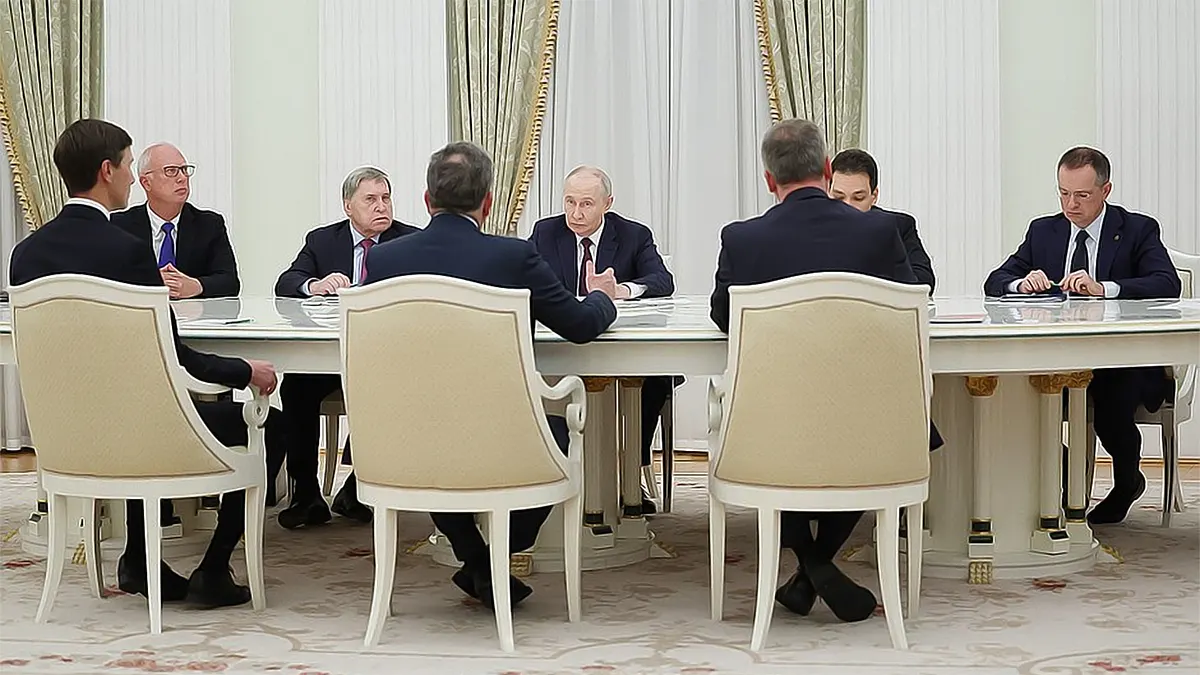
Russian President Vladimir Putin met U.S. special envoy Steve Witkoff and Jared Kushner at the Kremlin on Thursday, November 12, 2026. The two-hour meeting was part of a renewed push to end the war in Ukraine. Afterward, the two Americans flew straight to Dublin to brief Ukrainian President Volodymyr Zelenskyy.
The headline from Moscow was that European leaders may soon join the negotiations. That is a big shift, but as the details below show, it comes with plenty of strings attached.
Three Days of Talks, One Real Breakthrough
The Moscow meeting came right after two days of U.S.-mediated talks in Abu Dhabi on November 10 and 11. Russian and Ukrainian delegations sat down directly for the first time in nine months, since February 2026. It was the third round of talks held in the Emirati capital.
The sessions did not produce a ceasefire or a peace deal. The one concrete result was an agreement in principle on a major prisoner swap, which U.S. and Ukrainian officials described as the biggest humanitarian release of the conflict. Exact numbers are still being worked out, but Russian military officials said it could happen within two to three weeks.
Kushner called the Abu Dhabi talks “productive but difficult.” Both Washington and Moscow described the mood as constructive rather than stuck. Putin used the Kremlin meeting to thank President Donald Trump for arranging contacts with the Ukrainian side. He pointed to the prisoner exchanges as proof that at least one track is working.
Europe Gets an Invitation, With Conditions
In Abu Dhabi, European officials were kept on the sidelines. They held separate talks with the U.S. and Ukrainian teams but never met the Russians. That is changing.
After the Kremlin meeting, Witkoff said European representatives will take part in the next round, calling them “partners” whose involvement matters. Kushner said Washington sees “a big change” in Europe’s approach. He argued that Europe must be involved to settle postwar security arrangements for the continent.
Putin said Moscow has “always been open” to talking with the European Union. But the Kremlin’s other voices were much less welcoming:
- Dmitry Peskov, the Kremlin spokesperson, said European countries must first choose one single representative to negotiate with Moscow. European governments have not yet done that.
- Yuri Ushakov, a Kremlin foreign policy aide, declined to confirm that Europeans would actually be seated. He described Europe’s current stance as “a recipe for endless war.”
Zelenskyy welcomed the change and stressed that Europe will have a direct voice at the table, not just a seat in the hallway.
Putin’s Red Lines Haven’t Moved
Whatever the diplomatic mood, Putin’s core demands stayed the same. Reports from the meeting point to four main ones:
- No foreign troops in Ukraine. Putin said any foreign forces sent after a peace deal would be treated as “legitimate targets,” and that the war would “resume immediately.” This is aimed at the proposed French- and UK-led Multinational Force for Ukraine, meant to help rebuild Ukraine’s military and protect its skies and waters.
- All four annexed regions. Moscow still wants Ukraine to withdraw completely from the four regions Russia claimed in 2022.
- No “gray zones.” Putin rejected Kyiv’s idea of demilitarized buffer areas, saying “there is only one demarcation line—the state border.”
- No NATO growth. Russia also wants Kyiv to give up its NATO ambitions and accept strict limits on its military. Ushakov said the U.S. envoys were told in “no uncertain terms” that NATO must stop expanding and halt activity in Eastern Europe.
Putin also floated a five-day demining and “humanitarian mission” in Kostyantynivka, a heavily contested city in Donetsk. He modeled it on an earlier operation in Oleshky. Kyiv is skeptical and says Russia has used similar arrangements before to rotate troops and move military equipment.
What Zelenskyy Told the Americans in Dublin
Zelenskyy met Witkoff and Kushner on the evening of November 12 at Baldonnel Aerodrome, outside Dublin. The meeting took place on the sidelines of the 9th European Political Community Summit. They discussed Putin’s demands, postwar security guarantees and “reciprocal” de-escalation steps.
Kyiv’s message was firm. Zelenskyy repeated that Ukraine will not give up occupied territory for peace. He also called the U.S. approach of discussing a new European security order directly with Russia “a bit strange,” and warned European leaders against making “strange” separate security deals with Moscow.
He also raised a more immediate worry: new restrictions on how Ukraine can use Starshield, SpaceX’s military satellite network. He said the limits are hurting Ukrainian forces’ ability to intercept Russian drones.
Late that night, he met national security advisors from France, Germany, Italy and the UK, along with the European Commission and European Council, to coordinate a response. European Council President António Costa said Russia’s continued strikes on civilians and energy infrastructure look more like escalation than a real wish to end the war.
What Comes Next, and What Could Derail It
Several things are now moving at once:
- The prisoner swap. Working groups from Kyiv, Moscow and Washington are finalizing the details, with a target of two to three weeks.
- One European negotiator. Washington and Kyiv are both pushing Europe to name a single representative, the same thing Moscow is demanding.
- A bigger negotiating table. The U.S., Russia, Ukraine and Europe have agreed in principle to a next round. No date or location has been set. Ukrainian negotiator Davyd Arakhamia said Kyiv hopes for an overall framework agreement before the end of 2026.
Three problems could still stall everything: the territory deadlock, the fight over peacekeepers and security guarantees, and the Starshield restrictions. For now, the talks are alive, but the gap between the two sides on the hardest questions is as wide as ever.