A narrow stretch of water in the Middle East has once again become the center of global tension. Over the past several days, a wave of attacks on commercial ships in the Strait of Hormuz has dramatically escalated the ongoing regional conflict, raising fears of a wider disruption to global trade.
For the world economy, the stakes are enormous. The Strait of Hormuz carries roughly one fifth of the planet’s oil and natural gas supply, making it one of the most critical energy corridors on Earth.
When shipping through the waterway slows or stops, the consequences ripple through fuel prices, shipping costs, and global supply chains.
Now, after a series of new attacks on merchant vessels on March 11, 2026, the region appears to be entering what analysts describe as a de facto blockade, with energy markets and maritime logistics already feeling the shock.
A New Wave of Ship Attacks
The most recent escalation unfolded on March 11, the twelfth day of the broader conflict.
Three commercial vessels sailing under different national flags were struck by projectiles while transiting the Strait of Hormuz, underscoring how dangerous the waterway has become.
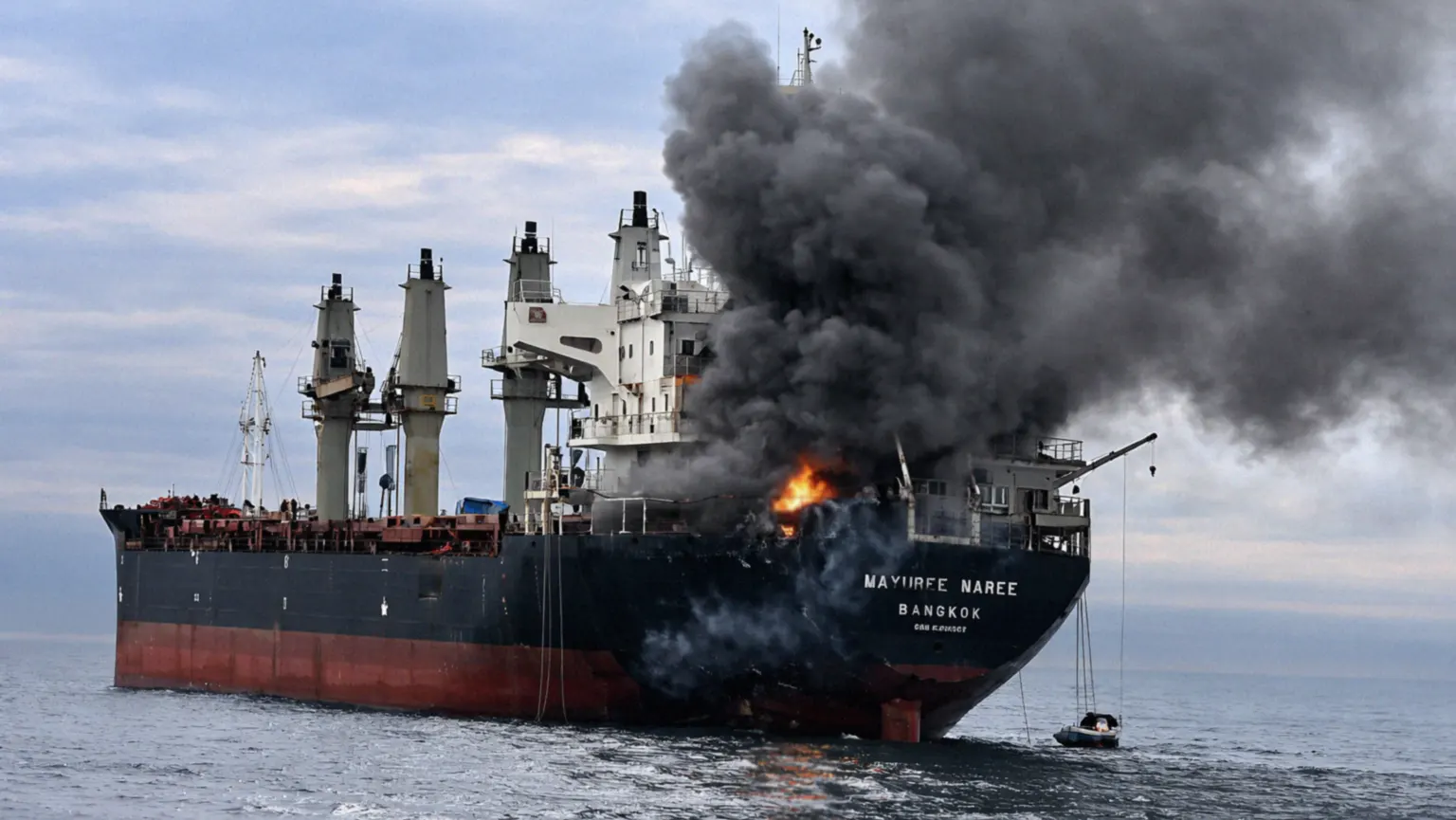
The most serious incident involved the Thai flagged bulk carrier
Mayuree Naree. The vessel sustained heavy damage and caught fire while passing through the Strait, forcing an emergency response. Most of the crew were rescued, with 20 sailors reportedly picked up by the Omani navy, while several others initially remained aboard as the fire was brought under control.
Two additional ships were also hit.
The Japanese flagged vessel ONE Majesty suffered structural damage
but was able to move toward a safe anchorage. Meanwhile, a Marshall Islands registered bulk carrier, Star Gwyneth, was also struck,
though its crew remained safe.
Taken together, the incidents highlight a troubling reality:
commercial shipping in the Gulf is increasingly exposed to military style attacks, regardless of a vessel’s nationality or cargo.
Why the Strait of Hormuz Matters So Much
To understand why these attacks are sending shockwaves through global markets, it helps to understand the strategic importance of the waterway itself.
The Strait of Hormuz connects the Persian Gulf to the Arabian Sea. Though only about 21 miles wide at its narrowest point, it serves as the primary export route for oil and liquefied natural gas from several major producers, including Saudi Arabia, Qatar, Iraq, and the United Arab Emirates.
In normal conditions, around 20 percent of global oil supply passes through the strait each day.
Because of this, even partial disruption can trigger global economic consequences. When ships stop moving through the corridor, the world’s energy system feels the impact almost immediately.
Shipping Companies Pull Back From the Region
As attacks have intensified, commercial shipping companies are increasingly refusing to enter the Gulf.
Major global carriers including Maersk, CMA CGM, and Hapag-Lloyd
have suspended operations through both the Strait of Hormuz and parts of the Red Sea.
For much of the global shipping industry, the route has simply become too dangerous.
Instead, many vessels are rerouting around the Cape of Good Hope at the southern tip of Africa. While safer, this detour adds up to two weeks to transit times and dramatically increases freight costs.
At the same time, dozens of oil tankers loaded inside the Persian Gulf remain effectively stranded. Unable to safely pass through the Strait, these ships are sitting at anchor, delaying the delivery of millions of barrels of crude oil.
Oil Prices Surge as Energy Supply Tightens
With supply routes disrupted, global energy markets have reacted quickly.
Brent crude prices have surged above $100 per barrel, reflecting fears that large volumes of oil could remain trapped inside the Gulf if the situation deteriorates further.
Regional producers have already begun adjusting their operations.
Some shipments have been delayed or rerouted, while logistical bottlenecks have slowed exports.
At the same time, governments and international energy agencies are discussing the potential release of strategic petroleum reserves to help stabilize markets and cushion the supply shock if disruptions persist.
Because global oil markets operate on tight margins, even modest supply interruptions can trigger rapid price increases.
Insurance Markets Amplify the Crisis
Another factor worsening the disruption is the retreat of marine insurers.
Shipping companies rely on war risk insurance policies to operate in conflict zones. But as attacks have intensified, many insurers have either withdrawn coverage or raised premiums to levels that make voyages economically impossible.
Without insurance protection, companies cannot legally or financially risk sending vessels into the region.
The result is a cascading effect: fewer insured ships mean less cargo movement, which further disrupts global trade flows.
Evidence Points to an Iranian Pressure Strategy
While early maritime reports sometimes describe attackers as unidentified, analysts say the broader pattern strongly suggests Iranian involvement.
Officials from the Islamic Revolutionary Guard Corps have publicly warned that vessels connected to the United States, Israel, or their partners could become legitimate targets in the Strait of Hormuz.
Notably, the latest attacks came after a roughly 72 hour lull in maritime incidents, which many experts interpret as a deliberate signal following U.S. strikes on Iranian mine laying vessels.
This pause and strike pattern fits a strategy designed to demonstrate
that Iran still retains the ability to disrupt global shipping despite ongoing military pressure.
According to the United States Central Command, Iranian forces have been preparing to deploy naval mines and using drones, missiles, and small attack craft to threaten vessels in the area.
These tactics match Iran’s long standing doctrine of asymmetric naval warfare aimed at disrupting maritime chokepoints.
Naval Confrontations Are Already Underway
The maritime crisis is closely tied to the broader military campaign that began on February 28.
In recent days, U.S. forces have conducted strikes against Iranian naval assets near the Strait of Hormuz, targeting vessels suspected of preparing mine deployments.
Military officials say 16 Iranian mine laying boats were destroyed on March 10, part of a larger effort to prevent explosive devices from being deployed in the shipping lanes.
Since the start of the conflict, more than 50 Iranian naval vessels
including patrol ships and drone platforms have reportedly been
destroyed or disabled.
Despite these operations, the region remains highly contested.
While the United States maintains a strong naval presence, a fully coordinated escort system for commercial vessels has not yet been established, leaving merchant ships exposed to ongoing threats.
A Global Trade Artery Under Pressure
The situation in the Strait of Hormuz remains volatile.
Commercial shipping has slowed to a fraction of normal levels, oil prices are rising, and naval forces from multiple countries are operating in close proximity.
Although the waterway has not been formally closed, the combination of attacks, insurance restrictions, and shipping suspensions has created something very close to a blockade.
If the disruption continues, the world could face a prolonged shock to one of its most vital trade routes.
And because the global economy depends on the energy that flows through the Strait of Hormuz, the consequences of this confrontation will reach far beyond the Gulf itself.