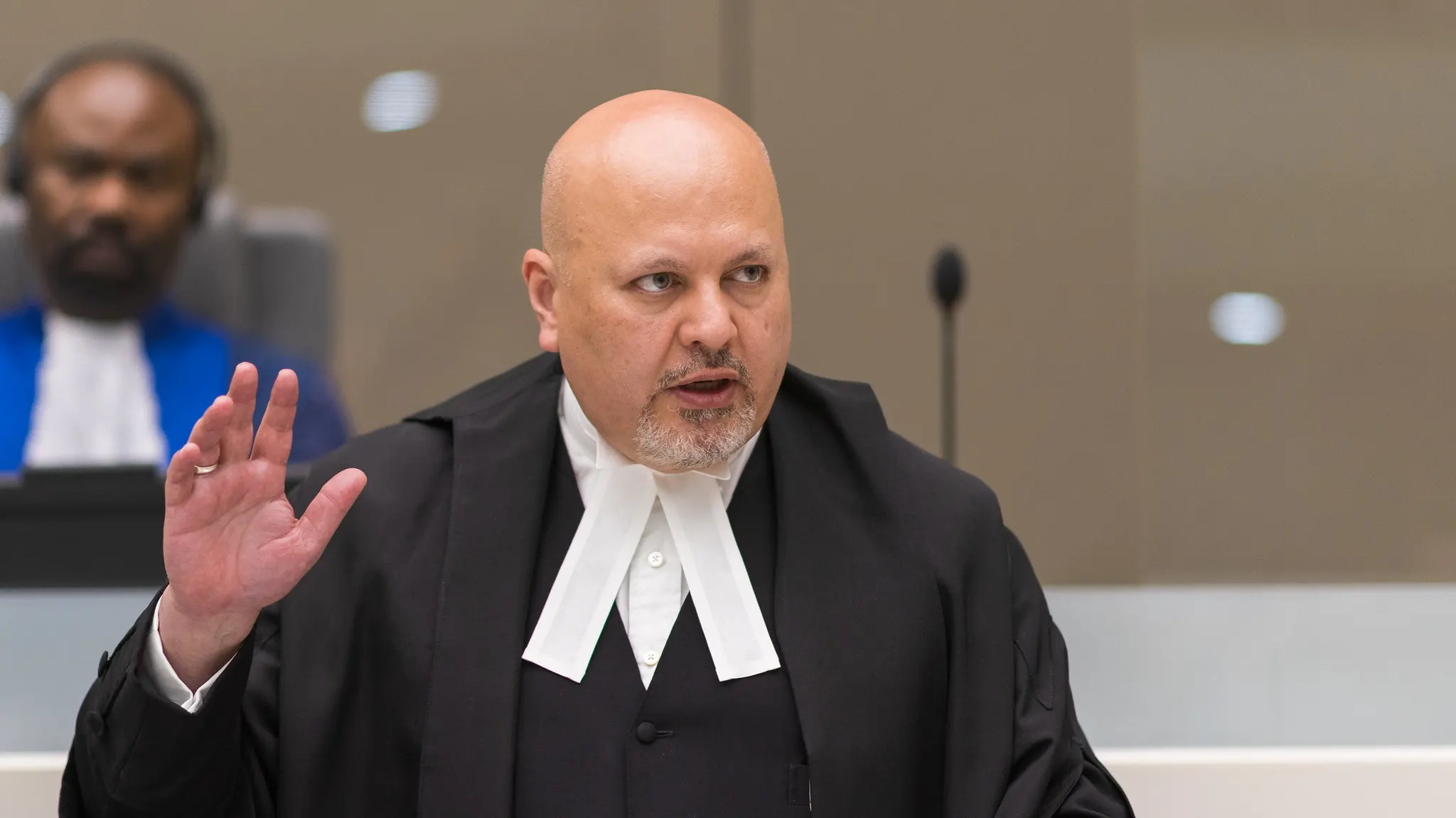
Karim Khan, the man who issued arrest warrants for Vladimir Putin, Benjamin Netanyahu, and Hamas leaders is now fighting for his own career. The International Criminal Court’s chief prosecutor has been formally suspended, and the court he leads is now navigating one of the most serious institutional crises in its history.
But the story isn’t as simple as “official accused, official suspended.” Two separate bodies reviewed the exact same evidence and reached completely opposite conclusions. That tension is what makes this situation so complicated and so important to understand.
Who Is Karim Khan, and Why Does This Hit So Hard
Before getting into the mechanics of the suspension, it helps to understand just how prominent a figure Khan is in international law because that’s exactly why this is sending shockwaves across the global legal community.
Born in Edinburgh in 1970, Khan spent over three decades building one of the most formidable careers in international criminal law. After being called to the bar in England and Wales in 1992, he cut his teeth as a prosecutor for the UK’s Crown Prosecution Service before shifting his focus to international tribunals. Between 1997 and 2000, he worked as a legal officer at both the UN tribunals for the former Yugoslavia and Rwanda, the cases that essentially wrote the modern rulebook on prosecuting war crimes.
What made Khan unusual was his willingness to work both sides of the courtroom. He spent years as lead defense counsel for major political figures including Kenya’s former Deputy President William Ruto, Saif al-Islam Gaddafi, and former Liberian President Charles Taylor while simultaneously taking on pro bono work representing victims of the Khmer Rouge in Cambodia and survivors of sexual violence in Sierra Leone.
His global profile surged further in 2018 when UN Secretary-General António Guterres appointed him to lead UNITAD, the special UN investigative team responsible for collecting and preserving evidence of ISIS war crimes and genocide in Iraq. That field-heavy, high-stakes operation put him firmly on the world stage.
In February 2021, ICC member states elected Khan as the court’s third Chief Prosecutor for a nine-year term. His tenure quickly became defined by historically volatile decisions: a 2023 arrest warrant for Russian President Vladimir Putin over the deportation of Ukrainian children, and a 2024 move to seek warrants for Israeli Prime Minister Benjamin Netanyahu, former Defense Minister Yoav Gallant, and top Hamas leaders, a decision that triggered heavy political blowback and U.S. sanctions against several ICC judges.
This is the man now at the center of a formal misconduct proceeding. That’s why this matters so much beyond the headlines.
What the Allegations Actually Say
The case against Khan began when a female staff member at the ICC’s Hague headquarters alleged that he repeatedly coerced her into sexual acts between 2023 and 2024. The claims weren’t dismissed or quietly shelved, they triggered a formal, 18 month long independent investigation carried out by the United Nations Office of Internal Oversight Services (OIOS), one of the UN’s most credible internal watchdog bodies.
The OIOS investigation wasn’t a vague inquiry. It was a structured probe that gathered witness statements, text messages, and travel records. Its findings were specific: the report concluded there was a “factual basis” for the allegations, documenting incidents of alleged nonconsensual sexual contact in Khan’s office, at his private residence, and during official foreign missions. Evidence described Khan moving the staff member into his office and making unwanted physical advances on official trips.
Then, in August 2025, a second woman came forward with separate allegations that Khan had abused his authority over her broadening the scope of the accusations and intensifying the pressure on the court.
Khan has consistently and categorically denied all wrongdoing. He remains on the record as having rejected every allegation.
Why Khan Says He Was “Exonerated” And Why That Claim Is Disputed
Here is where the situation gets genuinely complicated and where two highly qualified groups end up reading the same report in entirely different ways.
After the OIOS completed its investigation, the evidence file was reviewed by a separate panel of three judicial experts. That panel examined the findings through a strict criminal legal standard essentially asking whether the evidence was strong enough to prove misconduct beyond a reasonable doubt under the ICC’s specific legal framework. Their conclusion: it wasn’t quite enough to cross that precise threshold.
Khan seized on that judicial opinion to publicly declare that he had been “exonerated.” His legal team followed up by calling his subsequent suspension “unlawful, procedurally unfair, and unsupported by evidence.”
But here’s the critical distinction Khan’s argument glosses over: those three judges were operating in an advisory capacity only. Under the Rome Statute, the treaty that created and governs the ICC judges do not have the authority to fire or formally discipline the Prosecutor. They can offer a legal opinion. They cannot close a case.
The body that does have that authority is an entirely different one.
The Bureau’s Decision And Why It Carries More Weight
The formal suspension was made by the Bureau of the Assembly of States Parties (ASP), the ICC’s executive oversight committee, made up of 21 members elected from among the court’s 125 member states. This is not a secondary body. It is the institution’s highest administrative authority, with full constitutional power over the court’s top officials under the Rome Statute.
The Bureau reviewed the same OIOS report, the same underlying evidence, the same witness testimony and reached the opposite conclusion from the judicial panel. Rather than asking whether the evidence met a criminal legal standard, the Bureau asked a different, broader question: does this report contain credible evidence of serious misconduct that damages the integrity of the institution?
Their answer was yes. The Bureau determined that the factual record compiled by the UN was more than sufficient to establish that serious misconduct had occurred and that Khan could no longer credibly lead the court while these proceedings were ongoing. They formally suspended him with immediate effect and referred the matter upward to a full vote.
To be clear: the Bureau explicitly stated that this suspension is “not an indication of the final outcome” of the case. It is a procedural step, not a verdict.
The Same Evidence, Two Completely Different Verdicts
To understand why this situation feels so messy, it helps to see it side by side.
Both groups, the three-judge panel and the oversight Bureau read the exact same OIOS report. They didn’t find new facts. They just applied different standards to the same stack of evidence.
The judicial panel looked through a narrow criminal lens and concluded the evidence didn’t definitively prove a violation beyond a reasonable doubt. Their role: advisory.
The Bureau looked through an institutional and administrative lens and concluded the factual basis for serious misconduct was alarming enough that Khan shouldn’t remain in his post during the investigation. Their role: decision-making authority.
This isn’t a contradiction, it’s a deliberate feature of how oversight systems are designed. The standard for removing a prosecutor from office during an ongoing investigation is intentionally lower than the standard for a criminal conviction. The Bureau was not overruling the judges; it was exercising a separate and superior authority the judges simply don’t have.
What Comes Next, A Vote by 125 Countries
With Khan formally suspended, the Bureau has referred the entire matter to the full Assembly of States Parties, the body representing all 125 member countries of the ICC.
A special session will be convened as soon as possible. Only the full Assembly has the constitutional power to permanently remove a chief prosecutor from office. That requires a majority vote by secret ballot meaning at least 63 countries would need to vote in favor of removal.
Khan was on voluntary leave since May 2025, with his deputies running the office. That arrangement has now been replaced by a formal suspension, which carries a fundamentally different legal and institutional weight.
The Bigger Picture the ICC Can’t Ignore
None of this is happening in a vacuum. The court was already under intense geopolitical pressure long before this internal crisis surfaced.
Khan’s 2024 decision to seek arrest warrants for Netanyahu and Gallant alongside Hamas leaders triggered extraordinary international friction, including U.S. sanctions against several ICC judges, an unprecedented form of pressure on the court’s independence. The Russia-Ukraine arrest warrant for Putin had already strained relations with major powers.
Now, with its own chief prosecutor suspended over misconduct allegations, the ICC is managing an external legitimacy battle and an internal governance crisis simultaneously. The outcome of the upcoming Assembly vote won’t just determine Karim Khan’s fate, it will say something significant about whether the court’s institutional structures can hold up under this kind of pressure.