On the night of December 3, 2025, an 18 year old accounting student named Henry Nowak was walking home through Southampton when he was stabbed five times by a man he had never met. What happened in the minutes that followed captured on police bodycam footage and seen by millions after his killer’s conviction has since ignited the most explosive debate about race, policing, and justice that Britain has seen in years.
The footage is difficult to watch. It is also impossible to look away from.
What the Bodycam Showed
When officers arrived at the scene, the attacker 23 year old Vickrum Digwa immediately told police he had been the victim of a racist attack by Nowak. Officers believed him. They handcuffed Henry Nowak and pinned him to the ground as he lay bleeding from five stab wounds.
In the video, Nowak can be heard telling officers he had been stabbed not once, not twice, but nine times. At one point he cries out “I can’t breathe.” A responding officer’s reply, captured clearly on the footage: “Don’t think you have, mate.”
Medical intervention was delayed. Nowak lost consciousness. He died shortly after.
Digwa was later convicted of murder and sentenced to life in prison with a minimum term of 21 years. The release of the bodycam footage following that conviction is what broke the story open and broke something in British public life along with it.
The Weapon and a Community’s Response
Digwa had carried the 21-centimetre blade under a religious exemption, claiming it was a kirpan, the ceremonial dagger traditionally carried by observant Sikhs. That framing didn’t survive scrutiny. The UK Sikh Federation publicly and forcefully condemned Digwa, making clear that the blade was an offensive weapon with no connection to genuine Sikh religious practice. A traditional kirpan, the Federation noted, bears no resemblance to what Digwa was carrying.
The case has since prompted the Hampshire Police and Crime Commissioner to write directly to Prime Minister Keir Starmer, demanding an urgent national review of religious exemptions for carrying bladed weapons in public.
Southampton Erupts
The public reaction to the footage was immediate and, in parts of Southampton, violent.
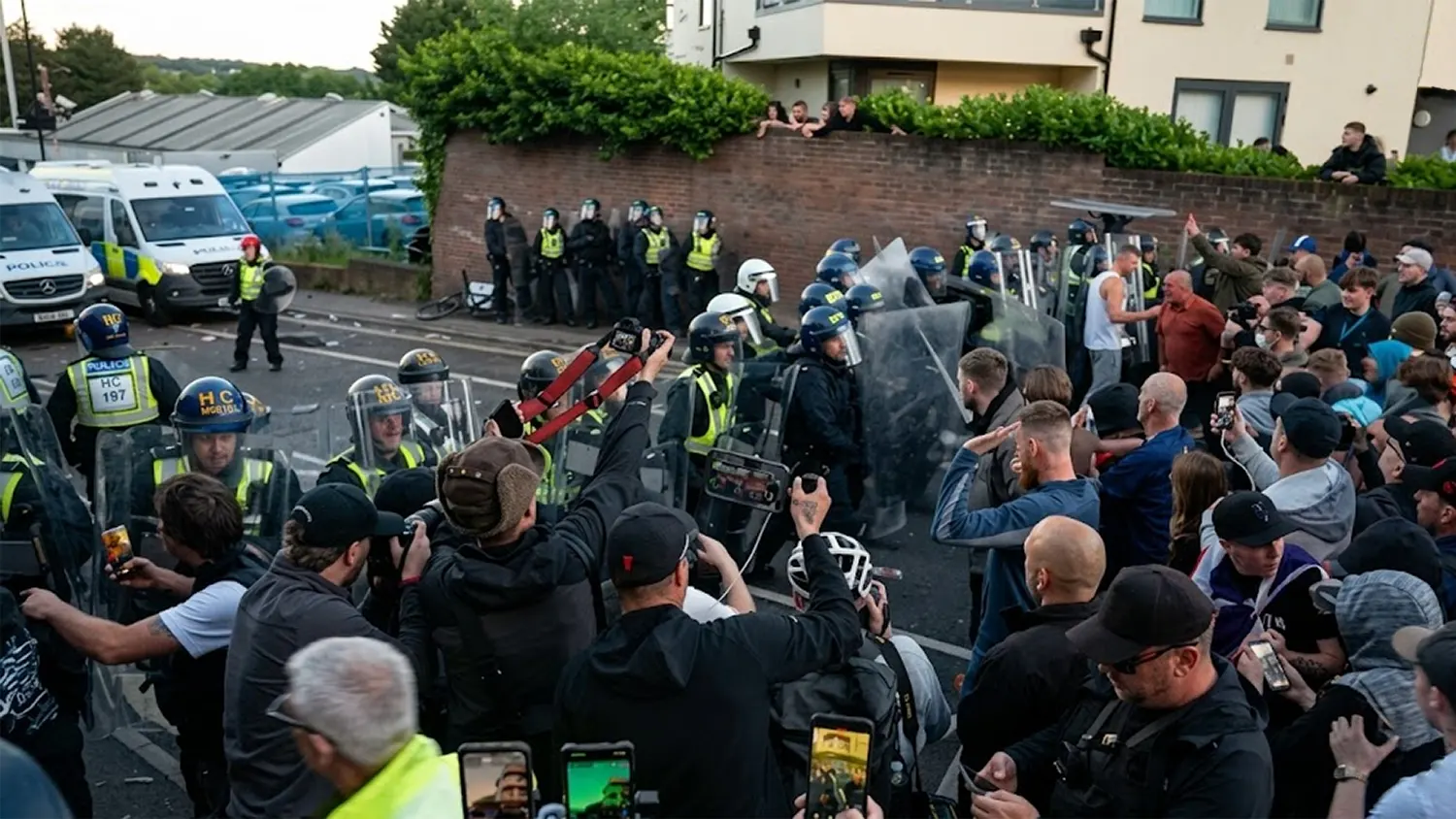
A rally under the banner “Justice for Henry Nowak” drew between 1,000 and 4,000 people outside Southampton Central Police Station figures that vary depending on whether you trust official police counts or organizer estimates. Speeches were given by right-wing figures including Tommy Robinson and Laurence Fox. Then a few hundred protesters broke away, marching toward the Portswood and St. Denys Road neighborhoods, the area where Nowak had been arrested and where his killer’s family lived.
Riot police blocked access to the residential street. What followed was a violent standoff: bricks, beer cans, flares, and wheelie bins hurled at officers. Eleven police officers and a police dog were injured. Local residents woke to smashed car windows and debris scattered across their streets.
Local officials noted pointedly that many of the most violent participants were not Southampton residents at all, they had travelled into the city from elsewhere in the UK specifically to confront police.
Henry Nowak’s father, Mark Nowak, acknowledged the “inhumane” treatment his son had received, but made a direct public plea: do not use Henry’s death to cause further hatred or violence. It is, at least in part, why the unrest has not yet spread into coordinated riots across other British cities though the political temperature nationally remains dangerously high.
A Government Forced to Respond
Prime Minister Keir Starmer said watching the footage made him “feel sick” as a father, and acknowledged that police face “serious questions.” Home Secretary Shabana Mahmood condemned the street violence as “disgraceful,” warning those using the tragedy to incite further unrest that they would face the “full force of the law.”
But the government has also been forced into more substantive action. The backlash has triggered an immediate review of official anti-racism policing guidance specifically, whether its current wording creates a bias in how officers handle cross-racial incidents. The Police Minister acknowledged that the existing guidance gives the “wrong impression”, a remarkable admission given how central that guidance has become to the national debate.
That debate has been amplified and in some corners, increasingly used by right-wing politicians. Reform UK leader Nigel Farage has used the case to push allegations of “two-tier policing” and “anti-white prejudice”, arguing that officers were predisposed to believe a minority attacker’s claim of racism over a dying white teenager’s repeated statements that he had been stabbed.
The charge resonates with a portion of the British public regardless of how one evaluates its political motivation. That is part of what makes this moment so combustible.
Where the Investigation Stands and Why People Are Angry
Four officers responded to the scene that night. As of now, none have been formally charged, suspended, or arrested.
One officer has resigned from Hampshire Police. The other three remain on active duty. All four are currently classified by the Independent Office for Police Conduct (IOPC) as witnesses rather than subjects of a misconduct investigation, a legal distinction that, to many members of the public, looks less like process and more like protection.
The IOPC has stated it will “fully establish the circumstances of the case, including whether there may be misconduct on the part of any of the officers involved,” and is currently reviewing bodycam data, emergency room timelines, and dispatch audio. Formal findings and any potential misconduct charges are not expected for weeks.
Police and Crime Commissioner Donna Jones, apparently unwilling to wait, has bypassed standard procedures to order an urgent independent inspection into Hampshire Police’s training and culture. The review is focused specifically on a deeply uncomfortable question: did the officers’ anti-racism training cause them to prioritize a false hate-crime allegation over the life of a dying person? Jones has stated plainly that providing immediate medical assistance must be an “unconditional duty”, one that cannot be conditional on who police believe is the suspect or the victim at any given moment.
The Attorney General is separately reviewing whether Digwa’s 21-year minimum sentence is “unduly lenient.”
The Question Britain Is Now Asking
The Henry Nowak case has exposed fault lines in British society that were already there about race, about policing culture, about how anti-racism guidance is applied in real-world split-second decisions, and about who gets the benefit of the doubt when the stakes are highest.
Those are not simple questions, and they do not have simple answers. What is simple and what the bodycam footage makes impossible to deny, is that a teenager told police nine times that he had been stabbed, and they did not believe him until it was too late.
Whatever conclusions the IOPC eventually reaches, that fact is not going anywhere. And neither, it seems, is the fury it has produced.