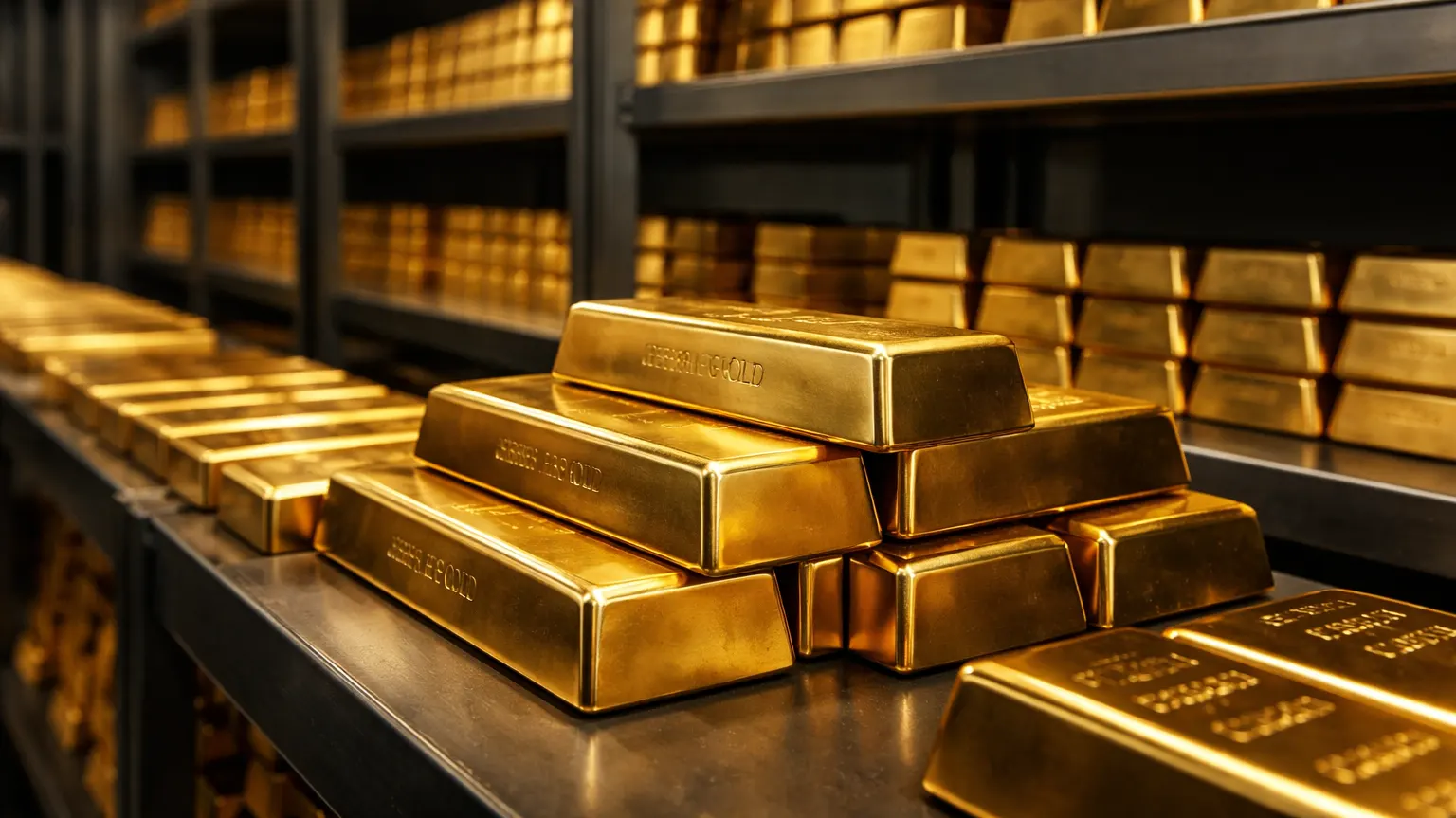
Gold is having a quiet down day. The spot price is hovering around $4,462 per troy ounce, off roughly 0.3% to 0.5% on the session, and on track to close the week about 1.7% lower. At the gram level that’s approximately $143.50, or $143,560 per kilogram.
On the surface, that looks like a metal losing steam. But zoom out, and Wall Street tells a very different story.
| Per troy ounce |
| $4,462 |
| -0.35% today |
| Per gram |
| $143.50 |
| -1.7% this week |
| From Jan 29 |
| Peak: $5,589 |
| peak-16% |
Why a 16% Dip Doesn’t Worry the Big Banks
To understand why institutions remain so bullish despite the pullback, you need two pieces of context.
First: gold has already proven it can trade far higher. On January 29, 2026, gold hit an all-time high of $5,589.38 per troy ounce driven in large part by the panic following joint U.S.-Israeli military operations in Iran. The current $4,450–$4,465 range is a 16% correction from that peak, not a new baseline. For J.P. Morgan, targeting $6,300 isn’t a wild 40% lunge from nowhere, it’s a prediction that gold breaks its January record by roughly 12% and then keeps climbing.
Second: two specific macroeconomic headwinds are causing today’s softness. Fresh sticky inflation data has reignited fears that the U.S. Federal Reserve may hold interest rates higher for longer or even nudge them up. Because gold yields nothing, elevated bond rates raise the opportunity cost of holding the metal. Layered on top of that, a tentative Israel-Lebanon ceasefire has cooled some of the urgent safe-haven buying that sent prices vertical earlier in the year. The banks see both of these as temporary.
The Math Behind the $6,300 Call
J.P. Morgan’s commodities team didn’t arrive at $6,300 by intuition. Their model tracks global quarterly gold purchases against mined supply, and the relationship is brutally simple: the world’s gold supply is essentially fixed. You can’t mine more gold just because the price goes up. That rigidity makes prices hypersensitive to large institutional buy orders.
The model rests on one key threshold: to keep gold prices flat, global buyers need to net-purchase 350 tonnes per quarter. Every 100 tonnes above that baseline mechanically pushes the price roughly 2% higher per quarter. Based on that formula, the banks are pricing in three distinct waves of buying in the second half of 2026:
Central bank accumulation is the biggest driver. Emerging market central banks particularly China, India, Turkey, and Poland are aggressively moving out of U.S. dollar-denominated assets. J.P. Morgan estimates central banks will buy roughly 800 tonnes of gold this year alone. Their model shows that even a 0.5% shift of these nations’ foreign reserves into gold generates enough physical buying to mechanically force the price to $6,300.
The return of Western ETF investors is the second wave. Right now, institutional money in the West is sitting on the sidelines, U.S. Treasuries are paying attractive interest, making gold less competitive. The moment the Federal Reserve signals its first rate cut, analysts expect billions of dollars to flood back into gold ETFs, creating a secondary surge on top of the central bank baseline.
New pools of institutional capital represent the third factor. For the first time, major forecasts are explicitly factoring in Chinese insurance giants rotating into gold as a safe-haven allocation, alongside crypto community profit-taking finding its way into hard assets.
The Geopolitical Engine Nobody Is Ignoring
The price of gold is, to an unusual degree, a real-time referendum on global stability and 2026 is not offering much stability.
When J.P. Morgan, UBS, and Goldman Sachs built their aggressive models, they didn’t treat geopolitics as a footnote. They treated it as the primary engine. The January spike to $5,589 happened in a single session, driven entirely by escalation panic. The current correction to $4,462 happened because a fragile truce temporarily calmed speculative trading. The banks argue the underlying risk hasn’t disappeared, it’s just coiled, waiting for the next flashpoint to send prices back above $5,500.
But the deeper geopolitical driver and the one that explains the $6,300 ceiling is de-dollarization. The combination of aggressive U.S. trade tariffs, sweeping sanctions, and a $34+ trillion national debt has accelerated a structural pivot among non-Western central banks. They are actively trying to insulate their financial systems from Washington’s political leverage, and physical gold is the asset they’re turning to.
UBS frames this starkly in their forecast. Their base case steady central bank accumulation gets gold to $5,900–$6,200. But their “chaos scenario,” which assumes current geopolitical tensions escalate into a broader trade war or deeper military conflict, puts gold at $7,200.
The One Condition That Has to Be Met
All of this, the central bank accumulation thesis, the ETF re-entry wave, the de-dollarization tailwind hinges on a single variable: the Federal Reserve has to blink.
If inflation stays sticky and the Fed refuses to cut rates through the end of the year, the opportunity cost of holding gold remains too high for Western institutional money to return in force. In that scenario, the metal likely stays range-bound between $4,450 and $4,800 through Q4, regardless of how much emerging-market central banks buy.
There is also a genuine bear case. HSBC has issued explicit warnings that if U.S.-Iran peace talks unexpectedly succeed and the Middle East fully stabilizes, the geopolitical panic premium built into the current price could evaporate rapidly, potentially triggering a sharp correction toward $4,000.
The consensus view, for now, is that neither of those scenarios is the base case. The structural bull market hasn’t reversed, it’s pausing. With the Non-Farm Payrolls report and the next Fed meeting on the horizon, the next few data points will go a long way toward telling us whether the banks’ $6,300 thesis holds water or whether gold’s most dramatic year on record is already behind it.