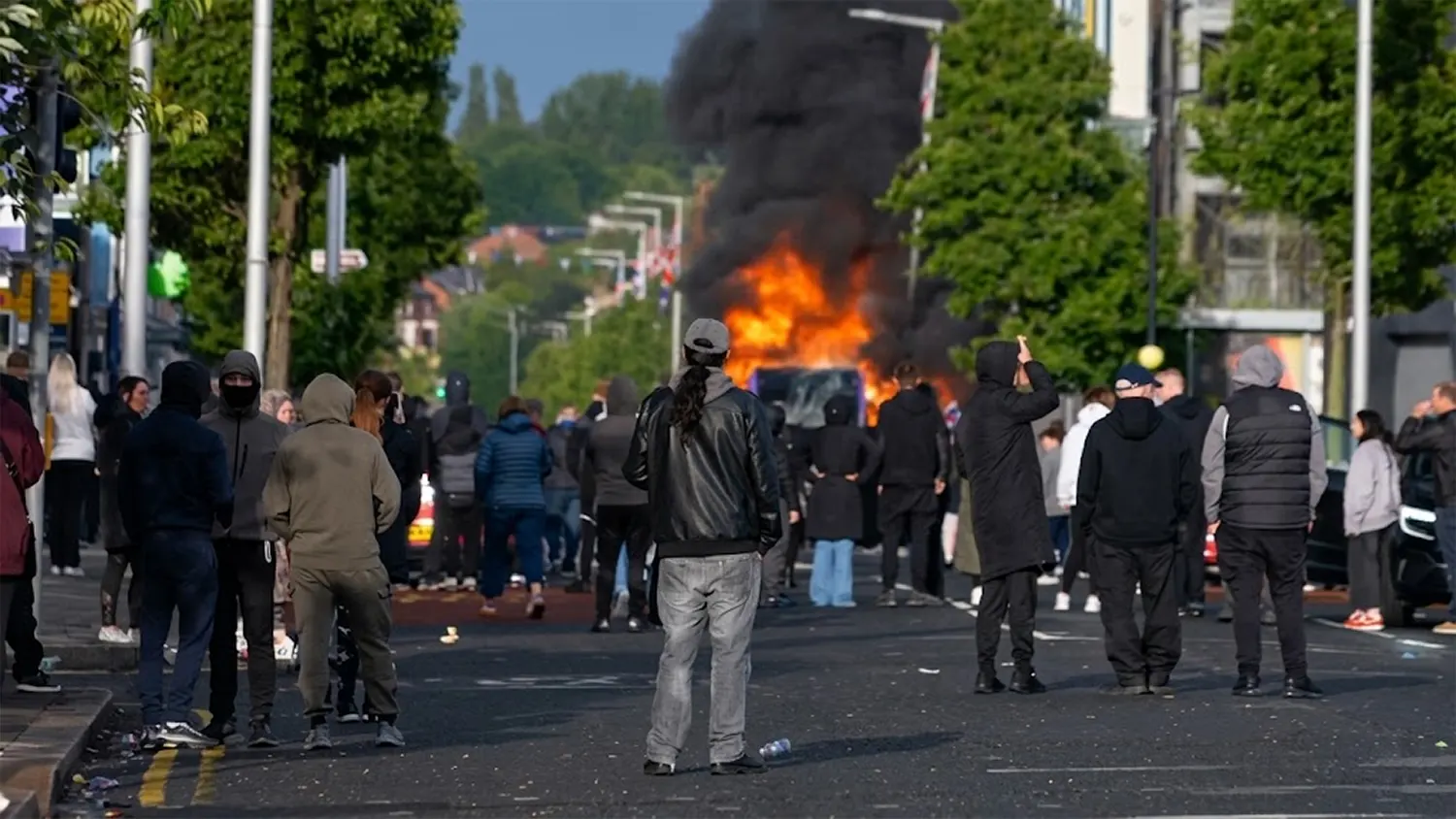
It started with a stabbing on a Monday night. Within 48 hours, it had become something far darker masked mobs, burning homes, and families being hunted door to door in the streets of Belfast.
The speed at which things unraveled has shocked even seasoned observers of Northern Ireland’s turbulent history.
A Disabled Man, a Night Out, and a Blade That Changed Everything
At around 10:30 PM on June 8, Stephen Ogilvie, a 44 year old disabled man was attacked in North Belfast. He survived only because bystanders physically intervened to fight off his attacker. But the cost was devastating: Ogilvie lost his left eye, sustained severe damage to his right, and was left with deep slash wounds across his face, head, and back. He remains hospitalized.
Police arrested Hadi Alodid, a 30 year old Sudanese national holding legal refugee status in the UK until 2028. On June 10, he appeared in court via video link and was formally charged with attempted murder, possession of a bladed article, and making threats to kill a hospital radiographer who was treating his hand injury. He did not enter a plea.
The attack was horrific. What happened next made it worse.
How a Viral Video Became a Match to Dry Kindling
Footage of the stabbing circulated rapidly online. Right-wing and anti-immigrant networks mobilized almost immediately, framing the attack as justification for street action. By Tuesday night, June 9, masked crowds had taken over several neighborhoods particularly along the Crumlin Road and Lower Newtownards Road in Belfast.
What followed was not a protest. It was a systematic campaign of terror.
Rioters went door to door, trying to identify which houses were occupied by immigrants and ethnic minorities. They burned a city Glider bus, a Middle Eastern supermarket, a street cleaner, and dozens of civilian vehicles. Masked men set up illegal road checkpoints, letting drivers through based solely on skin color. Nurses trying to reach the Ulster Hospital were stopped and forced to show identification to armed strangers just to get to work.
Among those targeted: Ugandan healthcare workers, a Ukrainian family who had fled the war in their homeland, and a Romani family neighbors noted it was the third time that same family had been forced out of a home by racist intimidation.
At least 27 people were made homeless by arson attacks. The Police Service of Northern Ireland (PSNI) deployed armored vehicles to rescue trapped families from burning buildings. One of those rescued was a two month old baby.
“A Race-Based Pogrom” The Words Politicians Reached For
The condemnation from Northern Ireland’s political leaders was swift, and notably unified across traditional sectarian divides.
First Minister Michelle O’Neill (Sinn Féin) described masked men burning families out of their homes as “nothing less than disgusting cowardice,” making clear the violence had nothing to do with legitimate community concerns.
Deputy First Minister Emma Little-Pengelly (DUP) called the scenes “thuggery and intimidation” and said the region had been appalled by both the original stabbing and everything that followed.
Claire Hanna, leader of the SDLP, went further, using the phrase “race-based pogrom” to describe what she saw as a premeditated, coordinated hunt for minority families not a spontaneous outburst of anger, but an organized effort.
Perhaps most powerfully, Stephen Ogilvie’s own family issued a public plea: the attack on their loved one must not be used to justify racial hostility. The overnight violence, they said, is entirely unwelcome.
Who Was Really Running the Streets
While many of those throwing petrol bombs and smashing windows were young men and teenagers, local intelligence and media reports pointed to a more organized hand behind the chaos. Well-known loyalist paramilitary figures were reportedly seen standing back from the front lines watching, directing, and orchestrating movements rather than participating directly.
The PSNI deployed water cannons and heavy riot units. By Wednesday night, June 11, the situation was slightly less volatile than the Tuesday peak but 14 PSNI officers had been injured over two nights, with 12 hurt on Wednesday alone when rioters hurled bricks, sledgehammer fragments, and petrol bombs at police lines.
The violence did not stay in Belfast. Far-right solidarity protests and clashes broke out in Glasgow, Edinburgh, and Southampton, where two Scottish officers were also injured.
The Human Cost, by the Numbers
As of June 11, the full picture of casualties looks like this:
- Stephen Ogilvie: Lost his left eye, severe damage to his right, deep lacerations to face, head, and back. Still hospitalized.
- 14 PSNI officers injured across two nights of rioting in Belfast.
- 2 Scottish police officers injured during spillover clashes in Glasgow and Edinburgh.
- At least 3 civilians injured in Scotland during protests.
- 27 people displaced and homeless — their homes gutted by arson including a two-month-old baby rescued from a burning building.
No fatalities from the riots have been reported as of this writing.
A City at a Crossroads
What happened in Belfast this week did not begin with politics. It began with a brutal, senseless attack on one man, a man whose own family has now asked the world not to use his suffering as a weapon.
The rioters ignored that plea entirely.
Northern Ireland has spent decades trying to move past cycles of violence rooted in who belongs and who doesn’t. What played out this week families burned out, checkpoints run by masked men, a baby rescued from a fire was a brutal reminder of how fragile that progress can be, and how quickly a single spark can be fanned into something far more dangerous by those with an agenda to push.
The streets are quieter tonight. But the tension hasn’t gone anywhere.