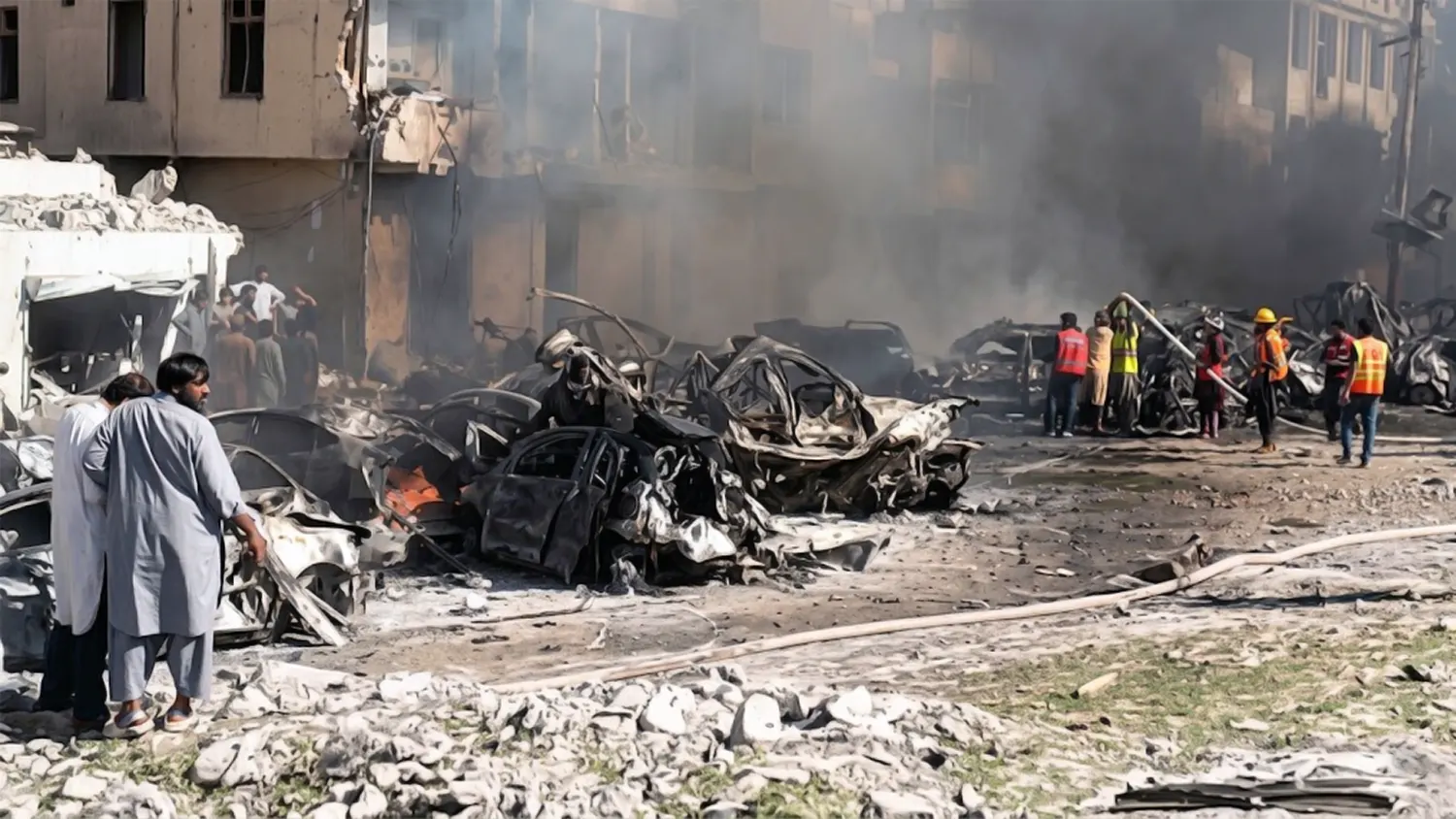
At 8:00 in the morning, when a shuttle train was making its routine run from the Quetta Cantonment to the main station, a car packed with explosives slammed into it. The blast derailed the engine and three carriages, flipped two of them completely over, set them on fire, and tore through a dense residential neighborhood igniting gas cylinders in cars waiting at a nearby crossing and collapsing the walls of apartment buildings close to the tracks.
By the time emergency crews reached the Chaman Phatak area, the death toll had already begun climbing past 30. More than 100 others were wounded, with at least 20 still in critical condition. Doctors warned that the numbers weren’t done rising.
Among the dead and injured: frontier corps soldiers, civilian passengers, and local residents including women and children who happened to be in the wrong place when the bomber struck.
Why a Train? Why This Train?
The shuttle wasn’t a random target. It was transporting military personnel and their families from the cantonment to connect with the long-distance Jaffar Express, a route the Balochistan Liberation Army (BLA) had clearly mapped in advance. The timing and location weren’t accidental. This was a planned strike on a moving security-force target, executed in the middle of a civilian neighborhood.
The BLA wasted no time claiming it. The group publicly identified the attacker as Bilal Shahwani, an operative of their elite suicide unit, the Majeed Brigade, and released his name and photograph. It was a deliberate, almost theatrical act of ownership, a declaration that this was an operation, not an incident.
Who Is the BLA and What Do They Actually Want?
To understand this attack, you have to understand the group behind it, and the BLA is not what most people imagine when they picture a militant organisation.
This is not a religiously driven group. The BLA is secular and ethno-nationalist, motivated by a decades-long political grievance: the belief that Balochistan, Pakistan’s largest, most resource-rich, and yet most impoverished province has been systematically exploited by a central government they see as dominated by the Punjabi ethnic majority.
Their core argument is straightforward: Balochistan sits on enormous reserves of natural gas, copper, gold, and oil. The profits leave. The poverty stays. The Baloch people, in their view, get none of the benefit and bear all of the cost with crumbling infrastructure, no reliable electricity, and scarce clean water in communities sitting on top of some of the country’s most valuable land.
That grievance has been sharpened in recent years by two additional flashpoints. The first is the China-Pakistan Economic Corridor (CPEC), a multi billion dollar Chinese infrastructure project built largely through Balochistan and centred on the Gwadar Port. The BLA views China not as a development partner but as an imperial force, and has repeatedly targeted Chinese engineers and investments working in the region.
The second is a painful and unresolved human rights issue: enforced disappearances. For years, Baloch students, journalists, and activists have vanished, with families openly accusing Pakistani security and intelligence agencies of extrajudicial abductions. The anger this has produced particularly among educated, middle-class Baloch youth has become a significant recruitment engine for the BLA, which today is far less tribal elder, far more university-educated professional than its earlier incarnations.
The group’s Majeed Brigade is its most lethal arm, a dedicated suicide unit responsible for high-profile bombings including this one. It’s notable for being one of the few militant groups in the region to actively recruit female suicide bombers.
Internationally, the BLA is designated a terrorist organisation by Pakistan, the United States, the United Kingdom, China, Iran, and the European Union.
This Is Not an Isolated Attack
Pakistan’s railways have become a recurring target. This bombing follows a large-scale BLA railway station attack late last year and a dramatic train hijacking in March that drew international attention. The pattern points to a deliberate strategic focus on rail infrastructure, a high-visibility, high-casualty target that simultaneously disrupts military logistics, terrifies civilian commuters, and generates international headlines.
Each attack also represents an intelligence failure, and Pakistani security officials know it. A suicide bomber doesn’t acquire and load a vehicle with explosives, identify a military train’s exact schedule, navigate into a militarily sensitive zone, and execute an attack alone. Someone mapped the route. Someone sourced the vehicle. Someone helped move the explosives. Finding that network is now the central focus of the investigation.
The Hunt for the Network Behind the Bomb
Pakistani security forces and the Counter-Terrorism Department (CTD) launched an immediate, widening crackdown in the hours after the attack. Having been handed the bomber’s identity by the BLA itself, investigators now have a starting point and they’ve moved fast.
Two of Bilal Shahwani’s brothers have already been detained for questioning about his movements and the planning timeline in the days before the attack. Forensic teams are working through the wreckage at Chaman Phatak, analysing the chassis and engine numbers of the vehicle used in the bombing to trace its registration history and prior ownership trying to find where it was acquired and where it was loaded.
The provincial government has been explicit about what it’s looking for: the “facilitators and financiers”, the people who arranged the vehicle, knew the train’s schedule, and successfully moved explosives into a high-security zone without detection. That last part is what keeps investigators most concerned.
Pakistan’s Response: Condemnation, Crackdown, and a Pointed Accusation
The political response was swift and, at the top, carried a specific geopolitical charge.
Prime Minister Shehbaz Sharif condemned the attack as a “cowardly act of terrorism” and pledged that Pakistan’s resolve to eliminate militancy would not waver. President Asif Ali Zardari framed the attack in broader terms calling it a deliberate attempt to undermine Pakistan’s role in facilitating U.S.–Iran peace talks, suggesting the timing was intentional.
Balochistan Chief Minister Sarfraz Bugti was the most aggressive in tone, vowing publicly to “hunt down” everyone responsible. He also deployed a phrase that Pakistani officials have leaned on heavily: “Fitna al-Hindustan” roughly translated as “the mischief of India”, the government’s term for what it alleges is Indian intelligence backing of the BLA. Islamabad has long claimed that India funds, trains, and arms the separatist group as a proxy to destabilise Pakistan internally and sabotage CPEC. New Delhi has consistently denied these allegations.
On the operational side, the government rolled out three immediate measures: large-scale CTD and paramilitary raids on suspected safe houses around Quetta; a declared medical emergency across all public hospitals in the city, with all medical staff ordered to remain on duty; and a railway security overhaul, with Pakistan Railways and intelligence agencies working to introduce stricter perimeter controls and checkpoints along high-risk train routes.
A Province, a Conflict, and No Easy Exit
What happened in Quetta on Monday morning is horrific by any measure. But it didn’t emerge from nowhere. It is the product of a decades-old conflict between a separatist movement that believes its people have been abandoned, and a state that responds with force while the underlying grievances poverty, disappearances, resource extraction remain unaddressed.
None of that context excuses a suicide bombing that killed soldiers, civilians, and children waiting at a train crossing. But it does explain why this keeps happening, and why the gap between Pakistani government condemnations and lasting security on the ground in Balochistan remains so wide.
The investigation is ongoing. The death toll may still rise. And somewhere in Quetta, investigators are following a paper trail from a vehicle chassis back toward the people who made Monday morning possible.