Vladimir Putin had a choice to make after a Russian drone gutted a residential apartment building inside NATO territory. He made it quickly: deny ownership, cast doubt on the evidence, and turn the story into a question of Western credibility.
It was a familiar playbook. But this time, the forensic record made it harder to run.
What Putin Actually Said and What He Meant
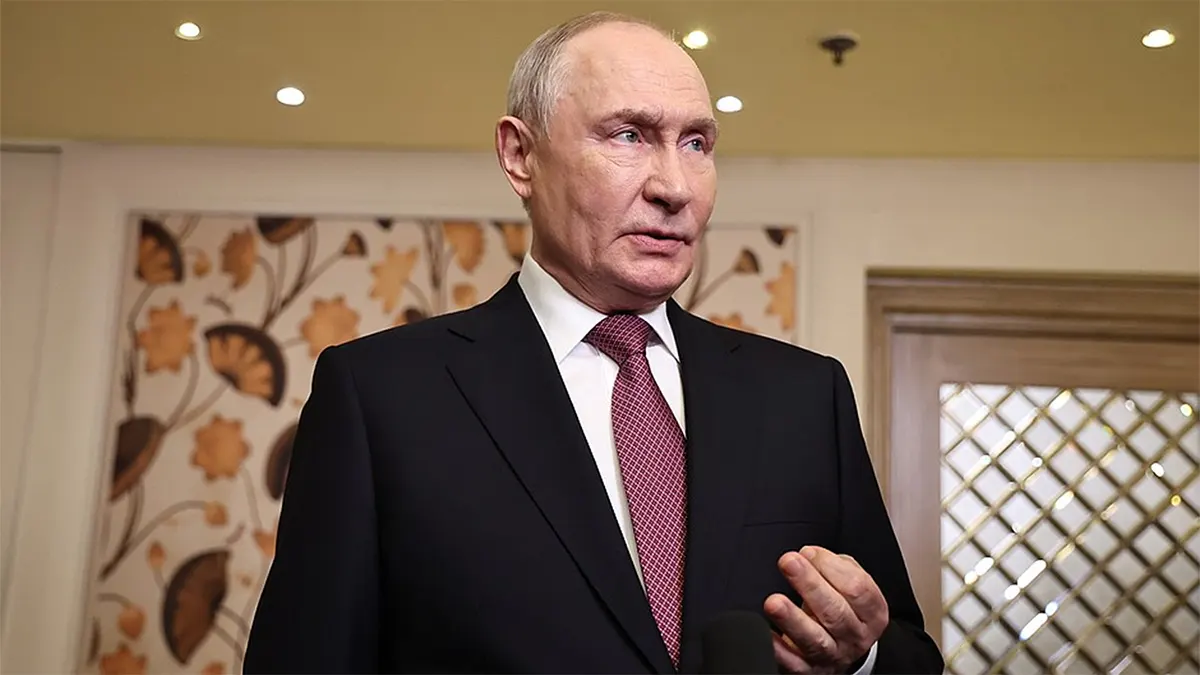
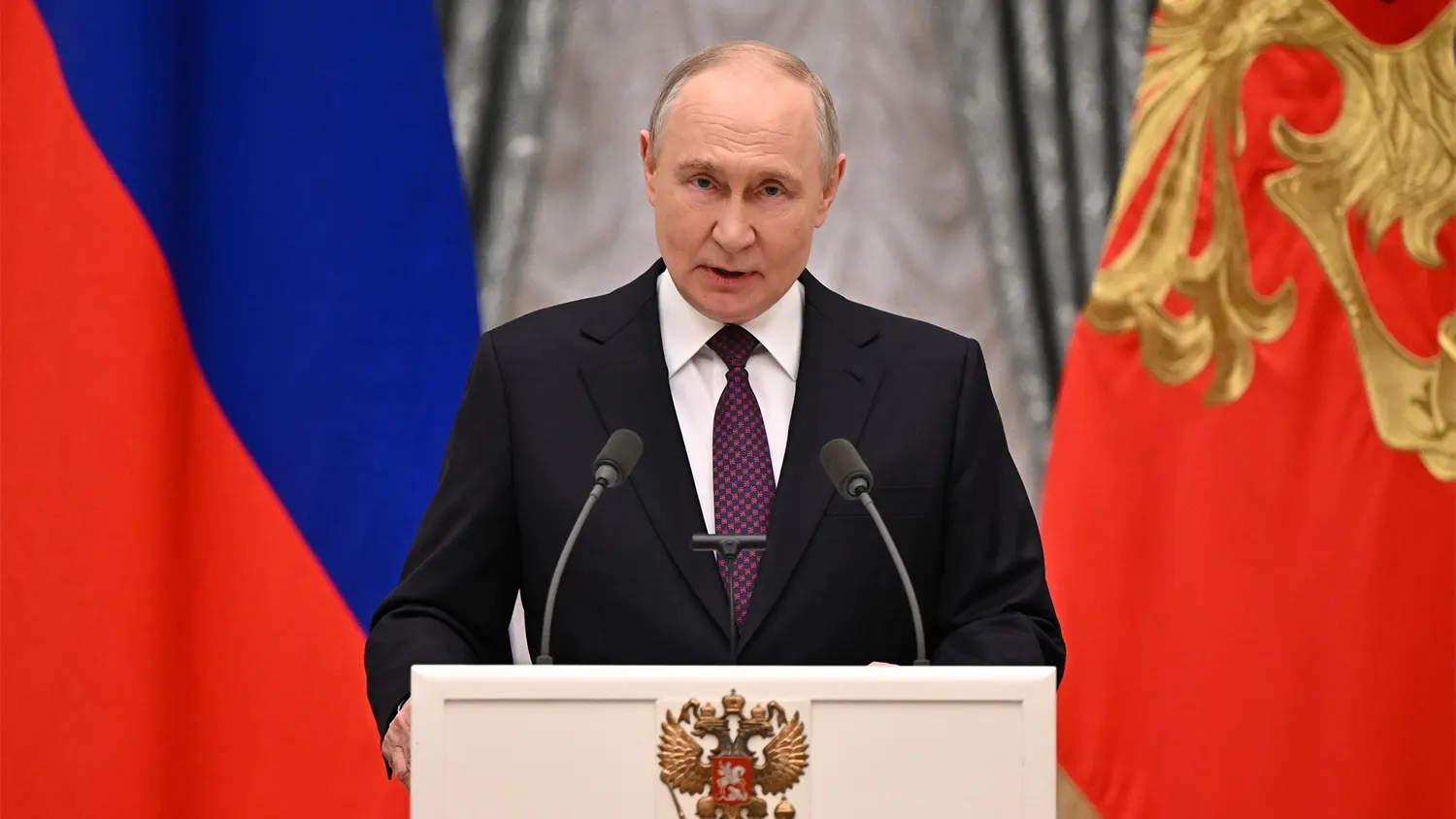
Speaking at a press conference during his state visit to Astana, Kazakhstan, Putin did not simply say “it wasn’t us.” He constructed a multi-layered rhetorical defense that was carefully designed to accomplish several things at once.
“Russia has never threatened European countries.”
With a Romanian apartment building still smoldering and two civilians nursing injuries, Putin dismissed the Western condemnation as “madness” and “egregious lies,” arguing that “no one can say the origin” of the drone without a formal technical examination. The line is a pivot away from the immediate facts and toward a broader framing of Russia as a misunderstood party being scapegoated by an alarmist West.
The “Ukrainian drone” precedent.
Putin reached for historical examples: Ukrainian drones and air-defense missiles that previously strayed into Finland, Poland, and the Baltic states. “The first reaction was exactly the same as it is now in Romania,” he said. “‘Help! The Russians are coming, the Russians are hitting us!’ Then, after a short time, it turned out it had nothing in common with Russian aircraft.”
This is deflection via historical precedent using genuine past incidents of Ukrainian navigation drift to plant the suggestion that the Galați strike follows the same pattern. The implication: NATO always panics first, corrects later, and the real story is Western hysteria rather than Russian weapons.
The “objective data” demand.
Putin offered to conduct a joint investigation, if Romania hands over the debris. “Let them hand it over to us, we will conduct an objective investigation, and only then will we give an assessment of what happened.” He even cited a precedent where Russia handed drone remains to American representatives after an alleged Ukrainian strike on a Kremlin residence.
The move is tactically elegant. It projects a posture of reason and scientific patience while shifting the burden of proof entirely onto Romania. It also implies that Romania currently has no credible evidence which is precisely the opposite of what Romanian defense officials announced publicly.
The financial wedge.
Putin also used the moment to drive at something larger: the argument that European leaders are “milking taxpayers” to prolong a war that serves political rather than security interests. He framed rising European defense budgets not as a rational response to Russian aggression but as a financial racket, an attempt to tap into genuine “war fatigue” across European publics and separate them from their governments’ support for Ukraine.
Kremlin spokesman Dmitry Peskov added another layer: confirming that Putin had been briefed on the incident while carefully declining to say whether the aircraft belonged to the Russian military. Former President Dmitry Medvedev went further still, posting that EU nations should “get ready” and that strikes like this “will keep on happening.” Plausible deniability from one official, explicit threat from another, the messaging is coordinated.
What Romania and NATO Actually Found
Putin’s demand for “objective data” ran into an inconvenient problem: Romania already had it.
Forensic teams recovered the wreckage from the roof of the Galați apartment building within hours of the strike. Romanian Defense Minister Radu-Dinel Miruta announced the findings publicly and without qualification.
The serial numbers on the debris were traced directly to Russian military production. The drone model was confirmed as a Geran-2, Russia’s domestically produced variant of the Iranian-designed Shahed-136 kamikaze drone. Ukraine does not operate Geran-2 drones. There is no version of this evidence that points to a Ukrainian origin.
The physical forensics were backed by independent tracking data. A NATO Allied Airborne Early Warning (AWACS) E-3A aircraft was actively monitoring the region during Russia’s 232-drone overnight salvo targeting Ukrainian port infrastructure along the Danube River. Radar data tracked the drone from Russian-controlled territory, through Ukrainian airspace, across the river border, and into Romanian airspace where it flew for approximately four minutes at roughly 200 km/h before impact.
Romania’s military was not passive. Two F-16 fighter jets and an IAR-330 helicopter were scrambled with full authorization to shoot it down. They didn’t fire. General Gheorghe Maxim explained the dilemma plainly: intercepting a low-flying explosive drone directly over the densely populated city of Galați carried a serious risk that falling debris and the warhead detonation from a successful shoot-down could cause far more civilian casualties than the crash itself. The four-minute window between radar detection and impact left no clean intercept geometry over an urban area.
Why the “Ukrainian Drone” Comparison Doesn’t Hold
Putin’s invocation of past incidents, the 2022 missile landing in Poland, stray Ukrainian air-defense fire reaching the Baltics is the strongest element of his rhetorical case, because those incidents were real. In several cases, NATO’s initial alarm was followed by a quieter correction.
But the comparison breaks down on the evidence. The Polish incident involved a Ukrainian air-defense missile chasing an incoming Russian target, a defensive system responding to a Russian attack. The Baltic incidents involved Ukrainian drones that lost navigation guidance. None of those incidents involved a Russian-manufactured, Russian-launched offensive kamikaze drone verified by serial number and tracked by NATO radar from its point of origin.
The Geran-2 is not an air-defense missile. It is a one-way attack weapon. It has one job.
What NATO and the EU Are Treating This As
Neither NATO nor the EU is treating the Galați strike as a navigation accident, even while acknowledging that the drone may not have been deliberately aimed at Romania. The position stated consistently by NATO Secretary-General Mark Rutte, European Commission President Ursula von der Leyen, and EU Foreign Policy Chief Kaja Kallas is that Russian recklessness at this scale, with this weaponry, inside EU and NATO territory, constitutes a serious violation regardless of intent.
The diplomatic and security response is already in motion. Romania expelled the Russian Consul General from Constanța. The EU’s 21st sanctions package against Russia is being fast-tracked as a direct consequence. Emergency funding through the EU’s SAFE security program is being mobilized to deploy specialized electronic warfare and anti-drone systems along Romania’s eastern border, a direct response to the low-altitude radar gap that allowed this drone to go undetected until interception was no longer safely possible.
The gap between Putin’s “let’s wait for the science” posture and the actual state of the evidence is not ambiguous. Romania has the serial numbers. NATO has the radar track. The Geran-2 has only one country that makes it and launches it.
The Real Subtext of Putin’s Press Conference
Strip away the rhetorical architecture and Putin’s press conference communicated something straightforward: Russia will not admit to the strike, will not apologize for it, and views the Western response as an opportunity rather than a liability.
The “war fatigue” framing targets European publics directly. The “objective data” demand is designed to be impossible to satisfy on Russia’s terms, any evidence Romania presents will be dismissed as insufficient until it is handed to Moscow for evaluation. The historical precedents are real enough to create doubt in audiences unfamiliar with the technical distinctions. And the combination of Kremlin denial alongside Medvedev’s explicit threat “they will keep on happening” leaves nothing to interpretation about Russia’s actual posture.
What Putin did not do is offer any alternative account that explains why a Geran-2 drone, a weapon that exists only in Russia’s arsenal, ended up on the roof of an apartment building in a Romanian city that sits on the border with Ukraine during a night when Russia launched 232 drones at Ukrainian targets on that same river.
The question he posed, who can say the origin without an expert examination? was answered before he finished asking it.