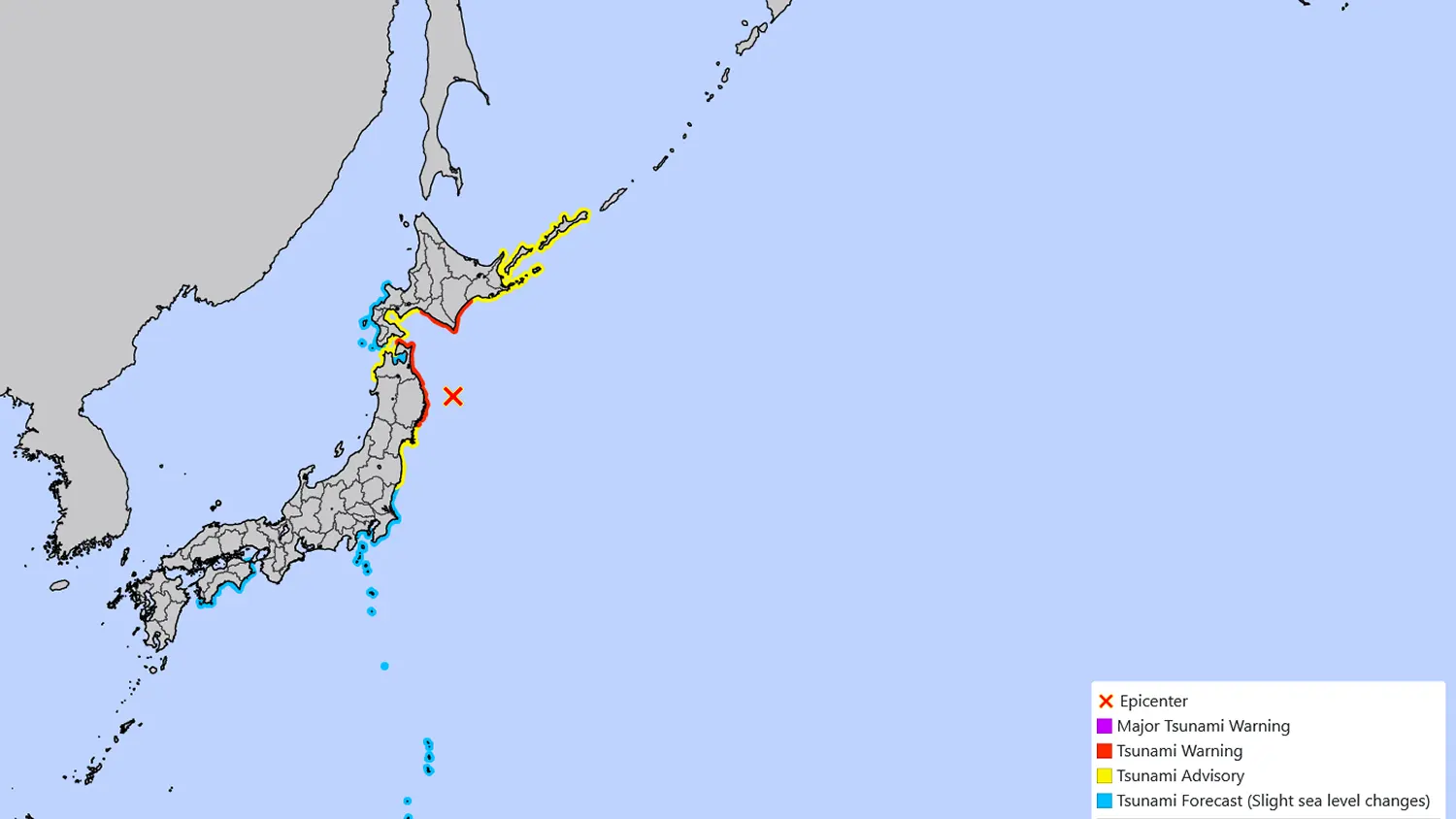
A powerful 7.5 magnitude earthquake struck off northern Japan on April 20, 2026, triggering major tsunami warnings and mass evacuations along the Pacific coast, with authorities warning that the most dangerous waves may still be approaching.
The quake hit at approximately 4:53 PM local time off the Sanriku coast at a shallow depth, amplifying its impact. Strong tremors were felt hundreds of miles away in Tokyo, underscoring the scale of the seismic event. But while the shaking has stopped, the more dangerous phase may just be beginning.
That immediate shift from earthquake to tsunami threat explains why officials are urging urgent action. The risk now lies not in the ground, but in the water, where powerful waves can travel quickly and strike with little warning.
Why the tsunami threat remains the most urgent danger
Within minutes of the quake, the Japan Meteorological Agency issued a major tsunami warning for northern coastal regions, including Iwate Prefecture, Aomori Prefecture, and the Pacific coast of Hokkaido.
Authorities warned that waves could reach up to 3 meters (10 feet) large enough to flood coastal communities and sweep away vehicles or structures. Early signs of this threat are already visible. An 80-centimeter wave has struck Kuji Port, while smaller surges have reached other locations.
But the real danger is still unfolding. Tsunami waves move in a series, not a single surge. The first wave is often not the largest, and subsequent waves can arrive with far greater force hours later.
That raises a critical point: even areas that appear calm may still be at risk.
Evacuations intensify as officials invoke lessons from 2011
Across northern Japan, emergency alerts are being broadcast in multiple languages. Public broadcaster NHK has issued stark warnings, urging residents to evacuate immediately and not return.
Officials are drawing on painful historical memory. References to the 2011 Tōhoku earthquake and tsunami are being used to stress urgency. Residents in low lying and riverside areas are being told to move to higher ground without delay, as tsunami waves can travel inland through rivers.
Prime Minister Sanae Takaichi has activated the national Crisis Management Center and reinforced a key message: “Tsunami waves hit repeatedly.”
This emphasis reflects hard learned lessons. What makes this even more urgent is that people often underestimate later waves, assuming the danger has passed.
Infrastructure disruptions highlight the scale of the response
As evacuations continue, major infrastructure has been shut down as a precaution. The Tohoku Shinkansen line has been suspended, halting high speed rail service across a wide stretch of northern Japan.
At the same time, authorities are closely monitoring sensitive facilities. Operators at the Onagawa Nuclear Power Plant and Higashidori Nuclear Power Plant report no abnormalities so far, though emergency systems remain on standby.
These checks are routine but critical. The combination of seismic activity and tsunami risk can pose complex challenges for coastal infrastructure, particularly energy facilities.
Meanwhile, aftershocks continue to ripple through the region. Multiple smaller quakes have already been recorded, increasing the risk of structural damage in already weakened buildings.
The hidden dangers: repeated waves and inland flooding
Even as initial waves arrive, experts warn the threat is far from over. Tsunami behavior is often misunderstood. Rather than a single crest, waves arrive in sequences sometimes over several hours.
Water can recede suddenly before surging back with greater force, creating a powerful and unpredictable hazard. This pattern can catch people off guard, especially those who return too early.
There is also a lesser known risk inland. Tsunami surges can travel up rivers and flood areas far from the coastline, extending danger zones well beyond beaches and ports.
This expanding threat zone is why evacuation orders include riverside communities, not just coastal ones.
A tense waiting period as Japan braces for further impact
As of early evening, the tsunami warning remains fully active. Authorities stress that this is an ongoing emergency, not a past event.
Residents in affected regions are being told to remain on high ground until the all clear is issued. The timeline is uncertain. Tsunami activity can persist for hours, and conditions can change rapidly.
For now, Japan is in a holding pattern watching the sea, tracking wave data, and preparing for what may come next. The coming hours will determine whether early warnings were enough to prevent a larger disaster, or whether the full force of this event is still yet to arrive.