
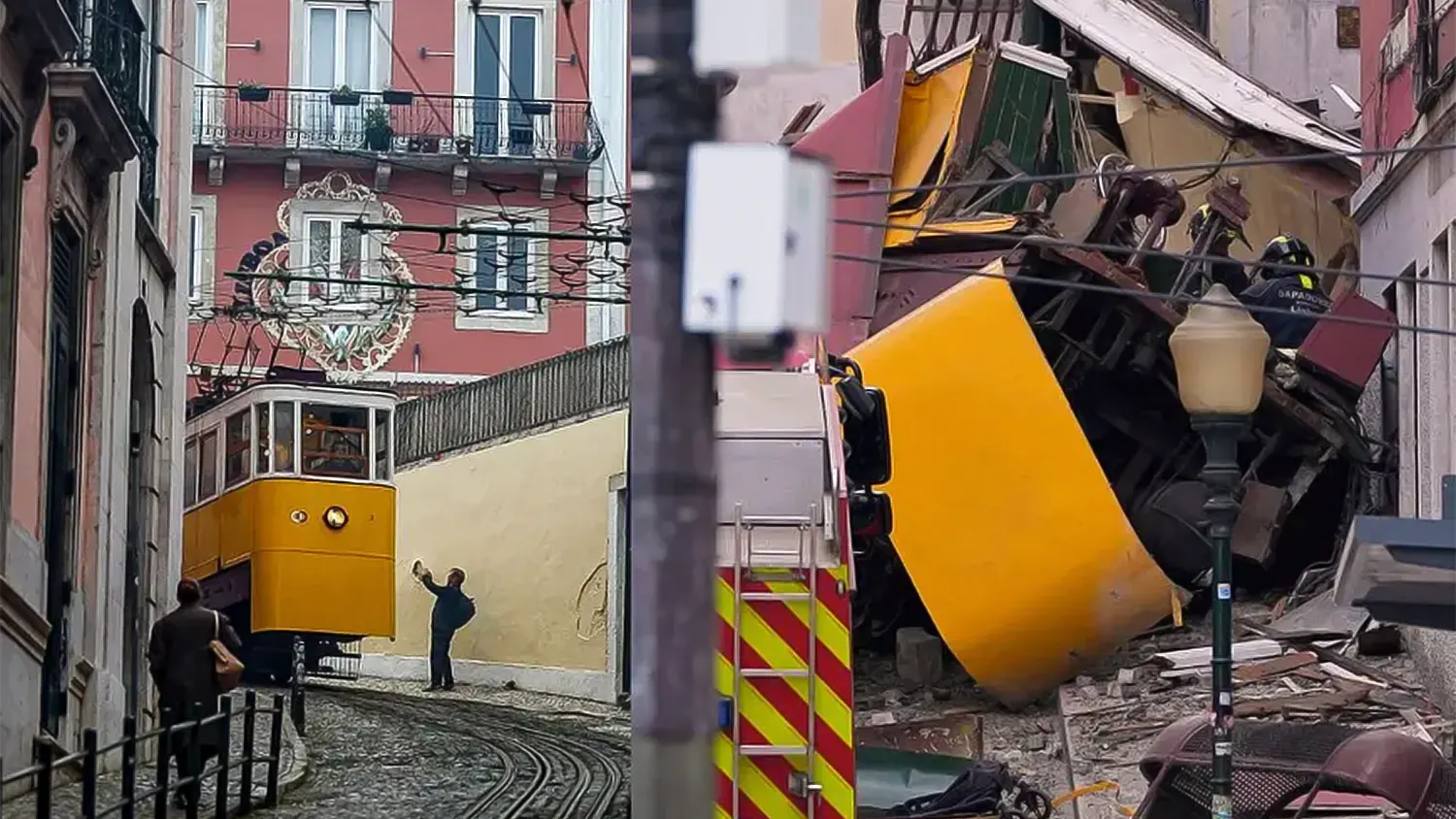
It was just after 6 p.m. on a Wednesday. The Elevador da Glória was full, as it always is at that hour commuters heading downhill, tourists taking in the ride. Then something went wrong, and 15 people were killed.
The iconic yellow funicular, one of Lisbon’s most recognizable landmarks, lost control on its steep descent from the city center toward the bohemian Bairro Alto district. It accelerated. It left the tracks. It slammed into a building with enough force to crumple the front of the car entirely. Eighteen more people were injured in the crash some critically.
The first confirmed victim was the funicular’s own brakeman, killed at his post.
Portugal declared a national day of mourning. A city that has ridden this tram for 139 years is now asking how something so familiar could go so wrong.
“It Was Going Too Fast and Then There Was a Terrible Sound”
Witnesses near the scene described the moments before impact with the kind of clarity that comes from shock.
“It was going too fast, and then there was a terrible sound of metal grinding,” said one person watching from a nearby café. “It just veered off and smashed into the building. The front of the car was completely crumpled.”
The derailment happened with little warning. One moment the funicular was descending as it has done countless times before. The next, it was careening out of control down one of Lisbon’s steepest slopes with no way to stop it.
What Investigators Think Went Wrong
The official investigation is still underway, but preliminary findings are pointing toward a catastrophic mechanical failure in the cable and braking systems.
The leading theory is that a critical cable snapped, triggering an immediate and total collapse of the primary braking mechanism. On a slope as steep as the Glória’s, that scenario leaves no margin for recovery. The vehicle becomes a runaway and the only thing that stops it is whatever it hits at the bottom.
Lisbon’s Firefighters Regiment noted the sheer force of the impact, describing what they observed as a “compound failure” suggesting that multiple safety systems may have broken down simultaneously, not just one.
Carris, the public transport operator that runs the funicular, stated that all scheduled maintenance was current and pledged full cooperation with investigators. As an immediate precaution, the company grounded every funicular and vintage tram in Lisbon, pending comprehensive safety inspections across the entire network.
Whether the maintenance records hold up to scrutiny and whether they reveal any missed warning signs will be central to the investigation going forward.
More Than a Tram. A Piece of the City’s Soul.
To understand why this crash hit Lisbon so hard, you have to understand what the Elevador da Glória actually means to the city.
Inaugurated in 1885, the funicular has been running for 139 years. It has carried generations of Lisboetas locals who grew up riding it, who took their children on it, who pass it every day without a second thought because it has simply always been there. It has also carried millions of tourists, drawn to its bright yellow cars, often painted over with vivid graffiti, climbing and descending the hill between Restauradores Square and Bairro Alto.
It is, in every sense, a living piece of Lisbon’s identity not just transport infrastructure but a moving monument to the city’s character.
That’s why Prime Minister António Costa called the crash a “heart-wrenching tragedy”, and why Lisbon Mayor Carlos Moedas declared three days of municipal mourning. It’s why condolences arrived from European Commission President Ursula von der Leyen and the leaders of Spain and Italy. The loss wasn’t just felt in Portugal. It resonated across a continent that knows and loves this city.
A Beautiful Network With an Aging Problem
Lisbon’s funiculars and vintage trams are among the most photographed transport systems in the world. They are also, by definition, old and Wednesday’s crash has forced the city into an uncomfortable conversation it can no longer avoid.
How do you maintain century-old infrastructure to modern safety standards? How do you preserve the historical character that makes Lisbon, Lisbon while guaranteeing that the people riding these vehicles make it home safely?
These aren’t new questions. But they’ve never felt more urgent.
The municipal government has pledged a top to bottom review of the entire historic transport network. The immediate work is the ongoing inspection of every similar vehicle. The longer-term challenge is harder: determining what investments, upgrades, or operational changes are needed to ensure that what happened to the Glória never happens again without hollowing out the very thing that makes these trams worth preserving.
Lisbon Is Grieving. The Investigation Is Just Beginning.
For now, the city’s focus is where it should be on the families of the 15 people who died, and on the 18 still recovering from their injuries.
The crash site is being carefully documented. The investigation will take time. And when it concludes, its findings will determine not just what went wrong on Wednesday evening, but what the future looks like for one of Europe’s most beloved transport networks.
A tram that has survived two world wars, a dictatorship, and 139 years of daily use has now become the scene of the city’s worst transit disaster in living memory. Lisbon will carry that with it and the least it can do is make sure the truth comes out.