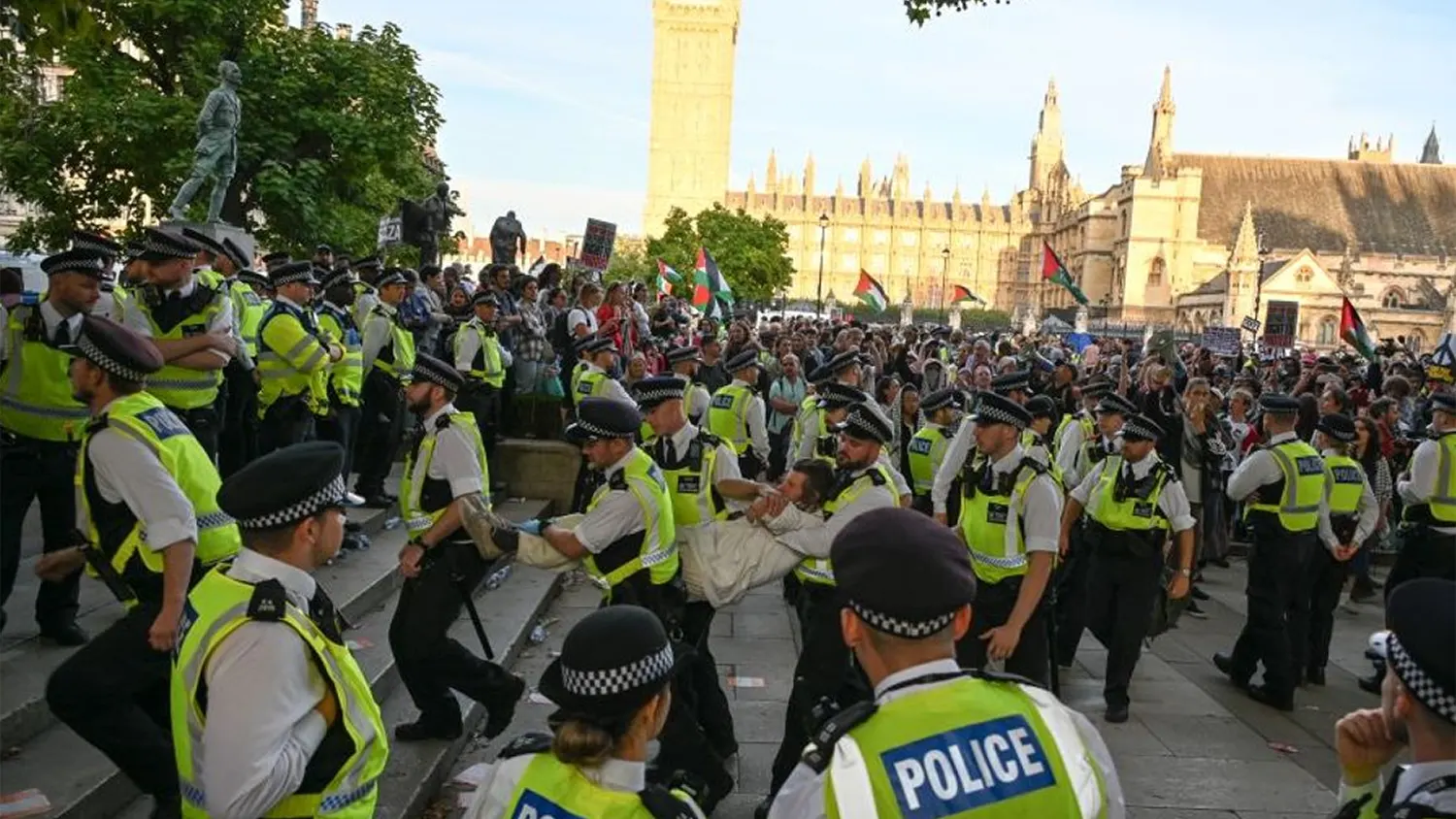
Nearly 900 people were arrested in central London after a mass protest against the UK government’s decision to classify the activist group Palestine Action as a terrorist organization. The scale of the arrests, one of the largest protest crackdowns in recent British history has triggered fierce debate over free speech, civil liberties, and how far governments should go in policing political dissent.
What began as a peaceful act of civil disobedience in Parliament Square has now become a national flashpoint.
Critics say the arrests reveal how Britain’s anti-terror laws are increasingly being used against nonviolent political activism. Supporters of the government, meanwhile, argue that authorities are simply enforcing laws passed in the name of public safety and national security.
The controversy has pushed the UK into an uncomfortable question: when does protest become extremism in the eyes of the state?
A Protest Designed to Challenge the Law Directly
The demonstration was organized by Defend Our Juries, a campaign group known for acts of civil resistance linked to climate and pro-Palestinian activism.
Protesters gathered in Parliament Square holding signs that read:
“I oppose genocide, I support Palestine Action.”
The wording was deliberate.
Earlier this year, the British government officially proscribed Palestine Action under anti-terror legislation. The designation makes public support for the group a criminal offense punishable by up to 14 years in prison.
The protest was therefore not only political, it was intentionally confrontational from a legal standpoint. Demonstrators openly challenged the government’s interpretation of terrorism laws by publicly expressing support for the banned group.
Police responded with a sweeping operation that resulted in the detention of approximately 857 people on suspicion of supporting a proscribed organization.
The sheer scale of the crackdown immediately drew international attention.
The Arrests Included Priests, Veterans, and Holocaust Survivors’ Families
Part of what intensified public reaction was the diversity of those arrested.
According to organizers, detainees included clergy members, retired teachers, military veterans, and descendants of Holocaust survivors people not typically associated with violent extremism or underground militancy.
One arrested protester, a 62 year old military veteran and son of a Holocaust survivor, reportedly told journalists:
“And I’m a terrorist? That’s the joke of it.”
The inclusion of such figures has complicated the government’s narrative and fueled accusations that Britain’s anti-terror laws are being stretched far beyond their original purpose.
Palestine Action itself is primarily known for direct-action protests targeting defense contractors such as Elbit Systems. Activists accuse those companies of supplying military equipment linked to the war in Gaza. Their tactics have included property damage, factory occupations, and disruptive demonstrations.
Critics of the ban argue that while such actions may violate criminal law, equating them with terrorism marks a dramatic escalation in state power.
Two Completely Different Versions of the Same Protest
The events in Parliament Square are now being shaped by two sharply conflicting narratives.
According to the Metropolitan Police, officers faced coordinated resistance during the operation. Police claimed demonstrators punched, kicked, and spat at officers while attempting to obstruct arrests.
Authorities described the response as necessary to address “public safety concerns and illegal actions.”
Organizers reject that version entirely.
Activists insist the demonstration was overwhelmingly peaceful and accuse police of exaggerating isolated incidents to justify aggressive tactics. Videos circulating online appear to show officers dragging protesters across the ground, carrying demonstrators to police vans, and using batons during arrests.
Many protesters reportedly used a pre-planned “going limp” tactic refusing to walk in order to slow police processing and increase operational pressure on authorities.
As officers carried them away, demonstrators chanted:
“We’re nonviolent, how about you?”
The conflicting accounts have turned the protest into more than a legal dispute. It is now also a battle over public perception and political legitimacy.
Britain’s Anti-Terror Laws Are Facing New Scrutiny
The controversy comes amid growing criticism of the UK’s expanding use of anti-terror powers.
Since Palestine Action was banned earlier this year, more than 1,600 people have reportedly been detained for publicly expressing support for the group. A significant number now face charges under the Terrorism Act.
Civil liberties organizations argue that the government is setting a dangerous precedent by applying terrorism legislation to political protest movements primarily associated with property damage rather than mass violence.
Amnesty International UK has launched what it describes as an unprecedented “Urgent Action” campaign in response to the arrests. The organization warned that Britain’s terrorism laws are becoming “overly broad” and risk suppressing lawful expression.
International concern is also growing.
United Nations human rights experts have reportedly questioned whether acts involving property damage should legally qualify as terrorism at all. Their criticism reflects broader fears that democratic governments are increasingly blurring the line between extremism and disruptive activism.
The Real Battle Is Over the Limits of Dissent
The mass arrests in London are about more than one protest group.
They reflect a wider shift happening across many Western democracies, where governments are expanding surveillance powers, protest restrictions, and anti-extremism laws in response to political unrest, climate activism, and highly polarizing international conflicts.
Supporters of these measures argue that modern protest movements are becoming more disruptive, coordinated, and economically damaging. Critics counter that governments are using national security language to criminalize dissent that would once have been treated as ordinary civil disobedience.
That tension is now playing out openly in Britain.
The government insists the law is necessary to maintain order and security. Protesters argue the state is redefining political speech itself as a security threat.
And with legal challenges already underway, the confrontation appears far from over.
Because at the center of this debate lies a question that reaches far beyond Parliament Square:
How much dissent is a democracy willing to tolerate before it begins treating protest as terrorism?