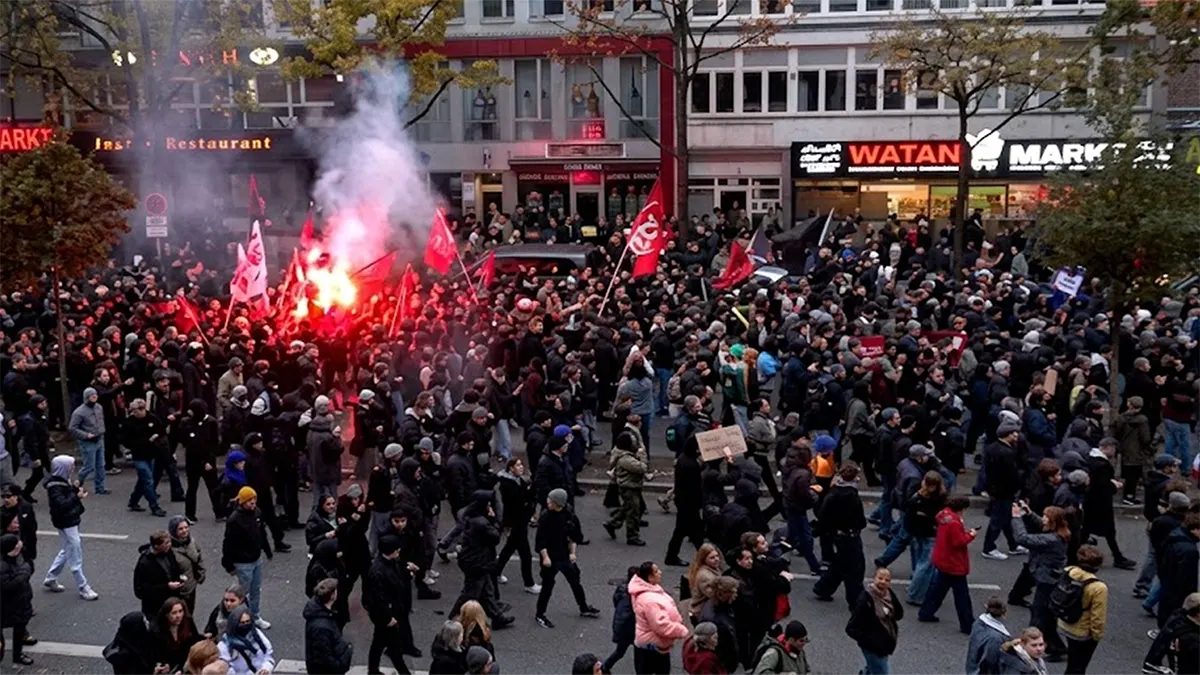
Tens of thousands of young people took to the streets across Germany on October 31, demanding better public services, affordable living costs and greater attention to their generation’s future. However, what began as largely peaceful demonstrations under the banner “Gen Z regelt” later descended into violence in several cities, with reports of looting, damaged businesses and clashes with police.
The nationwide demonstrations took place in 34 German cities, including Berlin, Frankfurt, Hamburg, Cologne and Munich. Organizers wanted to draw attention to growing frustration among young people over economic pressures, deteriorating public infrastructure and government policies affecting their future.
While most daytime rallies remained peaceful, tensions escalated after the official demonstrations ended. Police faced violent groups in several urban centers, prompting large-scale operations to restore order.
Young Germans Demand Better Education and Affordable Living
The campaign “Gen Z regelt,” roughly translated as “Gen Z takes charge,” brought together young people concerned about the economic and social challenges facing their generation.
One of the movement’s main demands is increased investment in public education. Protesters criticized deteriorating school buildings, inadequate facilities and a lack of resources in schools and universities. They also called for greater funding for healthcare, social services and climate protection.
The rising cost of living was another major concern. With housing, everyday expenses and other essential costs placing pressure on younger generations, demonstrators demanded policies that would make life more affordable.
Protesters also expressed opposition to plans to strengthen Germany’s military recruitment system, particularly proposals involving compulsory military service.
For many participants, the demonstrations represented a broader frustration with political decision-making. They argued that young people face long-term consequences from government policies but have limited influence over the decisions shaping their future.
Halloween Rallies Remain Peaceful During the Day
The demonstrations began on Saturday afternoon, with rallies taking place at prominent locations across the country.
In Berlin, demonstrators gathered near the Brandenburg Gate, while other major cities organized marches through central shopping districts and public squares. Some participants wore Halloween costumes and carried signs criticizing government policies.
According to German media reports, the main demonstrations were largely peaceful. Tens of thousands participated nationwide, although the final turnout was below the organizers’ initial expectations.
The campaign had anticipated at least 182,000 participants across the country. However, turnout estimates varied between cities, with police and organizers often reporting different figures.
The peaceful atmosphere began to change in some locations as the demonstrations approached their conclusion.
Frankfurt Faces Looting and Violent Clashes Along the Zeil
Frankfurt experienced some of the most serious incidents of the night.
After the main demonstration ended, groups of rioters moved through the city center, where several businesses along the Zeil shopping district were targeted.
Shop windows were smashed, and individuals entered stores to steal merchandise, including sneakers and other goods. Police eventually closed off sections of the busy shopping street as officers attempted to contain the unrest.
The violence also reached a firearms and tactical equipment store. Its display windows were smashed, and two firearms were recovered by police following an intervention involving special tactical units. Several individuals were arrested in connection with the incident.
Police also reported that emergency personnel were targeted with fireworks, stones and other objects, including Molotov cocktails.
Hesse Interior Minister Roman Poseck condemned the violence and said around 100 left-wing extremist individuals had been involved in attacks against police officers.
He described the events as a serious escalation and called for firm action against those responsible.
Cologne and Hamburg Also Experience Nighttime Unrest
Frankfurt was not the only city affected by violence.
In Cologne, tensions escalated near the central railway station and the Domplatte, close to Cologne Cathedral. Groups of individuals threw bottles and other objects at police officers. Bicycles were also thrown, while an electric scooter was reportedly used to smash a storefront window.
Police detained several people as officers attempted to control the situation.
In Hamburg, groups erected barricades and set fire to construction materials and rubbish containers. Emergency services and police officers were targeted with fireworks and other projectiles.
Authorities deployed water cannons and other crowd-control measures in affected areas.
Berlin also experienced incidents involving fireworks and objects thrown at police. However, reports distinguished between the main “Gen Z regelt” demonstration and separate protest groups operating in the city.
Organizers Distance Themselves From the Violence
Despite the incidents, organizers of “Gen Z regelt” emphasized that the movement was intended to remain peaceful.
The campaign rejected vandalism, extremist activity and violence, arguing that criminal incidents should not be confused with the demands of the broader youth movement.
A spokesperson for the initiative, identified publicly as Amadeo, said the organizers had no control over what happened after the official demonstrations ended.
German police union representatives also described the main daytime protests as largely peaceful, while noting that violence emerged in several locations later in the evening.
In some cities, authorities and media reports suggested that autonomous and extremist groups had joined or gathered around the demonstrations.
However, the precise relationship between these groups and the original protest movement remains an important distinction. Participation in the peaceful rallies does not establish responsibility for subsequent crimes.
Police Make More Than 200 Arrests as Investigations Continue
German authorities launched extensive police operations following the nighttime escalation.
According to reporting by Anadolu Agency citing police information, more than 200 people were arrested or temporarily detained nationwide following the clashes.
Special tactical units, water cannons and pepper spray were deployed in affected areas as officers attempted to disperse violent groups and secure public spaces.
Police also reported injuries among officers, including injuries associated with fireworks and objects thrown during confrontations.
Investigations are continuing across several states. Authorities are reviewing surveillance footage, recordings from police operations and videos shared on social media to identify individuals suspected of participating in looting, vandalism, arson and attacks against emergency personnel.
Potential criminal offenses include theft, property damage, arson, assault and breaches of the peace under German law. The specific charges will depend on the evidence collected in individual cases.
Merz Government Faces Pressure Over Youth Concerns
The demonstrations have placed renewed attention on the policies of Chancellor Friedrich Merz’s government and the challenges facing younger Germans.
The protesters’ demands extend beyond a single political issue. Education funding, housing affordability, public services, climate protection and military recruitment have all become part of a wider debate about Germany’s economic and social priorities.
The government faces competing pressures. It has emphasized the importance of fiscal discipline, economic stability and strengthening national defense, while critics argue that more substantial investment is needed to address problems affecting younger generations.
Military service remains particularly sensitive.
The government’s efforts to strengthen military recruitment have raised concerns among young people who fear that voluntary recruitment measures could eventually lead to compulsory service.
The Federal Students’ Conference has also announced a separate demonstration in Berlin for November 20. The organization previously distanced itself from “Gen Z regelt,” citing concerns about the campaign’s organizational transparency.
The separate student mobilization reflects the wider debate over education, military service and the future of young people in Germany.
Gen Z Regelt Plans Further Protests in November
The October 31 demonstrations are not intended to be a one-time event.
Following the nationwide rallies, the campaign said it wanted to continue mobilizing young people and participate in further European demonstrations.
A spokesperson described the October 31 protests as only the first step, indicating that the movement intends to remain active.
The next major date is November 20, 2026, when the Federal Students’ Conference plans its own student-led demonstration in Berlin, alongside other supporting organizations.
The upcoming actions could provide another opportunity for young people to bring attention to their concerns over education, living costs, military policy and public investment.
For Germany’s political leadership, the challenge will be addressing those concerns while maintaining public order and distinguishing legitimate political demonstrations from criminal activity.
The October 31 protests have shown that frustration among younger Germans extends across several policy areas. Whether that frustration develops into a sustained political movement will depend on how organizers, government representatives and the wider political system respond in the weeks ahead.