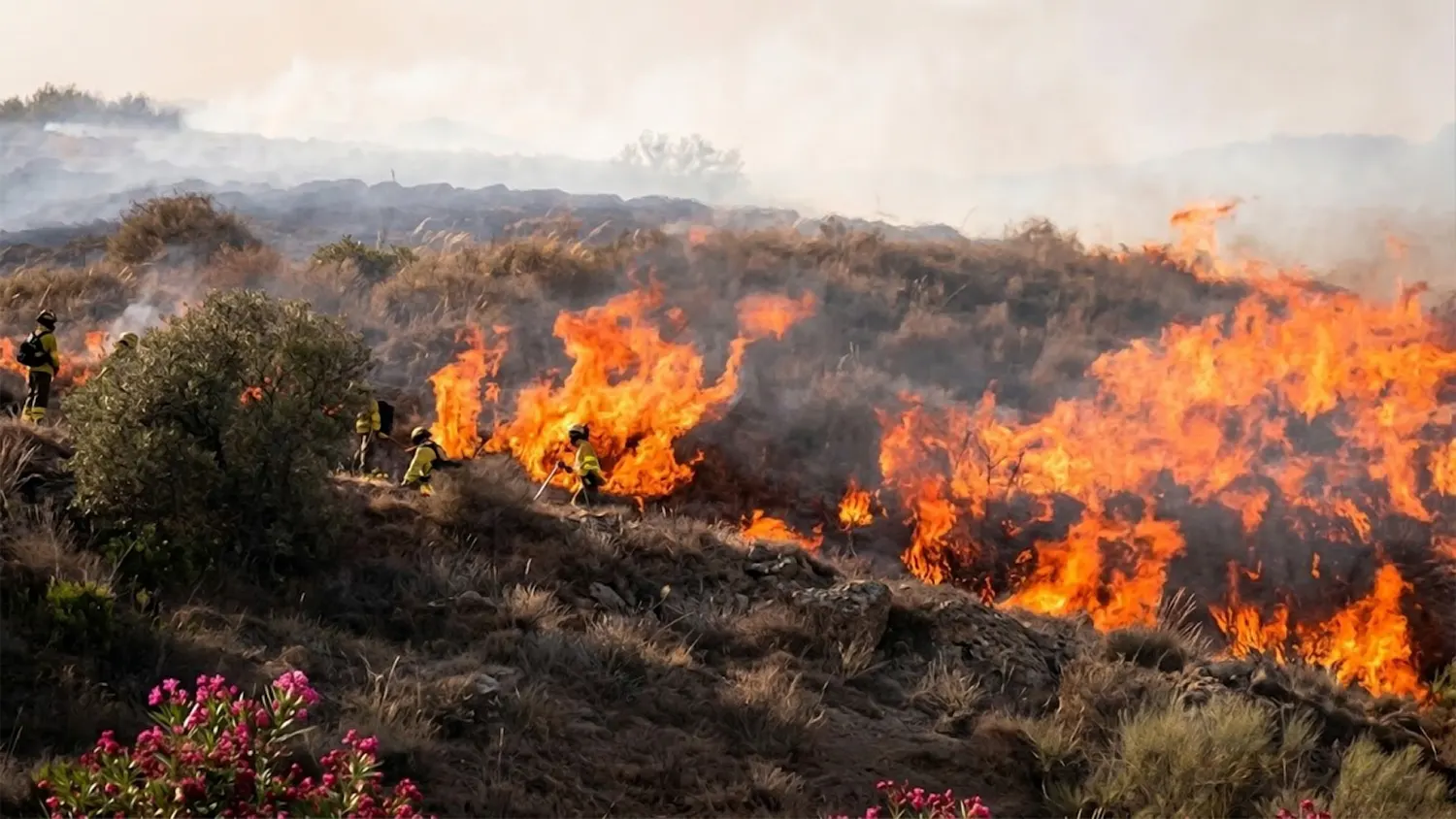
A fast-moving wildfire in southern Spain has become one of the country’s deadliest natural disasters in recent years, claiming at least 12 lives, injuring several others, and leaving dozens missing as firefighters continue battling flames across rugged terrain in Almería Province.
The blaze, which erupted on Thursday afternoon near Los Gallardos in Andalusia, spread with alarming speed under extreme heat, dry vegetation, and strong winds, overwhelming emergency responders and forcing more than 1,400 residents to evacuate.
The tragedy comes as multiple countries across southern Europe face a wave of destructive wildfires fueled by an intense summer heatwave.
Narrow Roads Became a Deadly Escape Route
Authorities confirmed that at least 12 people have died, while eight others were injured, several suffering severe burns. Another 23 people remain missing as search and rescue teams continue operations.
Officials have declared the disaster the deadliest wildfire in Andalusia’s history and the third deadliest wildfire ever recorded in Spain.
Many victims lost their lives while attempting to flee.
According to local authorities, thick smoke and rapidly advancing flames trapped vehicles along narrow rural roads near the village of Bédar, turning what should have been escape routes into deadly corridors.
Several victims were found inside their vehicles after being unable to outrun the fire.
The affected region is home to a large community of European retirees, and officials said several victims are foreign nationals, including at least four people believed to be British citizens.
Thousands of Hectares Reduced to Ash
The wildfire has already burned through more than 3,800 hectares (around 9,400 acres) of forests, farmland, and scrubland.
More than 300 emergency personnel remain deployed to contain the blaze, including 150 specialists from Spain’s Military Emergency Unit (UME).
Firefighters continue to face extremely difficult conditions as they battle steep mountainsides, shifting winds, and persistent high temperatures.
Cause Still Under Investigation
Investigators are still working to determine what sparked the wildfire.
Early witness reports suggested a fallen power line near the N-340 highway ignited dry vegetation, triggering the blaze.
However, regional electricity provider Endesa has rejected that explanation, stating the power line identified by witnesses was inactive and not part of the company’s electrical network.
Officials have not yet confirmed the exact cause.
Heatwave Created the Perfect Conditions for Disaster
Although the initial ignition remains unclear, experts say the extreme weather conditions are what allowed the fire to spread so rapidly.
A wetter-than-usual winter and spring encouraged dense vegetation growth across the region. That vegetation was later dried out by three consecutive heatwaves, with temperatures climbing above 42°C (107°F).
At the same time, wind gusts reaching 50 km/h (31 mph) pushed the flames across nearly 15 kilometers in just two hours, leaving firefighters little chance to contain the blaze during its early stages.
Scientists note that while heatwaves rarely ignite fires themselves, they dramatically increase the likelihood that a small spark can develop into a fast-moving wildfire.
Dry vegetation, low humidity, and prolonged high temperatures create what fire experts often describe as a “tinderbox” environment, where even a minor ignition source can trigger catastrophic consequences.
Wildfire Emergency Spreads Across Southern Europe
The disaster in Spain is part of a much larger wildfire emergency affecting several countries across southern and Mediterranean Europe, all facing similar conditions of prolonged heat and drought.
Portugal Battles One of Europe’s Largest Fires
In central Portugal’s Vouzela region, firefighters continue battling one of the continent’s largest active wildfires.
The blaze has already consumed more than 12,000 hectares (approximately 30,000 acres) of land.
Authorities have deployed over 1,200 firefighters, supported by hundreds of emergency vehicles and firefighting aircraft from neighboring countries, including Spain and Italy.
Greece Faces Multiple Fire Emergencies
Greece is also confronting several dangerous wildfires.
West of Athens, crews are using dozens of water-dropping aircraft to protect communities as flames spread through pine forests.
Meanwhile, near Thessaloniki, another wildfire engulfed a recycling facility, sending thick toxic smoke into nearby neighborhoods.
Emergency officials urged residents in several suburbs to remain indoors because of hazardous air quality.
France Orders Evacuations as Fire Threatens Communities
Southern France has also experienced rapidly spreading wildfires.
A fire near Perpignan created an 18-kilometer flame front, forcing around 5,000 people to evacuate.
The wildfire seriously injured both a firefighter and a local resident, while authorities also modified sections of the Tour de France route and restricted public access to affected areas for safety.
Another Major Blaze Burns in Northeastern Spain
Spain is simultaneously dealing with another significant wildfire in Girona, Catalonia, where more than 2,200 hectares have already burned.
Police have detained a worker suspected of accidentally starting the fire after sparks from an angle grinder ignited nearby vegetation.
Europe Mobilizes Joint Firefighting Response
With multiple countries battling large wildfires at the same time, the European Union has activated its Civil Protection Mechanism to coordinate international assistance.
The emergency response includes hundreds of pre-positioned firefighters from 14 countries and a shared fleet of 22 firefighting aircraft, allowing resources to be deployed quickly wherever conditions become most critical.
As extreme heat continues across southern Europe, authorities warn that the wildfire threat remains exceptionally high, with firefighters preparing for the possibility of additional outbreaks in the coming days.