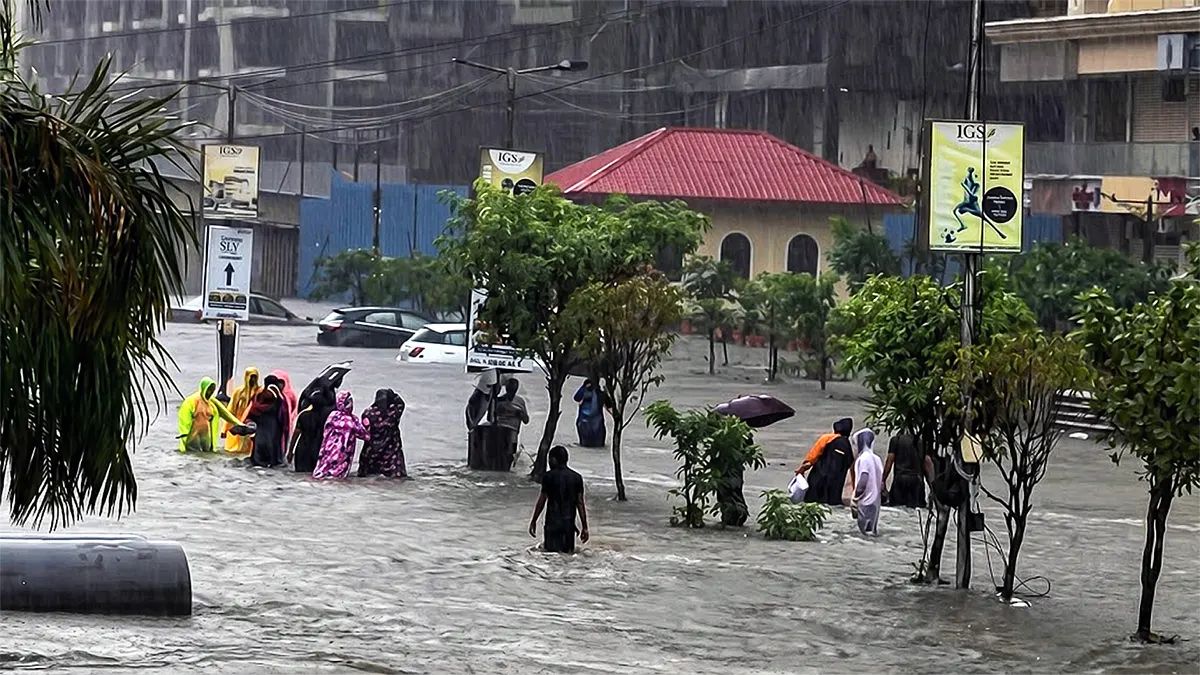
Mumbai remains under a Red Alert after relentless monsoon rain triggered widespread flooding across the city, with weather officials warning that the worst may not be over.
The India Meteorological Department (IMD) has forecast continued extremely heavy rainfall across Greater Mumbai and nearby districts, while a series of high tides over the coming days could worsen flooding in already waterlogged neighborhoods.
Over the past 24 to 48 hours, several parts of Mumbai, including Vikhroli, Colaba, and Malabar Hill, recorded between 250 mm and 300 mm of rainfall. That amounts to roughly 74% of the city’s average rainfall for the entire month of July, overwhelming drainage systems and inundating low-lying areas.
High Tides Could Make Flooding Worse
Authorities say the biggest concern now is the combination of heavy rain and high tides.
The Brihanmumbai Municipal Corporation (BMC) has warned that high tides exceeding 4.15 meters will significantly reduce the city’s ability to drain rainwater into the Arabian Sea.
When tides are exceptionally high, drainage gates must remain closed to prevent seawater from entering the city. As a result, rainwater has nowhere to escape, causing streets to flood rapidly.
Areas considered especially vulnerable include:
- Hindmata
- Parel
- Sion
- Kurla
Residents living in these neighborhoods have been urged to remain vigilant as water levels can rise quickly during periods of intense rainfall.
Public Transport Running With Delays
Despite the challenging conditions, much of Mumbai’s public transportation network continues to operate.
Local suburban trains, Metro services, and BEST buses are attempting to maintain regular schedules. However, commuters have reported delays on both the Central and Western Railway lines as waterlogged tracks continue to disrupt operations.
Officials are advising commuters to check service updates before traveling.
Authorities Urge Residents to Stay Indoors
With heavy rain expected to continue, the BMC is urging residents to avoid unnecessary travel and stay indoors unless absolutely necessary.
People are also encouraged to avoid flooded roads, underpasses, and low-lying areas where water levels can rise within minutes.
For emergencies, the BMC Disaster Management Helpline can be reached by dialing 1916.
Why Does Mumbai Flood So Easily?
Experts say Mumbai’s recurring flood problem is caused by a combination of extreme monsoon weather and long-standing urban infrastructure challenges. The phenomenon is often described as the city’s “bathtub effect,” where enormous amounts of rain fall faster than the city can drain it.
A Constant Supply of Monsoon Rain
During the southwest monsoon, moisture-laden winds from the Arabian Sea continuously feed rain clouds moving toward Mumbai.
At the same time, a persistent offshore trough along the Konkan coast helps keep rain bands nearly stationary over the Mumbai Metropolitan Region instead of allowing them to move inland.
The nearby Western Ghats further intensify rainfall through orographic lifting, forcing moist air upward where it cools and produces torrential downpours.
High Tides Block the City’s Drainage
Mumbai’s drainage system relies almost entirely on gravity to carry rainwater into the Arabian Sea.
During major high tides, however, seawater pushes back against drainage outlets. To prevent seawater from flooding the city, floodgates are closed, trapping rainwater within urban areas.
This creates one of the biggest contributors to flash flooding during peak monsoon periods.
Aging Infrastructure Adds to the Crisis
Mumbai’s geography also makes flooding difficult to avoid.
Much of the modern city sits on low-lying reclaimed land, formed by joining seven historic islands. Many neighborhoods are only a few meters above sea level, making them natural collection points for floodwater.
Urban development has also reduced many of the city’s natural flood defenses.
Over the years, mangrove forests, wetlands, and lakes that once absorbed excess rainwater have been replaced by roads and buildings, increasing surface runoff during heavy storms.
Adding to the challenge is Mumbai’s aging stormwater drainage network, much of which was designed to handle only 25 millimeters of rainfall per hour. During extreme events delivering 200 to 300 millimeters of rain in a single day, the system quickly becomes overwhelmed.
Blocked drains caused by plastic waste and debris further reduce drainage capacity.
IMD Warns More Heavy Rain Is on the Way
According to the India Meteorological Department, there is no immediate relief in sight.
Weather warnings remain in effect across Mumbai and the Konkan region, with intense monsoon activity expected to continue through the first week of July.
Meteorologists warn that although rainfall may briefly ease at times, localized cloudbursts capable of producing more than 200 millimeters of rain remain possible.
Because the ground is already saturated, any additional rainfall is expected to become immediate surface runoff, increasing the risk of rapid flash flooding.
Critical High Tide Windows to Watch
Flood risks will be highest when heavy rainfall coincides with incoming high tides.
Authorities are closely monitoring two key periods:
- Sunday afternoon: High tide of approximately 4.19 meters
- Monday early morning: High tide of approximately 3.51 meters
If intense rain falls during these windows, flooding could worsen significantly across low-lying parts of the city.
Strong Winds Raise Additional Safety Concerns
Beyond flooding, the IMD has also warned of gusty winds between 55 and 65 km/h.
The combination of saturated ground and strong winds increases the likelihood of:
- Trees falling
- Damage to vehicles
- Structural risks involving older buildings and compound walls
Several tree collapses have already been reported, including incidents in Ghatkopar.
Schools Closed in Nearby Districts
As a precaution, authorities have ordered school closures in neighboring districts including Thane and Palghar.
Residents are advised to monitor the latest weather forecasts, avoid flood-prone routes such as the Andheri subway, and plan any essential travel around high tide timings until conditions improve.