For more than four years, the fear that Russia’s war in Ukraine might physically spill into NATO territory has lived mostly in threat assessments and contingency briefings. On the night of the Galați strike, it stopped being theoretical.
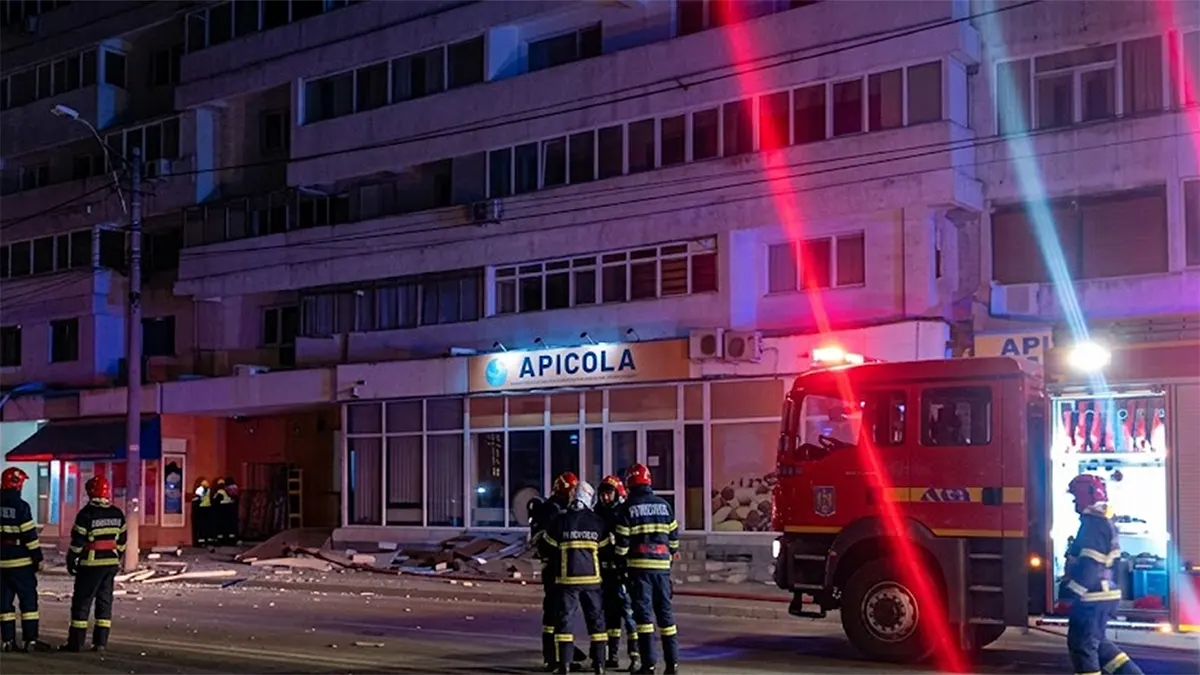
A Russian Shahed-equivalent drone crashed into a ten-story residential apartment building in Galați, a city in eastern Romania, triggering an explosion and fire on the building’s roof, damaging two stairwells, destroying five parked cars, and injuring two civilians. Around 70 residents were evacuated into the street.
Romania is a member of both NATO and the European Union. What happened in Galați was not a near-miss or a fragment landing in a field. It was a Russian weapon striking a densely populated civilian building on the territory of a Western alliance.
The responses from Bucharest, Brussels, and NATO headquarters moved fast and they moved hard.
What the Drone Was Doing Over Romania
The strike did not happen in isolation. Russia launched 232 drones overnight in a massive wave targeting Ukrainian civilian infrastructure and port facilities along the Danube River, the same waterway that forms the border between Ukraine and Romania.
The Geran-2 drone, Russia’s domestically produced version of the Iranian-designed Shahed-136 that crossed into Romanian airspace was almost certainly part of that salvo, likely displaced from its original trajectory by electronic countermeasures or navigation drift.
Romania’s military was not caught entirely off guard. Radar tracked the drone entering Romanian airspace, and the military scrambled two F-16 fighter jets and a military helicopter, pushing air raid alerts to residents in border counties. The problem was the timeline and the altitude. The drone was airborne over Romanian territory for approximately four minutes and was flying extremely low, low enough that radar contact was lost before an interception could be executed.
Crucially, Romanian military officials addressed this decision directly: attempting to shoot down the drone over Galați would have scattered heavy shrapnel across the same civilian neighborhood the drone ultimately hit. It was a no-win scenario built into the physics of the situation four minutes, low altitude, urban airspace, no clean intercept geometry.
Romania’s Response: Swift, Measured, and Pointed
Romanian President Nicușor Dan did not understate what had happened. He described it as “the worst incident to hit the national territory” since Russia’s invasion of Ukraine began, a statement that carries real weight given how many drone fragments and missile debris pieces have landed on Romanian soil in recent years without causing direct casualties.
Bucharest moved on multiple tracks simultaneously. Diplomatically, Romania summoned the Russian ambassador. Then it went further: shutting down the Russian Consulate General in the Black Sea port city of Constanța and declaring the Russian consul persona non grata, a significant escalation in the diplomatic confrontation.
On the military side, Romania formally requested that NATO allies urgently accelerate the transfer of advanced anti-drone capabilities to Romanian territory, specifically to address the low-altitude radar gaps along the Danube River border that allowed this drone to go undetected until it was too late to intercept safely.
Moscow’s Response: Deny, Warn, Deflect
Russia’s reaction followed a pattern that has become predictable in moments like this and it revealed more than the Kremlin may have intended.
Kremlin spokesman Dmitry Peskov confirmed that President Putin had been briefed on the incident, then carefully declined to say whether the aircraft belonged to the Russian military. The acknowledgment of awareness, combined with the refusal to take or deny ownership, is a form of studied ambiguity designed to avoid the diplomatic consequences of admission while leaving the psychological impact of the strike fully intact.
The more revealing response came from Russia’s Foreign Ministry. When Romania announced the consulate closure and the expulsion of the Russian consul, spokeswoman Maria Zakharova warned that Moscow’s retaliation “will not be long in coming” and dismissed the international outcry as a Western “fuss.”
Former President Dmitry Medvedev went further, posting publicly that EU nations should “get ready” and that strikes like this “will keep on happening” as long as Europe supports Ukraine.
Taken together, the Russian messaging accomplished something notable: it denied intentional responsibility while simultaneously threatening more of the same. That combination plausible deniability paired with explicit menace is not an accident. It is a posture.
NATO’s Four-Minute Problem
The detail that will stay with military planners longest is not the strike itself, it is the four-minute window.
That is how long the drone was over Romanian airspace. Four minutes is not enough time to scramble aircraft, establish intercept geometry, obtain authority to fire, and execute a clean intercept over a populated city. It is barely enough time to push an alert to residents’ phones.
NATO Secretary-General Mark Rutte held an emergency call with President Dan and publicly declared that the alliance “stands ready to defend every inch of Allied territory.” That commitment is real and it matters. But the Galați incident exposed a specific technical vulnerability that a declaration of solidarity does not fix: Romania has insufficient low-altitude anti-drone coverage along its Danube River border.
Allies are already moving to address this. NATO is accelerating the transfer of advanced anti-drone systems to Romania, electronic warfare tools and interception capabilities specifically designed for the kind of slow, low-flying threats that conventional air defense radar can miss. The four-minute window may not be expandable, but what Romania can do inside it is about to change significantly.
Brussels Moves on Sanctions and Funding
The European Union treated the Galați strike as an attack on EU soil because legally and territorially, it was.
European Commission President Ursula von der Leyen stated plainly that Russia’s war “has crossed yet another line” by injuring civilians inside the European Union, and announced that the 21st package of economic sanctions against Russia is being fast-tracked as a direct consequence of the strike.
Beyond sanctions, the EU is unlocking expedited funding through its SAFE security program to help Romania purchase and deploy specialized electronic warfare and anti-drone systems along its eastern border. This is not aid pledged for future budget cycles, it is emergency funding being mobilized now, for a gap that a burning apartment building in Galați made impossible to ignore.
EU Foreign Policy Chief Kaja Kallas called the incident a “blatant and serious violation of Romania’s sovereignty,” adding that Moscow cannot breach European airspace without consequences.
The Wider Neighborhood Speaks
The political reverberations spread beyond the immediate parties. Moldovan President Maia Sandu whose country sits between Ukraine and Romania and has repeatedly dealt with stray missile debris condemned the strike in direct terms, calling Russia “a danger to all” and stating that it “must be stopped.”
Moldova’s geography makes its position particularly pointed. The country has no NATO membership and no Article 5 protection. If Romania, which has both, can be struck by a Russian drone on a Tuesday night, the calculus for countries without that protection is darker still.
The Line That Just Moved
There is a version of this story where the Galați drone is classified as an accident, navigation error, signal drift, the chaos of a 232-drone salvo. Romanian and NATO officials will investigate, and the technical explanation may well land somewhere in that territory.
But the political and strategic reality of what happened does not depend on intent. A Russian weapon struck a residential building inside a NATO and EU member state, injured its citizens, and forced the evacuation of 70 people. Russia’s response was to deny ownership, threaten retaliation for the diplomatic fallout, and signal that more of this is coming.
Whatever the technical cause, the line has moved. The question every NATO capital is now asking isn’t whether Russia’s war can reach their territory. The answer to that question just landed on a rooftop in Galați.