It started as a warning. Within days, it became a crisis. By May 9, 2026, the South African government had seen enough and officially declared a national state of disaster, unlocking emergency powers and fast-tracked funding to deal with what is now the country’s most destructive weather event in a generation.
As of today, May 14, the storms have not fully stopped. More cold fronts are moving in. And for thousands of South Africans already sleeping in damaged homes, cut off from roads, without power or clean water, the worst may not be over yet.
What Turned Ordinary Winter Rain Into a 30 Year Catastrophe
This was not a single storm. It was a sequence and the sequencing is exactly what made it so devastating.
Between May 4 and May 11, two powerful cold fronts struck in rapid succession. The first saturated the ground. The second had nowhere to drain. Meteorologists note that when the soil is already waterlogged, nearly all of a second storm’s rainfall becomes instant runoff fast-moving, destructive, and near-impossible to contain.
Layered on top of that was a “cut off low” pressure system, a weather pattern South Africa knows well and fears for good reason. This type of system stalls over a region rather than moving through it, dumping rainfall totals that exceeded 200mm in some areas over just a few days.
Scientists from World Weather Attribution have pointed to La Niña conditions as a key amplifier. The climate pattern increases moisture carried in from the Indian Ocean, making already-wet years dramatically wetter and more damaging than historical averages would suggest. To make things worse, unusual early-winter snowfall in the high-lying areas of the Northern and Eastern Cape melted rapidly when warmer rain followed, pushing river systems like the Kouga and Gamtoos well beyond their banks.
Families Isolated, Schools Shut, Communities Severed
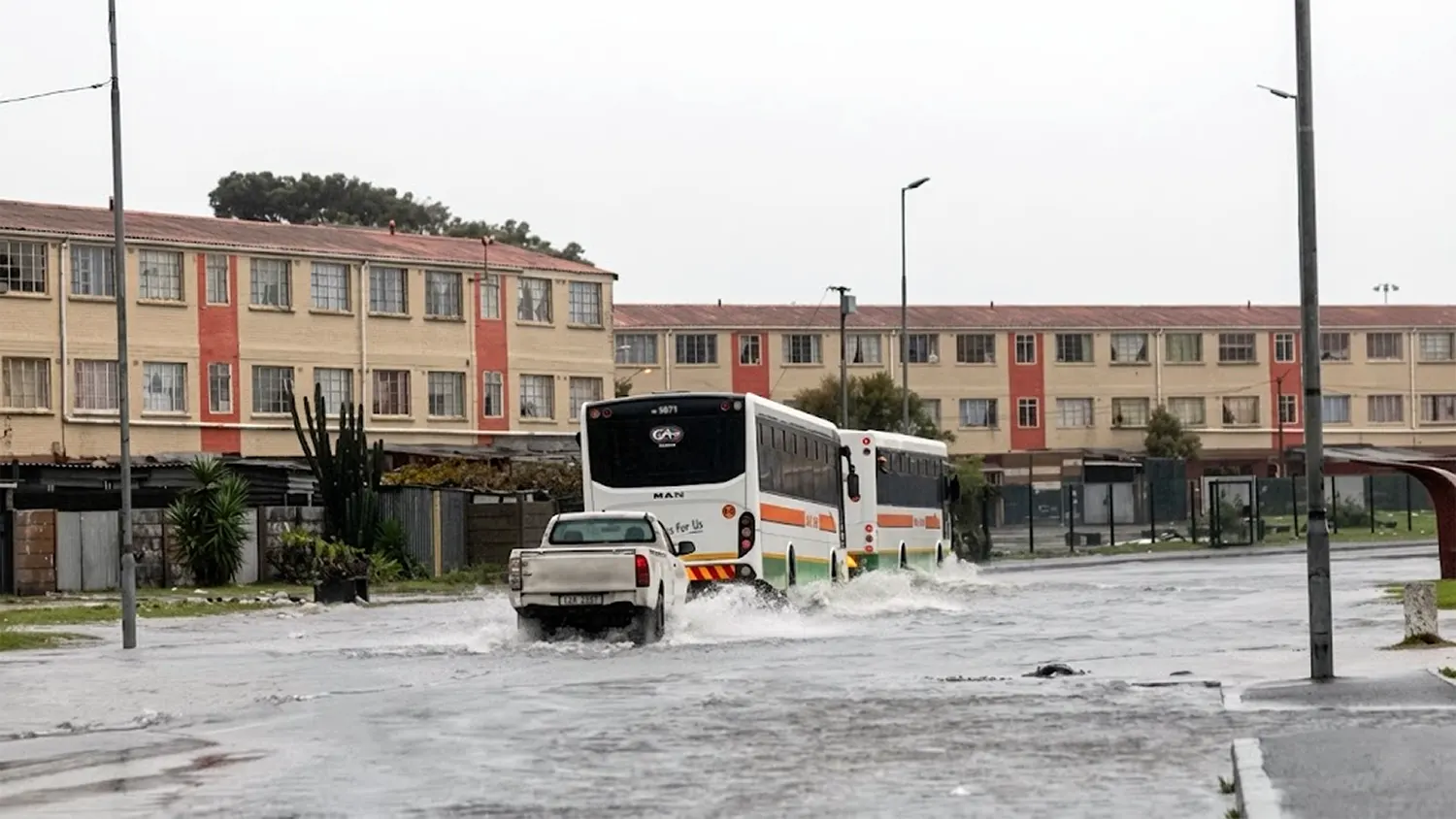
The numbers tell part of the story. At least 10 people have died across the Western Cape, Northern Cape, and North West provinces. Over 10,000 structures in informal settlements across the Western Cape have been damaged in Cape Town’s townships of Khayelitsha, Gugulethu, and Philippi alone, more than 5,600 residents found their homes flooded or destroyed.
But numbers can flatten the reality of what isolation actually means.
In Willowmore, a small Eastern Cape town where 80% of the population depends on social grants, road collapses and rockfalls have completely cut the community off. Without electricity, ATMs don’t work. Without ATMs, pensioners and grant recipients can’t access their money. Families are left without food, without medical supplies, and without a road in or out.
It is the same story in parts of the Garden Route, which is experiencing its worst flooding in 30 years. More than 45 major roads have been closed, including the R328 to the Cango Caves. Electrical substations have been damaged, leaving towns dark for days. Telecommunications infrastructure in rural areas has gone down, making it harder for emergency services to even find people who need help.
The Western Cape Education Department took the drastic step of closing all schools in the province on May 12, after 125 schools in the Garden Route had already been shut earlier in the week. Getting children to school safely was no longer possible and the government chose not to try.
The Economic Damage Goes Well Beyond the Visible
The flooding has struck at a particularly painful moment for South Africa’s agricultural sector.
The citrus and avocado industries are facing serious losses just as harvest season approaches. Early estimates suggest that 10 to 12 percent of the citrus crop in affected Cape regions may be lost to uprooted trees and flooded orchards. This comes on top of flooding earlier in 2026 across Limpopo and Mpumalanga that had already caused more than $230 million in agricultural damages.
Along the Garden Route one of South Africa’s most visited tourism corridors the economic standstill is visible. SANParks has closed numerous hiking trails and mountain passes due to the risk of mudslides and falling trees. Hotels, guesthouses, and tour operators along the route are absorbing losses with no clear timeline for when visitors can return.
And in communities like Willowmore, the economic damage is more immediate and human: no power means no ATMs, and no ATMs means no access to the social grants that keep a large portion of the local population fed.
How the Government Is Responding and What’s Still at Risk
The declaration of a national state of disaster on May 9 is more than symbolic. It legally allows the government to bypass bureaucratic delays in deploying resources, forces national, provincial, and local governments to coordinate under a single command structure, and authorizes National Treasury to release emergency relief grants.
On the ground, organisations like Gift of the Givers are already operating using 4×4 vehicles to reach isolated communities with food parcels, hygiene packs, and baby care supplies. The South African Police Service and the National Defence Force have been placed on standby for search-and-rescue missions and food delivery to cut-off areas. The South African Weather Service has maintained Level 8 “Orange” warnings, its second-highest alert triggering mandatory evacuations in high-risk informal settlements.
President Ramaphosa has assured the public that relief is coming. His government has also been explicit that strict verification processes will govern how disaster funding is allocated a pointed acknowledgment of the corruption concerns that have shadowed previous flood responses in South Africa.
The harder truth, however, is that full recovery is expected to take months, not weeks. Roads need to be rebuilt. Substations repaired. Sanitation infrastructure restored urgently, because the destruction of sewage systems and the persistence of standing water have raised the spectre of waterborne diseases including cholera, as well as an expected spike in malaria cases in warmer eastern regions.
The Storms Are Not Done Yet
What makes this moment particularly difficult is that the crisis is ongoing. The South African Weather Service continues to track cold fronts moving across the country. Disruptive rainfall and damaging coastal waves remain a real risk in the days ahead.
For the communities already dealing with the aftermath cleaning mud from homes, waiting for roads to reopen, hoping the next grant payment will somehow come through, the question is not whether South Africa will recover. It will. It always has.
The question is how much more damage arrives before the skies finally clear.