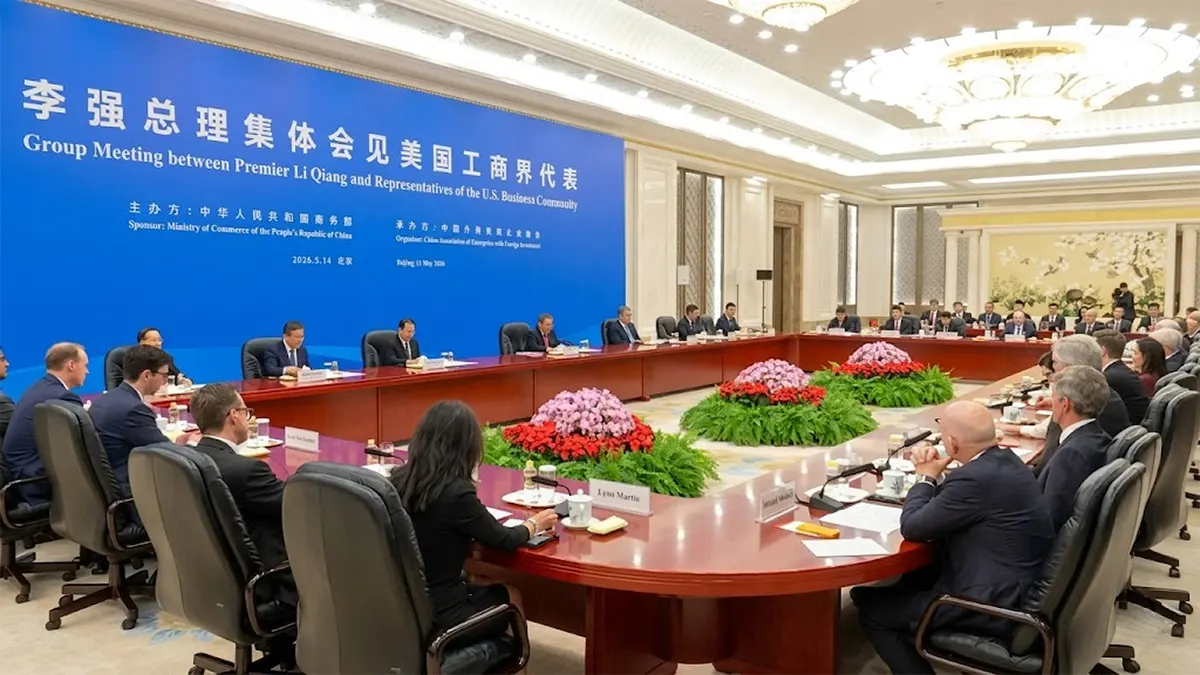
When Air Force One touched down in Beijing on May 13, 2026, it wasn’t just carrying a president. It was carrying approximately 17 of America’s most powerful CEOs, the heads of Tesla, Apple, Nvidia, Boeing, Goldman Sachs, BlackRock, Citi, and more each with billions of dollars in Chinese exposure and a very personal reason for wanting this summit to go well.
This was not a goodwill tour. It was, in many ways, a corporate rescue mission dressed up as diplomacy.
The Delegation That Tells You Everything About U.S.-China Dependence
The roster reads like a Fortune 50 roll call. Elon Musk flew aboard Air Force One itself a signal of his place in Trump’s inner circle. Tim Cook joined as he approaches his final months as Apple CEO before stepping down on September 1. Jensen Huang, Nvidia’s chief, was a last-minute addition, reportedly not on the original guest list, boarding the plane during a refueling stop in Alaska to join at the eleventh hour.
The rest of the delegation covered nearly every artery of the U.S. economy that flows through China: Larry Fink of BlackRock and Stephen Schwarzman of Blackstone representing global capital. David Solomon of Goldman Sachs and Jane Fraser of Citi representing Wall Street’s China operations. Kelly Ortberg of Boeing representing the industrial sector’s most urgent unfinished business. And Jensen Huang of Nvidia carrying the weight of the entire American AI industry on his laptop bag.
Notable absences told their own story. No pharmaceutical executives. No retail representatives. This summit was specifically engineered around manufacturing, finance, technology, and agriculture, the sectors where Chinese leverage over American business is most acute.
Who Has the Most to Lose if Trade Freezes
To understand why these particular CEOs made the trip, you need to understand what they actually have at stake in China and it goes well beyond revenue figures.
Elon Musk’s Giga Shanghai remains Tesla’s most productive factory on the planet and the hub for its global export market. Tim Cook has spent years cautiously moving some Apple production to India and Vietnam, but over 80% of Apple’s top 100 suppliers still operate in China. Cook himself reaffirmed as recently as March 2026 that China remains the “nexus” of Apple’s supply chain.
For Cargill’s Brian Sikes perhaps the least discussed name on the delegation the exposure is physical and enormous. Cargill operates crushing plants, corn processing facilities, and animal protein plants across China. In January 2026, the company broke ground on a major expansion of its Beijing facility. Jensen Huang’s Nvidia doesn’t own factories in China TSMC makes its chips but China historically accounts for 20 to 25 percent of Nvidia’s data center revenue, and that figure has been falling fast.
The common thread connecting all 17 executives is this: every one of them runs a business that would face a catastrophic hit if U.S.-China trade froze entirely. They weren’t there as cheerleaders. They were there as collateral and they knew it.
What Actually Came Out of the Great Hall
The meeting with Premier Li Qiang on May 14 at the Great Hall of the People was where the real commercial negotiation happened. While the headline agreements with President Xi focus on geopolitics, Li’s meeting with the CEOs is where the business plumbing gets fixed.
The headline result from Boeing was the clearest win of the summit. Reports indicate a commitment for 200 passenger jets, Boeing’s first major sale to China in nearly a decade. For Kelly Ortberg, this was the point of the entire trip.
On agriculture, China made verbal and written commitments to significantly increase purchases of American soybeans and beef, a deliverable Trump needed to bring home to his Midwestern base. Li Qiang explicitly told the assembled executives that China is launching its 15th Five Year Plan (2026–2030) and wants U.S. companies to be part of it, pledging to improve policy efficiency for foreign funded firms.
For the tech executives particularly Huang and Cook, the outcome was more cautious. China signalled openness to more investment, but the red line on U.S. export controls over high-end AI chips remained firmly in place.
The honest summary: no one walked away with a total victory. What the CEOs got was something arguably more valuable in the short term certainty. A signal that neither government is about to blow up the relationship entirely, at least not this quarter.
The Broken Window Problem: These “Breakthroughs” Are Mostly Repairs
Here is the part of the story that rarely makes the headline.
The Boeing deal being celebrated as a breakthrough?
China stopped buying Boeing planes as direct retaliation for Trump’s original tariffs switching orders to Airbus. Ortberg is in Beijing trying to restart an engine that Trump’s own trade policy helped stall.
The agricultural commitments being framed as a diplomatic coup?
American farmers, the very base Trump is trying to deliver for were among the hardest hit when China placed retaliatory tariffs on soybeans, corn, and pork during the first trade war. The U.S. government spent billions in taxpayer subsidies keeping those farms solvent. China buying soybeans again is not a new deal. It is a peace offering designed to prevent the tariffs from going even higher.
The technology negotiations are the messiest of all. The U.S. imposed strict export controls on AI chips, which hurt Nvidia’s Chinese revenue almost immediately. China responded with its own pressure launching a “cybersecurity review” of Micron, a U.S. memory chip maker, and restricting Chinese companies in critical sectors from buying its products. The two moves are separate battles in the same war: Micron was effectively picked as a visible American target to retaliate against, while Nvidia’s problem is different in nature.
Trump’s strategy is internally consistent, if cynical: threaten tariffs as high as 145 percent, which frightens both the CEOs and Beijing, then fly in as the rescuer. China buys Boeing jets and soybeans to keep him satisfied. The CEOs get a truce that lets them keep operating. Trump announces a “Great Deal.” The cycle resets. It is less a strategy than a managed loop create the crisis, then take credit for partially resolving it.
Jensen Huang’s Race Against His Own Obsolescence
Of all the CEOs on that plane, Huang’s position is the most strategically precarious and the most misunderstood.
The common assumption is that Nvidia holds enormous leverage over China because Chinese AI companies desperately need its chips. That was true in 2022. By 2026, the picture is significantly more complicated.
While the U.S. government was blocking Nvidia exports, China was not sitting still. Huawei’s Ascend 910C by late 2025 was being reported as performing at roughly 80 percent of Nvidia’s H100 for many common AI workloads. Chinese tech giants like ByteDance and Baidu have increasingly concluded that Huawei is “good enough” and, crucially, available without a license from Washington. A wave of domestic GPU companies including Moore Threads and Biren went public in early 2026, shipping tens of thousands of units to local data centres that previously ran on Nvidia hardware.
Every time Huang designed a slower, export compliant chip specifically for the Chinese market like the H20, the U.S. government eventually banned that version too. Chinese companies grew exhausted by the uncertainty. Why build your entire software stack on Nvidia hardware today if that hardware could be illegal to replace tomorrow?
Huang himself has been the most vocal critic of this approach, warning repeatedly that blocking exports doesn’t stop China from building AI capability, it just forces China to build its own version of Nvidia. By 2026, that prediction has substantially come true, including the development of Huawei’s own software framework, CANN, which competes directly with Nvidia’s CUDA ecosystem. Once developers learn a new system, they rarely switch back.
So why is Huang on the plane at all? Because Nvidia’s newest Blackwell architecture is still meaningfully ahead of anything China can domestically produce, and Chinese AI companies building for global markets still want the premium product to stay competitive. Huang is not negotiating from strength, he is negotiating to stop a total loss from becoming a permanent one. Trump is using him as a carrot: cooperate on Boeing and agriculture, and perhaps Nvidia can sell you the high end chips again. It is a race against time, and both sides know that the window for that offer narrows every month China’s domestic chip industry matures.
What Elon Musk Is Actually Doing in Beijing
Musk’s presence on this trip operates on a different level from the rest of the delegation entirely.
The simplistic read is that he’s there to protect Giga Shanghai and keep Tesla’s Chinese market alive. That’s real, but it’s the least interesting part of his agenda.
BYD has effectively won the Chinese mass-market EV battle. It sells models in the $10,000 to $20,000 range that Tesla cannot match on price or volume. Musk appears to have accepted this, and pivoted Tesla’s China strategy toward software and AI rather than car sales. His primary objective on this trip is securing unrestricted approval for Full Self-Driving in China not to sell more cars, but to activate a recurring subscription revenue stream from the millions of Tesla vehicles already on Chinese roads. That is pure margin, requiring no new factories.
To run FSD in China, however, Musk needs something the Chinese government is deeply uncomfortable with: the ability to transfer road data out of the country to train Tesla’s AI systems. He needs a data bridge and his unique closeness to Trump gives him a negotiating channel that no other CEO at the table has.
Then there is the dimension that barely gets discussed publicly: SpaceX. China is building its own Starlink competitor, the “Thousand Sails” constellation and orbital congestion is becoming a genuine safety issue. Musk, simultaneously a major U.S. defence contractor and the operator of the world’s largest satellite network, is in a position to hold quiet conversations about space safety and orbital traffic management that no diplomat is currently equipped to have.
His China calculus is ultimately about survival-proofing an entire empire. He needs tariff carve outs for lithium and graphite for his battery supply chains. He needs FSD approval and data rights for Tesla’s software future. He needs orbital stability for Starlink. And he needs to keep Giga Shanghai running to fund everything else. China values him because he praises their industrial capability. Trump values him because he delivers results. Musk is leveraging both relationships simultaneously and of everyone on that plane, he may be the one who leaves with the most.
Getting Back to Zero
There is a version of this summit where the narrative writes itself as triumph, the deals, the handshakes, the joint statements. And there is another version, less flattering but more accurate: 17 of the most powerful executives in America flew to Beijing to try to undo the damage that eight years of trade war created, and to call the result a victory.
For most of the companies represented, the honest goal of this trip was not to move forward. It was to get back to zero to restore the trading relationships that existed before 2018, when Boeing was selling planes, farmers were selling soybeans, and Nvidia was selling chips, all without requiring a diplomatic summit to make it happen.
The irony, as one observer put it, is structural: it is like breaking someone’s window, then flying across the Pacific with a delegation of glaziers and asking to be thanked for the repair.
For the CEOs themselves, the irony is largely irrelevant. They are not there to adjudicate trade policy history. They are there because the bleeding needed to stop and for now, it appears it has. Whether the truce holds long enough to matter is a question that will be answered not in the Great Hall of the People, but in the next tariff announcement, the next export ban, and the next quarterly earnings call.