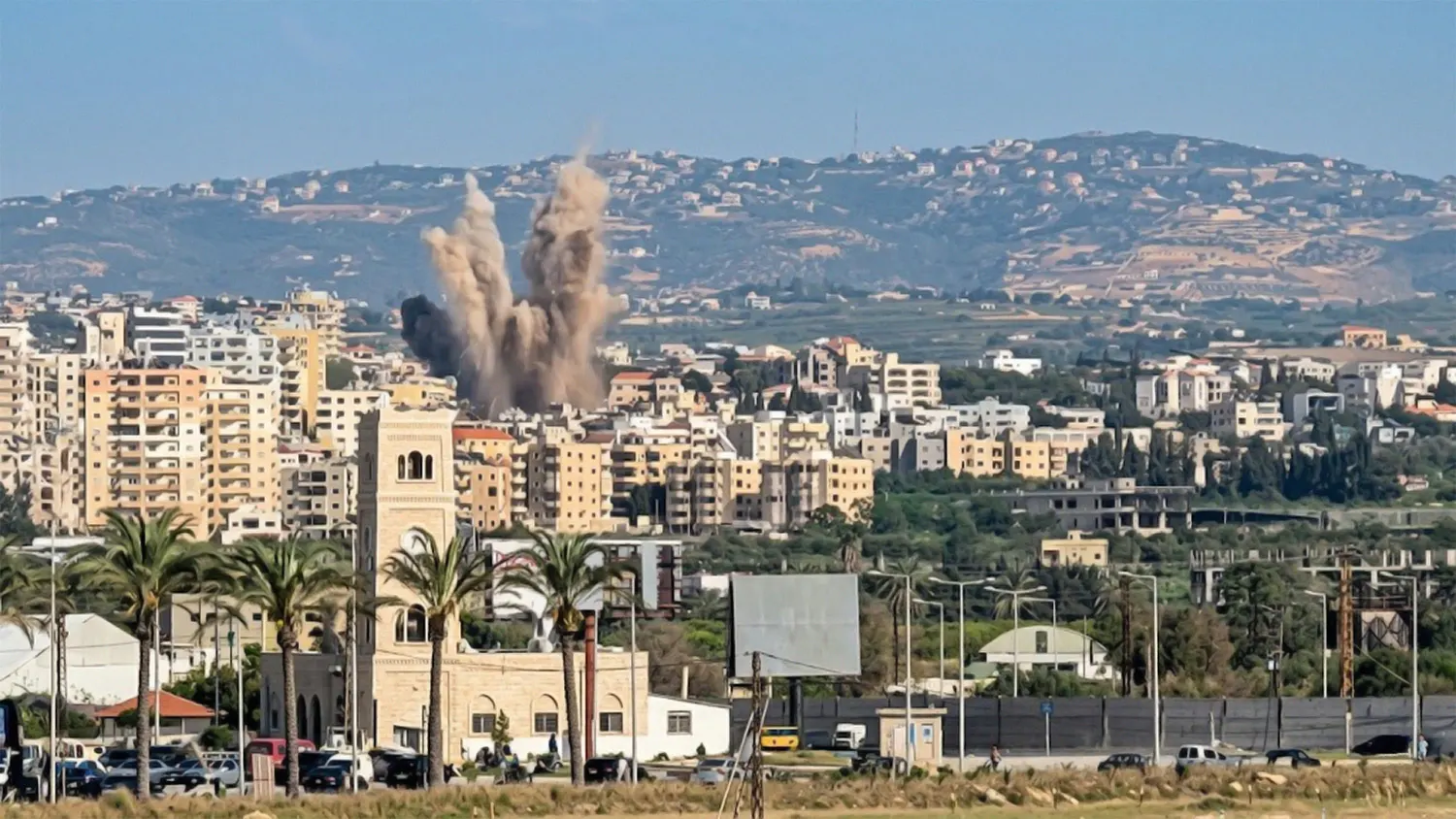
The highway between Beirut and Sidon has always been more than a road. It is the artery through which southern Lebanon breathes goods moving north, families moving south, ambulances moving in both directions. On the morning of May 13, 2026, Israeli drones struck three vehicles along that stretch near the towns of Jiyeh, Barja, and Saadiyat, roughly 20 to 25 kilometres south of the capital. At least eight people were killed, among them a woman and her two children.
By nightfall, delegations from Israel and Lebanon would be boarding flights to Washington for a third round of peace talks. The strikes did not pause for the calendar.
380 Dead Under a Truce That Was Supposed to Stop the Dying
Lebanon’s Health Minister Rakan Nassereddine did not mince words at his Tuesday press conference in Beirut. Since the April 17 ceasefire came into effect, 380 people have been killed and 1,122 more wounded bringing the cumulative toll since fighting resumed on March 2 to 2,882 dead and 8,786 injured.
Those numbers carry faces. Of the total killed, 279 are women and 200 are children. Save the Children confirmed that an average of four children are being killed or injured every single day under what is nominally a truce. The day before the highway strikes, Tuesday’s aerial campaign alone claimed at least 13 lives across southern Lebanon, including two paramedics in Nabatieh killed in a double tap strike, the second drone arriving while they were pulling the wounded from the first.
Healthcare, already hollowed out by years of economic collapse and months of active war, is approaching a point of no return. Since March 2, there have been 163 direct attacks on ambulance crews, killing 108 paramedics and health workers. Sixteen hospitals have been damaged. Four have closed entirely.
A Coastal Road Becomes the New Front Line
What made Tuesday’s highway strikes significant was not just the death toll. It was the location.
Jiyeh, Barja, and Saadiyat sit well outside the primary combat zone in the deep south. The Beirut-Sidon road had remained largely navigable, a corridor families used to flee, aid workers used to reach the displaced, and traders used to keep shelves in the south from going bare. By striking it, the IDF sent a signal that no geography is exempt, regardless of what the nominal ceasefire says about civilian infrastructure.
For the more than 1.2 million people currently displaced inside Lebanon, this is not an abstract strategic point. It is the destruction of another exit route. The 680 collective shelters mostly public schools are already operating at or beyond capacity. UN reports document families sleeping in cars in Beirut and Tripoli, priced out of the “safer” zones where rents have spiked beyond reach. Those who fled the border towns in March moved to cities like Nabatiyeh and Sidon; as those cities became flashpoints in recent weeks, they fled again. For many, there is no third destination left.
The Weapon Israel Cannot Jam
Hezbollah’s response to Israel’s air superiority has not been to match it in the sky. It has been to go around it entirely.
Fiber-optic guided drones have emerged as the defining tactical shift of this phase of the conflict. Unlike conventional drones that communicate via radio frequency and can therefore be jammed, spoofed, or confused by electronic warfare systems these drones trail a thin filament of glass wire behind them. The signal travels through light inside a physical cable. There is nothing to jam.
The consequences are significant. The drones deliver a crystal clear, lag free video feed right up to the moment of impact, allowing operators to target the hatch of an armoured vehicle or a specific window of an IDF outpost with a precision that older loitering munitions could not approach. Hezbollah leader Naim Qassem has explicitly framed their use as a vow to turn the battlefield into “hell” for Israeli ground forces and the IDF, which Prime Minister Netanyahu himself has described the drones as a “major threat,” is taking that seriously.
Israel’s countermeasures have required a full pivot away from software-based defences. Trophy active protection systems on tanks and Iron Fist on armoured personnel carriers are now being used to physically intercept incoming drones. High-speed 30mm autocannons and purpose-built interceptor drones are being deployed where jamming is simply not an option. And critically, the drive to push Hezbollah forces further back from the border, the logic behind the sustained hammering of southern Lebanon is partly a function of range. Fiber-optic cables have a practical limit of roughly 5 to 15 kilometres. Every kilometre of buffer zone gained is a kilometre that reduces the threat to Israeli communities in the north.
Those communities home to roughly 60,000 to 80,000 Israelis who have not been able to return since the conflict began are a core piece of Hezbollah’s leverage. Qassem knows that as long as un-jammable drones are striking Metula or Kiryat Shmona, no civilian will feel safe going home.
Three Divisions, One Loophole, and a Security Zone That Keeps Expanding
On the ground, the IDF currently has three active divisions operating in southern Lebanon, focused on clearing Hezbollah infrastructure in the Litani River region. Israeli media outlet Channel 12 has reported preparations to expand ground operations beyond the current “yellow line”, a boundary set approximately 10 kilometres inside Lebanese territory that has functioned as an informal limit on the ground campaign.
The legal justification for all of this, in Israel’s reading, flows from a single clause in the April 17 agreement: the self-defence provision, which permits strikes against “planned, imminent, or ongoing attacks.” Israel has applied that clause broadly enough to cover daily airstrikes, targeted assassinations, and the maintenance of a permanent security corridor inside Lebanese soil.
Hezbollah frames every drone barrage and rocket volley as a defensive response to Israeli violations, the continued surveillance overflights, the troop presence, the strikes on civilians. Both sides are pulling on the same loophole from opposite ends, and the result is a ceasefire that exists in the text of an agreement and almost nowhere else.
Lebanon’s government, which has officially banned Hezbollah’s military operations, lacks the military capacity to enforce its own position. Its primary tool has been filing urgent complaints with the UN Security Council, a process that has so far not altered the tempo of strikes by a single sortie.
Washington, Tomorrow Morning
The third round of direct negotiations opens in Washington on May 14, with Israel’s delegation led by Ron Dermer and Lebanon’s by Simon Karam. The gaps between them are not small.
The United States and Israel are pushing for the full disarmament of Hezbollah, a condition Qassem has publicly dismissed as “non-negotiable” and “an internal matter.” Lebanese President Joseph Aoun is seeking a ceasefire grounded in UN Resolution 1701, which would restore state sovereignty over the south and remove the IDF from Lebanese territory. Israel has no intention of withdrawing from the buffer zone it has spent months consolidating.
Diplomats have described the talks as a “last ditch effort” to prevent the fragile truce from sliding into a full-scale regional war, one that could draw Iran in directly. Tehran has warned that a continued collapse of the ceasefire risks derailing the broader U.S.-Iran understanding that has been quietly taking shape in parallel.
That is the weight the delegations carry into the room tomorrow. What they carry out remains to be seen. But on the Beirut-Sidon highway today, eight people who had no part in any of those negotiations did not make it to Wednesday. The distance between a diplomatic framework and a live able peace, measured in kilometres of charred road and glass-wire drone cable, has rarely looked wider.