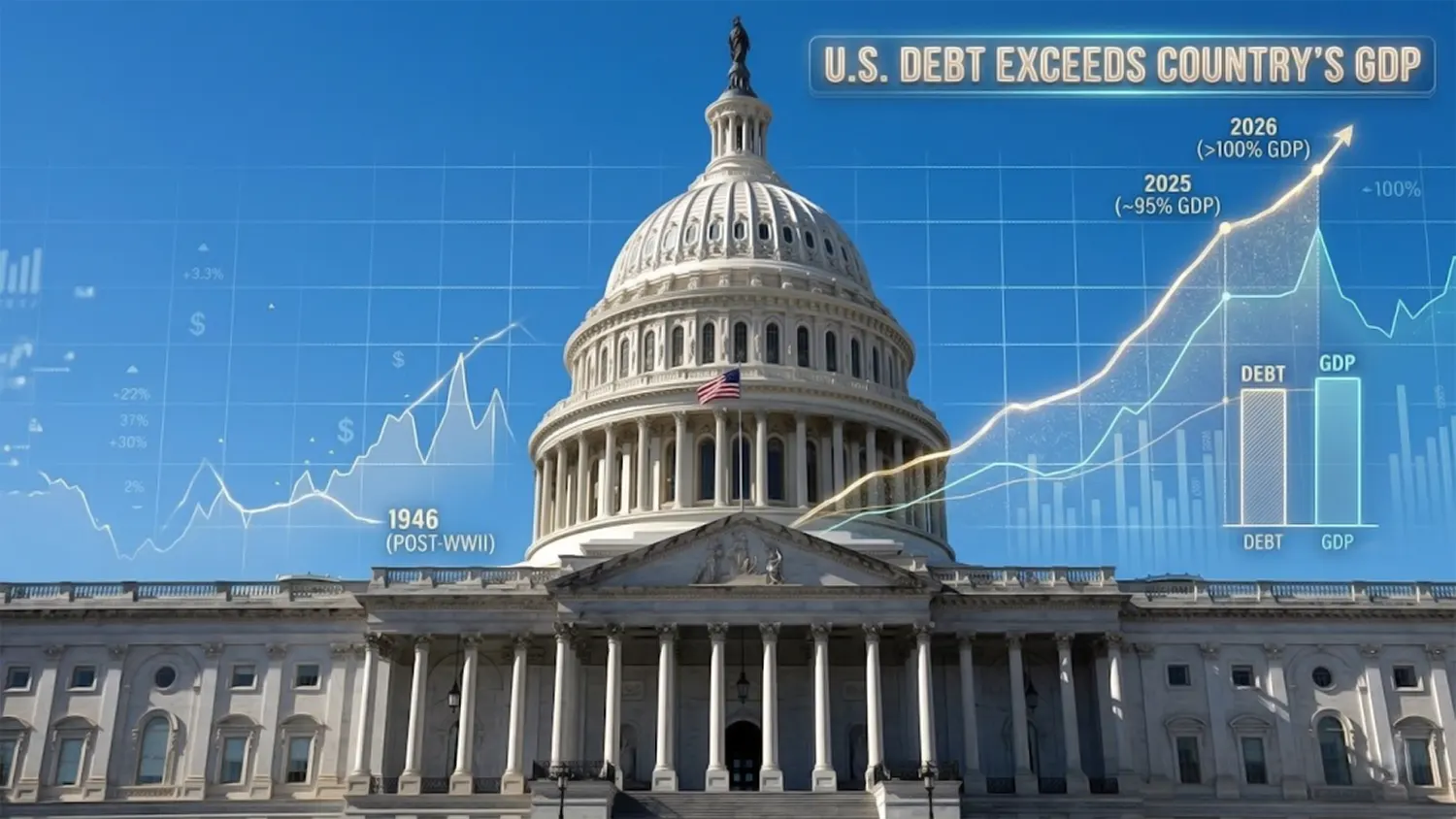
The US government is adding $7.8 billion to its debt every single day. And as of early 2026, the total just crossed a line that hasn’t been crossed since the aftermath of World War II.
For the first time in decades, America’s national debt is larger than its entire economy. Public debt hit approximately $31.27 trillion nudging past a nominal GDP of $31.22 trillion, pushing the debt to GDP ratio just above 100%.
The number is symbolic. But what it represents is real: the US now borrows faster than it grows, and the gap is widening. This isn’t a momentary blip. Economists increasingly describe it as structural baked into how the country’s finances are currently set up, and difficult to reverse without significant political will.
Twelve Months That Changed the Picture
A year ago, there was still a buffer. In March 2025, the US economy was roughly $1.4 trillion larger than its debt. That breathing room is now gone flipped into a deficit within a single year.
Over that same period, US debt grew by nearly $2.9 trillion, while the economy expanded by only $1.4 trillion. Borrowing ran at roughly twice the speed of growth.
What makes this particularly concerning isn’t the level of debt, it’s the acceleration. The trajectory is steepening, not flattening.
Three Forces Pushing the Number Higher
The interest trap is compounding itself. As interest rates rose, the cost of servicing existing debt surged with them. In 2026, the US is on track to spend approximately $1 trillion on interest payments alone more than the entire national defense budget. That money doesn’t build roads, fund schools, or pay doctors. It simply services past borrowing. And because the government must borrow to cover those payments, the debt grows faster still, a snowball that gets heavier as it rolls.
An aging population is squeezing both sides of the ledger. Every day, thousands of Americans retire drawing on Social Security and Medicare while contributing less in tax revenue. The result is a structural squeeze: more money going out, less coming in, with no natural reversal in sight as the Baby Boomer generation continues aging through the system.
The baseline deficit never goes away. Even without emergencies or recessions, the US runs a gap between what it spends and what it collects. In 2026, government spending sits at roughly 23.3% of GDP while revenue covers only 17.5%. That nearly $1.9 trillion annual shortfall gets added to the debt pile every year, in good times and bad.
Why This Isn’t Like 1946
The comparison to post-World War II debt gets made often usually as reassurance. It shouldn’t be.
Yes, US debt exceeded GDP after the war. But the country that emerged from 1946 had a young, expanding workforce, an economy primed for decades of rapid growth, and debt levels that were already falling. The debt shrank naturally, absorbed by a booming economy.
Today’s America looks almost nothing like that. Growth is slower hovering around 2%. The population is aging, not expanding. Interest rates are higher, making each dollar borrowed more expensive to carry. And unlike postwar debt, which declined steadily, today’s debt is projected to keep climbing potentially reaching 120% of GDP within a decade.
The historical parallel offers comfort it doesn’t actually provide.
What This Means Beyond Washington
The debate among economists breaks along a familiar line.
Those sounding the alarm argue that debt above 100% of GDP crowds out private investment, fuels inflation, and erodes the government’s ability to respond when the next crisis hits whether that’s a recession, a pandemic, or a geopolitical shock. With less fiscal space, the options narrow fast.
Those less worried point to something real: the US dollar remains the world’s reserve currency, and US Treasury bonds remain the asset that global investors run toward in times of uncertainty. That “exorbitant privilege” as economists call it gives America more room to carry debt than virtually any other country on earth.
Both sides have a point. The risk is assuming the second argument makes the first irrelevant.
For the Federal Reserve, the situation creates an impossible sounding balancing act. Raise rates to fight inflation and government debt becomes even more expensive to service. Keep rates low and inflation lingers. The Fed has held rates around 3.50% to 3.75%, caught between two bad options and officials have quietly begun warning that the current debt trajectory is, in their own word, “unsustainable.”
A Government Warning About a Problem It Keeps Making Worse
Washington’s response to its own debt crisis has been a study in contradiction.
The White House has proposed defense spending increases and selective cuts, banking on surging tariff revenue to help close the gap. Congress raised the debt ceiling through 2027 avoiding an immediate crisis while postponing any real reckoning. Efforts to meaningfully reform Social Security and Medicare, the two largest drivers of long-term spending, have stalled entirely.
Meanwhile, the Treasury holds hundreds of debt auctions every year, quietly funding the deficit by selling bonds to whoever will buy them.
The result is a paradox that defines the current moment: leaders warn publicly about the dangers of rising debt while continuing the policies that drive it higher.
The Number Isn’t the Problem. The Direction Is.
Crossing 100% of GDP is a milestone but milestones don’t cause crises. What causes crises is when the direction becomes impossible to reverse, and the options available to reverse it run out.
That’s the real question hanging over this moment. Not whether the US can sustain debt at 100% of GDP but whether it can change course before that number reaches a level where the choices left are all painful ones.
The debt is large. The speed at which it’s growing is the actual story. And right now, that speed isn’t slowing down.