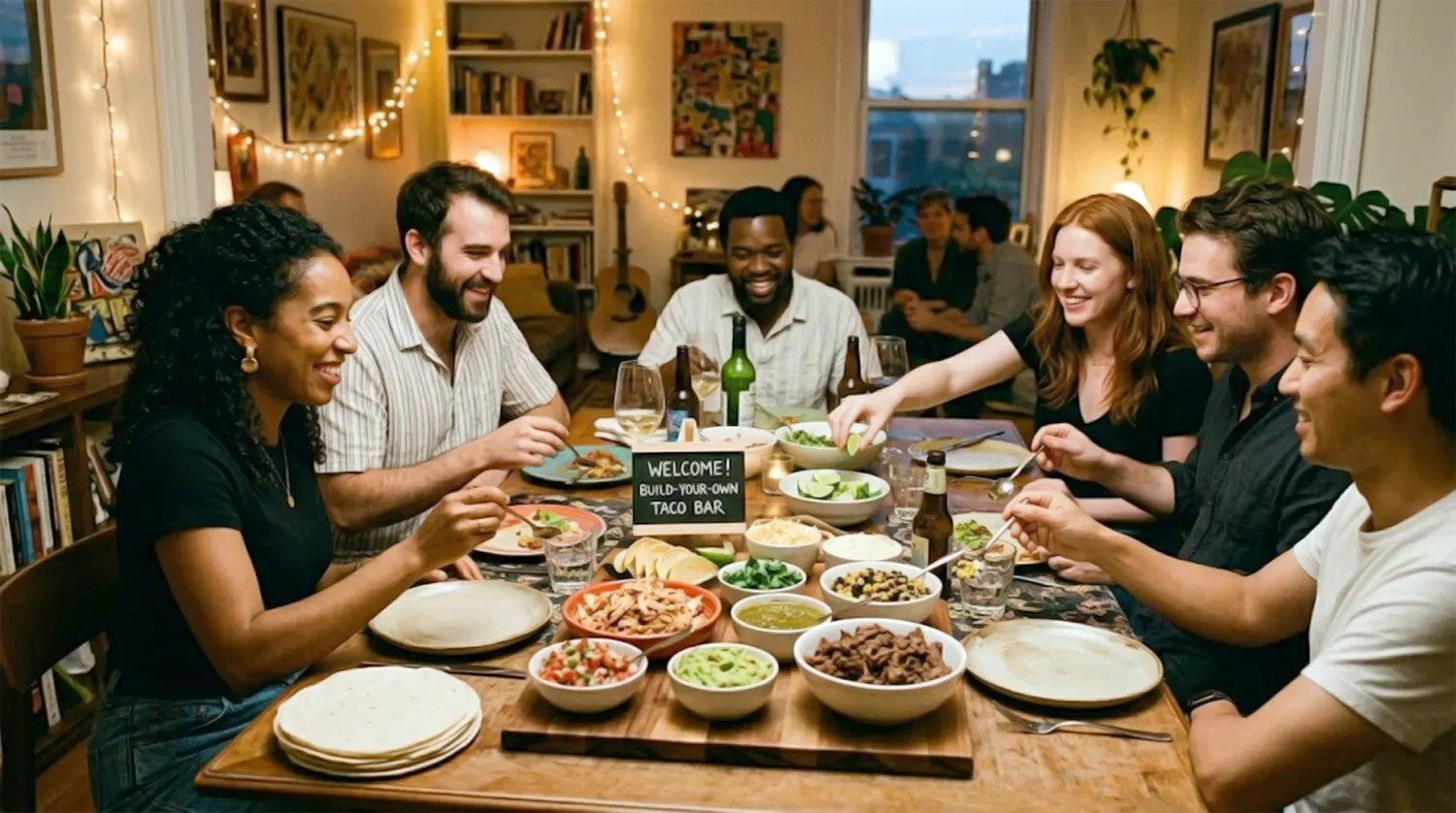
Here is something nobody says out loud: the best gatherings you have ever been to probably did not have a theme. The host was not wearing an apron. There may have been a suspicious stain on the couch that everyone politely ignored. And you stayed two hours longer than you planned because you were having too good a time to notice.
What made it great was not the food or the ambience. It was the fact that the host was actually there present, relaxed, laughing with you instead of sweating over a risotto in the kitchen. This is the whole idea behind what some people are calling “scruffy hospitality” the radical act of inviting people into your real life instead of a staged version of it.
It sounds simple. It turns out most of us need permission to actually do it.
The three hour clean is a trap
Let’s start with the cleaning, because it is where most hosting anxiety lives. There is a version of pre-guest preparation that makes complete sense, a quick pass through the bathroom, a clear path from the front door to wherever people will sit, a kitchen counter that is not actively alarming. That takes maybe 30 minutes.
And then there is the other version: the four-hour deep clean that leaves you exhausted, resentful, and already halfway through a glass of wine before the first guest arrives. You spent the whole afternoon preparing for people who, statistically, will not be examining your baseboards.
The practical rule is simpler than any cleaning checklist: focus only on the “path of travel.” Entryway, bathroom, kitchen counter. Everything else is set dressing that your guests will not register. A lived-in home books on the coffee table, shoes by the door, a plant that is slightly past its prime is not a sign of failure. It is proof that a human being lives there, and that is exactly what makes people feel comfortable enough to relax.
If you spend three hours cleaning before they arrive, you will spend the whole evening tired. Save the energy for the people, not the surfaces.
Food that doesn’t chain you to the kitchen
The three-course dinner party is a beautiful idea that requires you to be absent from your own party for significant stretches of the evening. While everyone else is in the living room having the conversation you actually wanted to have, you are in the kitchen plating the second course and wondering what you missed.
The fix is food that assembles itself or more precisely, food that your guests assemble. A taco bar. A baked potato spread with every topping you can think of. A big salad situation where everyone builds their own bowl. These are not lesser options. They are actively better, because they give people something to do with their hands and an excuse to move around and talk to someone new while they decide between the two kinds of salsa.
And for the moments when even assembly feels like too much: there is absolutely no shame in high end frozen appetizers arranged on a nice board, or in ordering three different kinds of pizza from three different local places and calling it a “tasting.” Nobody has ever left a party disappointed because there was good pizza. The food is an excuse to gather. It is not the point of gathering.
The assemble your own bar
Tacos, baked potatoes, big salad. Guests build their own, you stay in the room.
The freezer pivot
High-end frozen apps on a nice board. Three local pizzas as a “tasting.” Both are valid.
The reverse potluck
Ask guests to bring a weird drink, three songs, and one boring story from their week.
What to ask your guests to bring instead
The traditional potluck where everyone brings a dish sounds collaborative but often produces a stressful coordination game where the host ends up with four pasta salads and no dessert. There is a better version.
Try the reverse potluck: instead of assigning food, ask each person to bring something low-stakes and genuinely fun. The weirdest drink they can find at the corner store. A playlist of three songs they are currently obsessed with. A “boring” story from their week something small, mundane, with no pressure to be interesting. This last one sounds odd until you try it, at which point it tends to become the best part of the evening. It turns out people have remarkably funny boring stories, and “what happened to you this week that was completely ordinary” is a better conversation starter than “so what’s new with you.”
The drinks assignment alone will entertain the group for the better part of an hour. Someone will show up with a Lithuanian energy drink. Someone else will find a local kombucha flavor that defies description. It is a gift that generates conversation without anyone trying.
Phones down, without making it weird
There is a version of phone management at gatherings that feels like a TED talk, the host making a speech about “being present” before everyone awkwardly surrenders their devices. This is not that.
The low-drama approach is a phone basket near the door or on a side table, a designated spot where phones go “on vacation” during the meal. No announcement required. Most people will quietly appreciate the permission to not be reachable for two hours. The ones who genuinely need to stay connected will keep their phones, and that is fine too. You are not running a retreat. You are having people over.
For filling the analog space: simple card games have made an enormous comeback for a reason. They give people something to do together that does not require conversation to sustain it, which paradoxically makes conversation flow more easily. Collaborative coloring a big paper tablecloth and a cup of markers in the center of the table sounds absurd until you watch it become the thing everyone talks about afterward.
How to end the night without the awkward hover
The least discussed skill in hosting is knowing how to close the evening gracefully. Nobody wants to be the host standing by the door with their coat on. Nobody wants to be the guest who stayed two hours too long and only realized it on the drive home.
The solution is a signal that is warm rather than clinical. A specific “winding down” playlist something quieter, a little more ambient is a gentle environmental cue that the energy of the evening is shifting. Bringing out herbal tea alongside the regular options does the same thing. Neither of these requires an announcement. They are simply changes in the atmosphere that most people will read correctly and appreciate for the clarity.
The goal is to end the night while it still feels good before anyone is tired, before the conversation gets circular, while everyone still wishes it could go a little longer. That feeling, more than anything else, is what makes people say yes the next time you invite them.
A burnt roast is not a failed dinner party. A coffee table covered in books and a cat hair or two is not an embarrassing home. They are evidence of a life being lived, and people who come to your home to spend time with you are not there to inspect the evidence. They are there because they like you, the real, imperfect, slightly behind on laundry version of you.
The best memories from any gathering almost never happen during the planned moments. They happen in the gaps, the conversation that started because someone was waiting for the taco bar to clear, the inside joke born from the weird Lithuanian energy drink, the story that began as “boring” and ended with everyone crying from laughing. You cannot engineer those moments. You can only make enough space for them to happen. Scruffy hospitality is just the practice of getting out of the way.