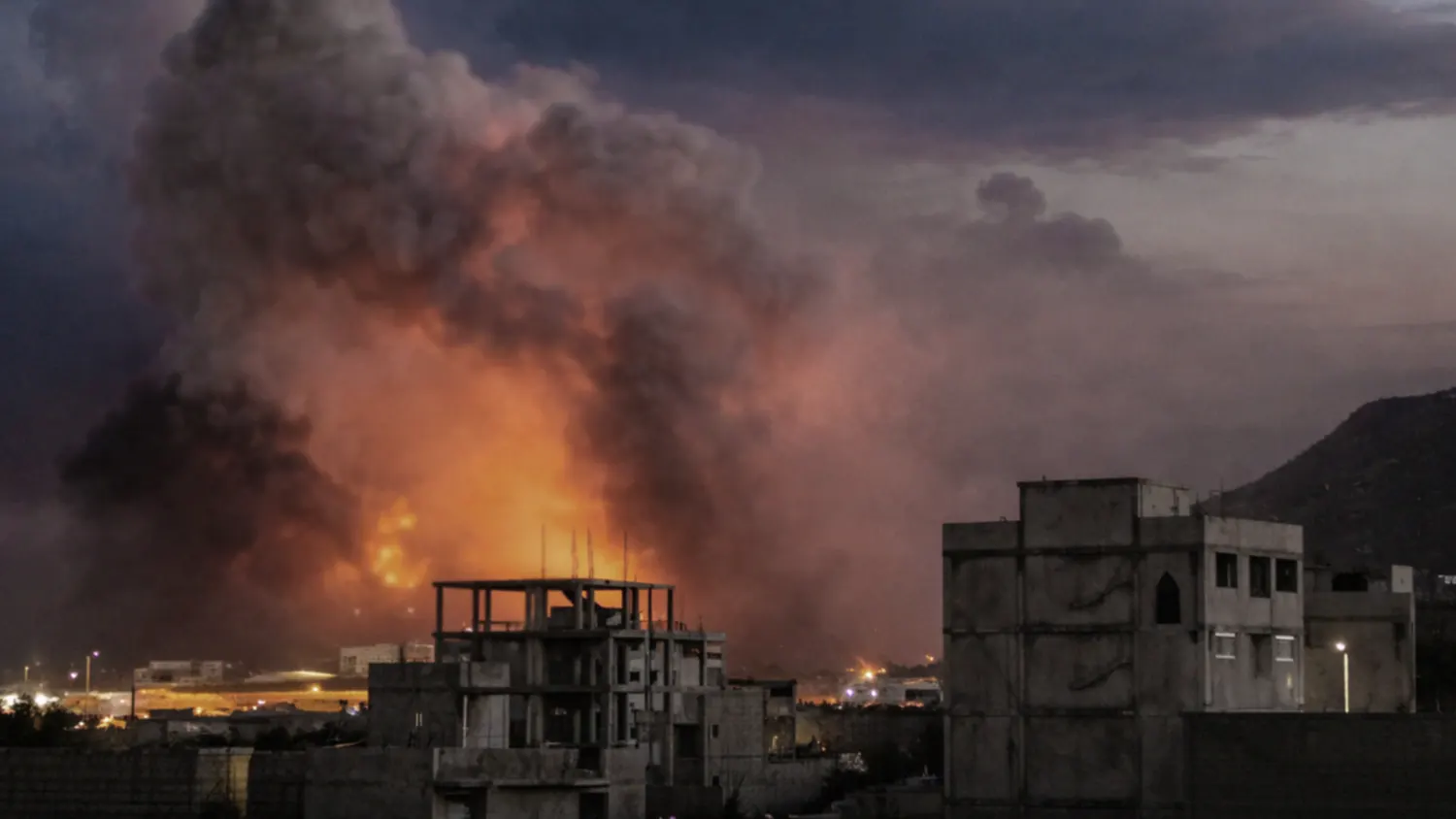
Explosions rocked Baharestan in Isfahan on April 2, 2026, as U.S. and Israeli forces struck a major Iranian missile base, marking one of the most intense escalations since the war began in late February.
The attack targeted a key facility linked to the Islamic Revolutionary Guard Corps (IRGC), with officials confirming the use of heavy bunker busting munitions. Massive fireballs and sustained secondary explosions suggest that large stockpiles of missiles and fuel were ignited.
But the immediate destruction tells only part of the story. What is unfolding in Isfahan is not just another strike, it is a calculated attempt to dismantle Iran’s military backbone.
Why Isfahan Has Become the Center of the War
Isfahan is not a symbolic target. It is the operational heart of Iran’s defense system.
The province hosts a dense concentration of military industrial assets, including missile bases, drone factories, and nuclear facilities. Hitting Isfahan means hitting multiple layers of Iran’s power at once.
That strategic importance explains why the latest strikes focused on Baharestan. The base served as a hardened storage and launch site for medium range ballistic missiles capable of reaching Israel and U.S. positions across the Gulf.
By targeting underground infrastructure with 2,000 pound “bunker buster” bombs, the goal appears clear: destroy not just weapons, but the ability to rebuild them quickly.
And yet, this raises a broader question: if Isfahan is the core, what does its degradation mean for the wider conflict?
A Campaign Designed to “Break the System”
The strikes come just one day after Donald Trump issued a stark warning. In a televised address, he claimed Iran’s offensive capacity was “essentially decimated” and vowed to continue attacks for weeks if Tehran did not yield.
The stated objective to push Iran “back to the Stone Ages” marks a shift from containment to systemic destruction.
Israeli officials have echoed that approach. The Israel Defense Forces (IDF) say they have already neutralized most high priority targets identified at the start of the war.
What remains is a second phase: ensuring that Iran cannot recover its strike capabilities.
This is no longer about limiting retaliation. It is about preventing future capability altogether.
But even as military planners pursue that goal, the reality on the ground is more complex.
When One Strike Triggers Many More
Eyewitness accounts from Isfahan describe explosions continuing for more than an hour after the initial impact. These “secondary blasts” are a key indicator: they suggest that missile fuel and warheads were successfully ignited underground.
In tactical terms, that represents a major success. Destroying stored munitions has a cascading effect, reducing both immediate firepower and future launch capacity.
However, Iran has not remained passive. Within hours of the strikes, multiple waves of ballistic missiles were launched toward Israel. While most were reportedly intercepted,
the response underscores a critical point: even degraded systems can still inflict damage.
This dynamic strike and counterstrike has defined the conflict since it began. But the scale is now increasing, not stabilizing.
And that escalation is beginning to ripple far beyond the battlefield.
The Economic Shock Is Already Spreading
As news of the Isfahan explosions broke, global markets reacted almost immediately.
Oil prices surged, with Brent crude climbing toward $108 per barrel, reflecting fears of broader disruption in the region.
The concern centers on the Strait of Hormuz, a vital chokepoint for global energy supplies. Iran has already signaled its willingness to target shipping and infrastructure in response to sustained attacks.
Any further disruption could send shockwaves through global trade, affecting everything from fuel prices to supply chains.
This economic dimension adds urgency to the conflict. It is no longer confined to military objectives; it now carries global financial consequences.
And yet, the strategic logic behind the strikes suggests they are far from over.
The Three Pillars of Iran’s Power Are Now Under Pressure
The choice of Isfahan as a focal point reflects a broader strategy: dismantle Iran’s capabilities across three critical domains.
First, missiles. The Baharestan and nearby Mobarakeh facilities form part of Iran’s “missile cities” network hardened, often underground complexes designed for survivability.
Their destruction weakens Iran’s ability to project force across the region.
Second, drones. Just north of the city lies the Iran Aircraft Manufacturing Industrial Company (HESA), a key producer of Shahed drones. These low cost weapons have become central to Iran’s strategy, particularly in swarm attacks. Disrupting production here targets the supply chain, not just the weapons themselves.
Third, nuclear infrastructure. Isfahan province is closely linked to facilities like Natanz, Iran’s primary uranium enrichment site. Recent strikes have already damaged parts of this network. There are now reports that the U.S. is considering a high-risk operation to secure enriched uranium from the region.
Taken together, these targets form the backbone of Iran’s strategic posture. The current campaign aims not just to weaken them but to dismantle them entirely.
A War Entering Its Most Dangerous Phase
What makes the situation particularly volatile is the convergence of multiple pressures.
Militarily, the strikes are intensifying. Politically, rhetoric is hardening. Economically, markets are reacting.
Each of these factors reinforces the others. More strikes invite more retaliation. Retaliation increases market instability. Instability raises the stakes for further escalation.
At the same time, the window for diplomacy appears to be narrowing. Public statements from Washington suggest a willingness to continue operations for weeks, while Tehran shows no sign of capitulation.
The result is a conflict that is not just escalating but accelerating.
The Meaning of Isfahan
The explosions in Isfahan are not just another headline in a fast moving war.
They represent a shift in strategy from targeting threats to dismantling a system.
That distinction matters.
If the campaign succeeds, it could reshape Iran’s military capabilities for years. If it fails
or provokes a wider response, it could expand the conflict in unpredictable ways.
Either outcome carries consequences far beyond the region.
And as the smoke continues to rise over Baharestan, one reality is becoming harder to ignore: this is no longer a limited conflict. It is a test of how far each side is willing to go and how much the world is prepared to absorb.